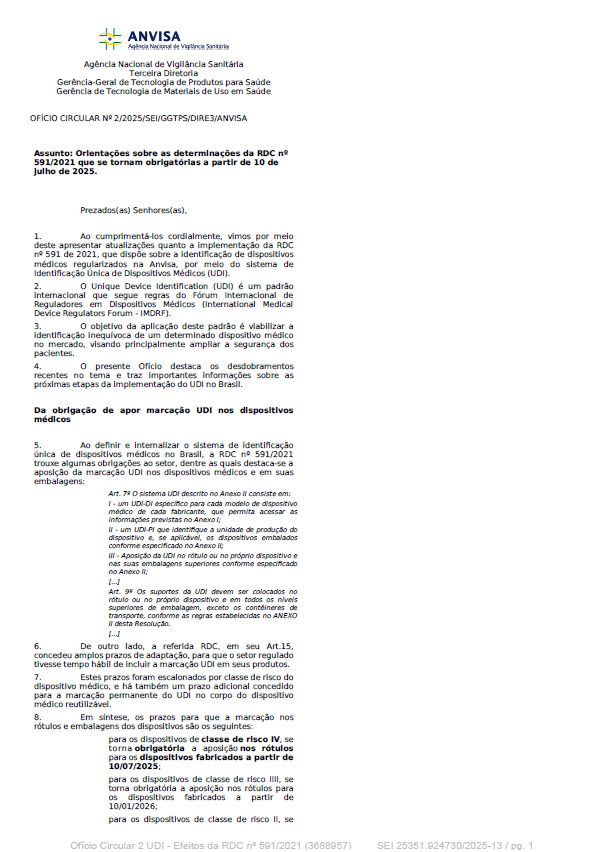
ANVISA Reforça Obrigações de Marcação UDI a partir de Julho de 2025
Com a publicação do Ofício Circular nº 2/2025, a ANVISA confirma a entrada em vigor da obrigatoriedade da marcação UDI para dispositivos médicos de classe IV a partir de julho de 2025, segundo os termos da RDC 591/2021. A medida inclui regras para rotulagem, prazos de implementação faseados por classe de risco e a criação do SIUD, a nova base de dados pública de UDI no Brasil.

MDCG Clarifica Prazos para a Implementação do Master UDI-DI em Lentes de Contacto, Armações e Óculos de Leitura
O guia MDCG 2025-7 define os prazos e critérios para a implementação do Master UDI-DI em lentes de contacto, óculos de leitura, lentes oftálmicas e armações. A clarificação introduz datas de obrigatoriedade faseada, com destaque para 2026 e 2028, e orienta os fabricantes de dispositivos médicos a prepararem as suas estratégias de rastreabilidade e registo na EUDAMED.

Comissão Europeia reforça estrutura e funcionamento dos painéis de peritos para dispositivos médicos
A nova Decisão de Execução (UE) 2025/1324 introduz alterações significativas ao funcionamento dos painéis de peritos no âmbito do MDR e IVDR, reforçando o papel da EMA e criando um novo grupo especializado em pediatria e doenças raras. A decisão define regras comuns de procedimento, critérios de remuneração e condições para criação de subgrupos técnicos. Para os fabricantes de dispositivos médicos, estas alterações implicam processos de avaliação mais especializados, especialmente para dispositivos de alto risco.

FDA reforça a cibersegurança na produção de dispositivos médicos: novas orientações para fabricantes
A nova orientação da FDA sobre cibersegurança na produção de dispositivos médicos alerta para os riscos associados à tecnologia operacional (OT) utilizada em ambientes industriais. A FDA recomenda o mapeamento das redes conectadas, a implementação de arquiteturas seguras e a integração de normas como IEC 62443 e NIST SP 800-82.

FDA publica uma proposta de orientação sobre requisitos de UDI para produtos combinados
O novo guia preliminar da FDA sobre UDI em produtos combinados descreve requisitos detalhados para a rotulagem, identificação e submissão ao GUDID. Esta orientação afeta fabricantes de dispositivos médicos e medicamentos combinados, que deverão avaliar se os seus produtos requerem UDI, NDC ou ambos, conforme o tipo de componente principal.

FDA publica nova orientação sobre cibersegurança em dispositivos médicos – o que os fabricantes devem saber
A nova orientação da FDA sobre cibersegurança em dispositivos médicos define como os fabricantes devem incorporar práticas de segurança digital desde o design até à submissão pré-mercado. A abordagem inclui modelação de ameaças, utilização de um Secure Product Development Framework (SPDF) e a apresentação de um Software Bill of Materials (SBOM).

Qualificação de Software no Âmbito do IVDR: Nova Orientação da Team-NB para Fabricantes
A nova orientação da Team-NB sobre a qualificação de software no âmbito do IVDR fornece critérios claros para que os fabricantes de software médico saibam quando uma aplicação se qualifica como dispositivo de diagnóstico in vitro (IVD MDSW). Com exemplos práticos e fluxogramas, o documento diferencia software autónomo, acessórios e ferramentas não qualificadas.

Instruções de Utilização em Formato Eletrónico: Comissão Europeia Alarga o Âmbito do Regulamento
O novo Regulamento de Execução (UE) 2025/1234 alarga o âmbito das e-IFU para dispositivos médicos e acessórios utilizados por profissionais, incluindo dispositivos sem finalidade médica do Anexo XVI do MDR. A alteração reflete a preferência crescente por formatos digitais e exige que os fabricantes garantam acesso contínuo, rastreabilidade e conformidade técnica das IFU online.

Team-NB's New Code of Conduct: Towards a More Harmonized and Transparent Evaluation
The new version of the Team-NB Code of Conduct establishes principles of transparency, coherence and quality in the work of Notified Bodies operating under the MDR and IVDR regulations. The document presents clear criteria for audits, technical review, management of conflicts of interest, use of external experts and deadlines for responding to non-conformities.

MHRA launches "AI Airlock": new regulatory sandbox for medical devices based on Artificial Intelligence
The AI Airlock initiative, launched by the MHRA, is an innovative regulatory sandbox designed to support the development and evaluation of Artificial Intelligence medical devices (AIaMD). This controlled regulatory environment allows manufacturers of AI-based medical technology to test compliance approaches, clinical evidence and algorithmic validation prior to formal submission. With a focus on adaptive machine learning models, algorithmic security and continuous monitoring, AI Airlock represents a strategic opportunity to accelerate market access with UKCA compliance.

MDCG 2019-11 Rev.1 - New guidance on qualification and classification of software as a medical device or in vitro diagnostic medical device
The new revised version of the MDCG 2019-11 (Rev.1) clarifies the qualification and classification of software as a medical device (MDSW ) and in vitro diagnostic software (IVD), in the context of the MDR and IVDR. The document covers classification rules, integration with AI Act and EHDS, and includes practical and up-to-date examples. Smart MDR supports MDSW manufacturers in managing compliance and technical documentation.

UK publishes new model periodic safety report (PSUR) for medical devices - MHRA 2024
The MHRA has published a new Periodic Safety Update Report (PSUR) template for medical devices in the UK, in line with the UK MDR. The document details how manufacturers should structure their post-market monitoring (PMS) reports, including performance data, surveillance, PMCF and benefit-risk profile analysis.

Health Canada publishes new guidelines on the use of technical standards to demonstrate compliance with the Medical Devices Regulations
In January 2025, Health Canada published a new guide on the use of recognized standards to demonstrate compliance with the requirements of the Medical Devices Regulations. The document guides manufacturers in preparing submissions, updates and lifecycle management of applicable standards.

MDCG publishes guide on the joint application of the MDR, IVDR and AI Act: what manufacturers should know
The new MDCG 2025-6 guide, published in June 2025, clarifies the joint application of the AI Act and the European MDR/IVDR regulations for medical devices and IVDs with artificial intelligence systems. The document addresses classification, risk management, life cycle, technical documentation and post-market monitoring. Smart MDR supports manufacturers in integrating these requirements into their quality management system and preparing for audits.

MDCG 2025-4: new guidance for the secure provision of MDSW apps on online platforms
The MDCG has published guidance 2025-4, which clarifies the responsibilities of manufacturers of software as a medical device (MDSW) and operators of online platforms that make these apps available in the European Union. The guidance addresses the application of the MDR, the IVDR and the Digital Services Act (DSA), and reinforces labeling, traceability and transparency requirements. Smart MDR supports manufacturers and platforms in regulatory compliance and adaptation to the new obligations of the European digital market.

Health Canada begins canceling MDEL licenses for failure to comply with annual review
Health Canada has begun automatically canceling MDEL licenses for operators who have not complied with the mandatory annual review. The measure affects distributors and importers of medical devices in Canada and has serious consequences, such as interruption of operations, the need to resubmit license applications, and product retention.

NIST publishes new version of cyber incident response guide, now part of Cybersecurity Framework 2.0
The new Revision 3 of NIST SP 800-61, published in April 2025, redefines incident response as an integral part of cyber risk management, now aligned with the Cybersecurity Framework 2.0. The guide covers everything from preparation and detection to recovery and continuous improvement. Smart MDR supports medical device manufacturers and SaMDs in implementing incident response processes in line with the requirements of the MDR, IVDR, FDA and international standards such as NIST.

EUDAMED: Updated Guide to Legacy Device Registration Now Available
The new EUDAMED Guide to the Registration of Legacy Medical Devices provides detailed and practical instructions for manufacturers operating under the MDD or AIMDD directives. The transition to MDR requires legacy devices to be identified with EUDAMED DI and EUDAMED ID, even in the absence of a UDI-DI. This registration in the EUDAMED database is essential to ensure regulatory compliance and maintain the placement of devices on the European market.

Coverage of MDR/IVDR Codes by Notified Bodies: June 2025 report highlights critical areas with low designation
The June 2025 report on the coverage of MDR and IVDR designation codes by notified bodies provides an updated view on the availability of designated bodies for specific categories of medical devices and in vitro diagnostic medical devices. It identifies critical areas with lower coverage, such as active implantable medical devices (codes MDA 0101 to MDA 0104) and devices originating from human tissues (MDS 1002), as well as IVDs for blood and tissue typing (codes IVR 0101 to IVR 0202). For medical device manufacturers seeking certification under Regulation (EU) 2017/745 or Regulation (EU) 2017/746, analysis of these codes is essential to plan the submission of applications to notified bodies with adequate coverage.

MHRA updates guidelines on the classification of borderline products with medical devices in the UK
The MHRA has published a new version of the guide to classifying borderline products with medical devices. This update clarifies the criteria used in the UK to determine whether or not a product is a medical device, with a direct impact on cosmetic products, food supplements and others with therapeutic claims. If you operate in this market, it is essential to review the declared purposes, clinical evidence and regulatory framework.