Swissmedic Highlights Updated MIR Template for Serious Incident Reporting Under MDR/IVDR
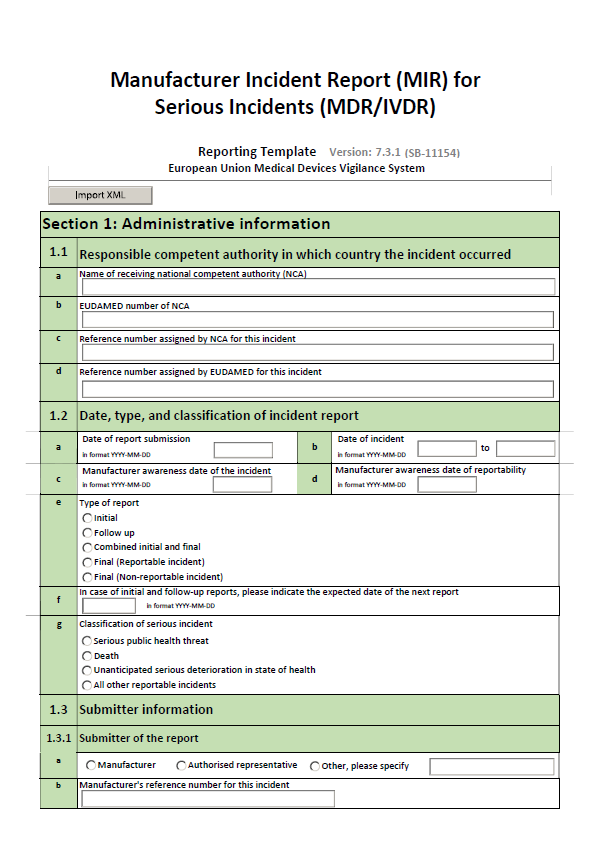
Swissmedic has published the updated Manufacturer Incident Report (MIR) template version 7.3.1 for reporting serious incidents under the European Medical Devices Regulation (MDR) and In Vitro Diagnostic Regulation (IVDR). The revised template reflects the continued alignment of the European vigilance system with EUDAMED requirements and reinforces the use of standardized IMDRF coding across incident investigations.
The MIR form remains one of the most critical post-market surveillance and vigilance tools for manufacturers placing medical devices and IVDs on the European market. The updated version introduces additional structured fields and expanded reporting expectations that manufacturers should carefully review to ensure compliance readiness.
Key Elements Manufacturers Should Pay Attention To
The updated template reinforces the mandatory use of IMDRF adverse event terminology and coding throughout the reporting process, including:
Medical device problem codes
Clinical signs and health impact codes
Cause investigation findings and conclusions
Component-related coding
Manufacturers are also expected to provide more structured information regarding:
UDI and Basic UDI-DI identification
Device categorisation under MDR/IVDR
Market distribution details
Similar serious incident trending
Root cause investigation documentation
Corrective and preventive actions (CAPA)
Field Safety Corrective Actions (FSCA)
The form additionally requests more detailed information about device lifecycle status, including whether the device continues to be placed on the EU market after MDR/IVDR application dates, and whether consultation procedures involving EMA or expert panels apply to the device.
Increased Importance of Data Consistency
One notable aspect of version 7.3.1 is the stronger integration between vigilance reporting and EUDAMED data structures. Manufacturers should ensure that internal vigilance procedures, complaint handling systems, and PMS documentation are fully aligned with:
EUDAMED registrations
SRN and UDI information
IMDRF terminology
PMS and PMCF processes
FSCA documentation workflows
Inconsistencies between vigilance reports and technical documentation may increase scrutiny during competent authority reviews or notified body audits.
Impact on Manufacturers
For manufacturers, the updated MIR template may require revisions to existing vigilance procedures, internal reporting forms, and training programs. Companies relying on legacy complaint handling systems or manual coding processes may face additional operational challenges when preparing serious incident reports.
Manufacturers should also evaluate whether their current systems adequately support:
IMDRF coding integration
Trending analysis of similar incidents
Traceability of distributed devices
Structured CAPA documentation
Cross-functional vigilance coordination
As competent authorities continue to increase expectations regarding vigilance quality and reporting consistency, proactive adaptation to the updated MIR structure will be essential to maintain regulatory compliance under MDR and IVDR.
The updated MIR template version 7.3.1 is now available below.