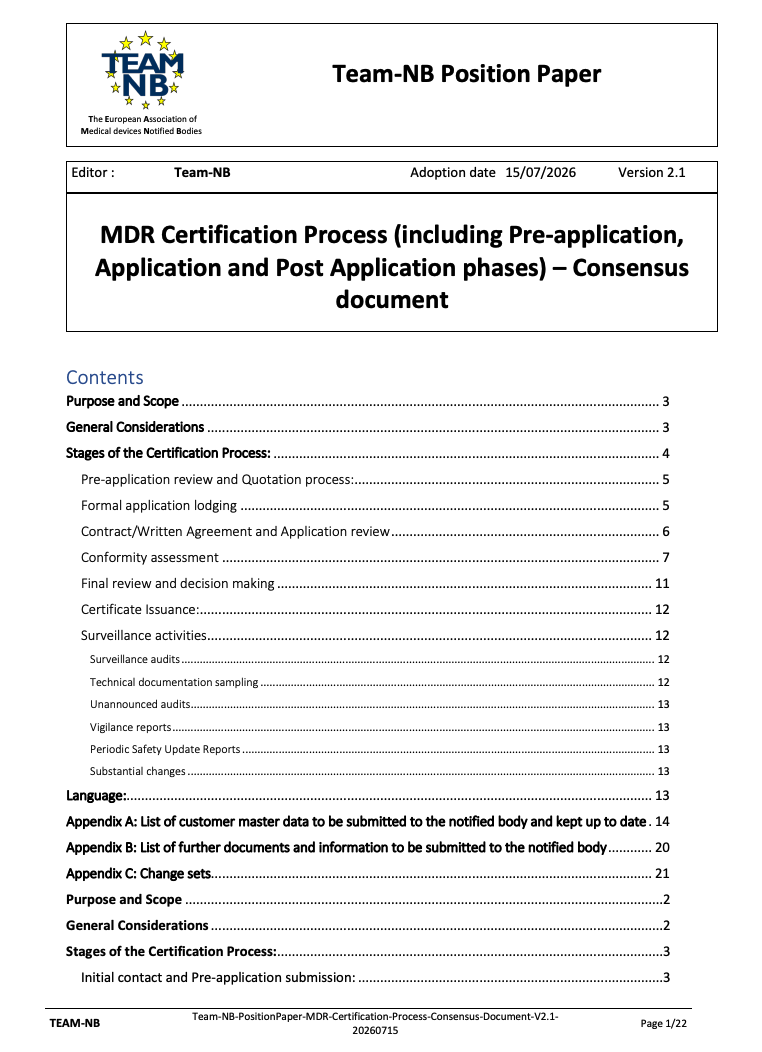
Team-NB Updates Consensus Position Paper on the MDR Certification Process
Team-NB, the European Association of Medical devices Notified Bodies, has updated its consensus position paper on the Medical Device Regulation (EU) 2017/745 (MDR) certification process.
The document establishes harmonized expectations for manufacturers and Notified Bodies across all stages of conformity assessment—from pre-application data gathering and quotation to technical documentation review, nonconformity resolution, and certificate issuance into EUDAMED.
Purpose and Objectives of the Updated Consensus Process
The transition to Regulation (EU) 2017/745 has frequently faced bottlenecks due to incomplete dossier submissions, varying interpretation of application requirements across Notified Bodies, and delays in initial technical reviews.
To address these challenges, Team-NB's updated consensus guidance aims to:
Standardize information requirements at the pre-application and application stages;
Reduce administrative friction and initial application rejections;
Align assessment procedures across all member Notified Bodies;
Provide clear operational rules for customer master data and change-set management.
By clarifying expectations upfront, the guidance helps manufacturers present fully structured, complete dossiers while enabling Notified Bodies to allocate appropriate auditing and technical expertise efficiently.
Scope and Specific Exclusions
The consensus paper applies broadly to initial MDR conformity assessments but explicitly defines boundary conditions.
The guidance excludes:
Activities under Article 16 (obligations of distributors and importers regarding relabeling and repackaging);
Article 117 drug-device combination product opinions;
Recertification procedures for existing MDR certificates;
Conformity assessment routes under Annex X (type-examination) and Annex XI Part B (product verification).
For all other MDR application routes, the consensus workflow governs the interaction between applicants and Notified Bodies.
Pre-Application, Quotation, and Formal Application Requirements
The certification workflow begins with a structured pre-application phase designed to confirm scope and resource feasibility before formal contractual commitments are made.
1. Pre-Application Data Submission
Manufacturers must provide detailed corporate, organizational, and device data. This enables the Notified Body to verify device qualification, classification, and applicable conformity assessment routes, while confirming that the device falls within the Notified Body's legal scope of designation.
2. Quotation and Review
Based on the pre-application data, the Notified Body prepares a formal quotation. If the scope, device specifications, or manufacturing network change after quotation, the Notified Body reserves the right to request clarification or issue a revised financial proposal.
3. Formal Application Submission
To formally apply, manufacturers must submit a signed application form alongside Quality Management System (QMS) documentation under Annex IX or Annex XI (Part A). For legacy devices transitioning to the MDR, Notified Bodies may accept initial technical documentation plans rather than complete technical files at the moment of formal application.
Application Review and Execution of Written Agreements
Upon receiving a formal application, the Notified Body conducts a rigorous completeness and eligibility review.
This phase verifies:
Total completeness of submitted administrative and technical records;
Correct qualification of the product as a medical device or accessory;
Validity of the chosen risk classification and conformity assessment route;
Notified Body designation scope and availability of qualified personnel.
Formal certification activities begin only after the application is accepted and a formal written agreement is executed by both parties. Any subsequent major expansion of product scope may require a separate application process.
Conformity Assessment Workflows Across Device Classes
The depth and structure of the assessment depend directly on the risk class of the device and the selected conformity assessment pathway.
Class I Devices with Special Functions
For Class I devices that are sterile ($Is$), have a measuring function ($Im$), or are reusable surgical instruments ($Ir$), Notified Body involvement is strictly confined to the specific aspects regulated by the MDR (e.g., sterilization validation, metrological compliance, or re-use processing instructions).
Class IIa, IIb, and III Devices
For moderate- to high-risk devices, assessment incorporates both full QMS audits and technical documentation evaluations:
Class III and Specified Class IIb Implantable Devices: Undergo systematic, individual technical documentation review prior to certification.
Class IIa and Non-Implantable Class IIb Devices: Technical documentation assessment follows representative sampling plans aligned with MDCG guidance.
Across all risk classes, Notified Bodies assess compliance against applicable Common Specifications, MDCG guidance documents, and harmonized standards. Where manufacturers deviate from published standards, robust scientific justifications must be documented in the technical file.
Handling Nonconformities, Independent Review, and Certification
The decision-making workflow mandates strict separation of assessment duties from final approval.
Nonconformities: Any major nonconformity identified during QMS audits or technical documentation reviews requires a formal Corrective and Preventive Action (CAPA) plan and satisfactory verification by the audit team before a recommendation for certification can be submitted.
Independent Review: An independent reviewer—not involved in the audit or technical evaluation—conducts a final assessment to confirm procedural completeness and closure of all findings.
Certificate Issuance: Certificates are issued for a maximum validity period of five years in compliance with Annex XII and uploaded to EUDAMED in accordance with legal reporting timelines.
Impact on Medical Device Manufacturers
For regulatory affairs managers, quality directors, and medical device executives, Team-NB's consensus document provides essential clarity for planning MDR submission strategies.
Manufacturers should focus on:
Completing thorough pre-application data packages to prevent quotation delays;
Ensuring QMS documentation and technical files strictly match the declared scope;
Justifying any alternative approaches to Common Specifications or harmonized standards;
Establishing realistic timelines for CAPA closure during nonconformity resolution;
Preparing for ongoing post-certification surveillance audits and change notification protocols.
By aligning internal preparation with Team-NB's standardized expectations, manufacturers can reduce application friction, minimize review cycles, and secure timely MDR certification.