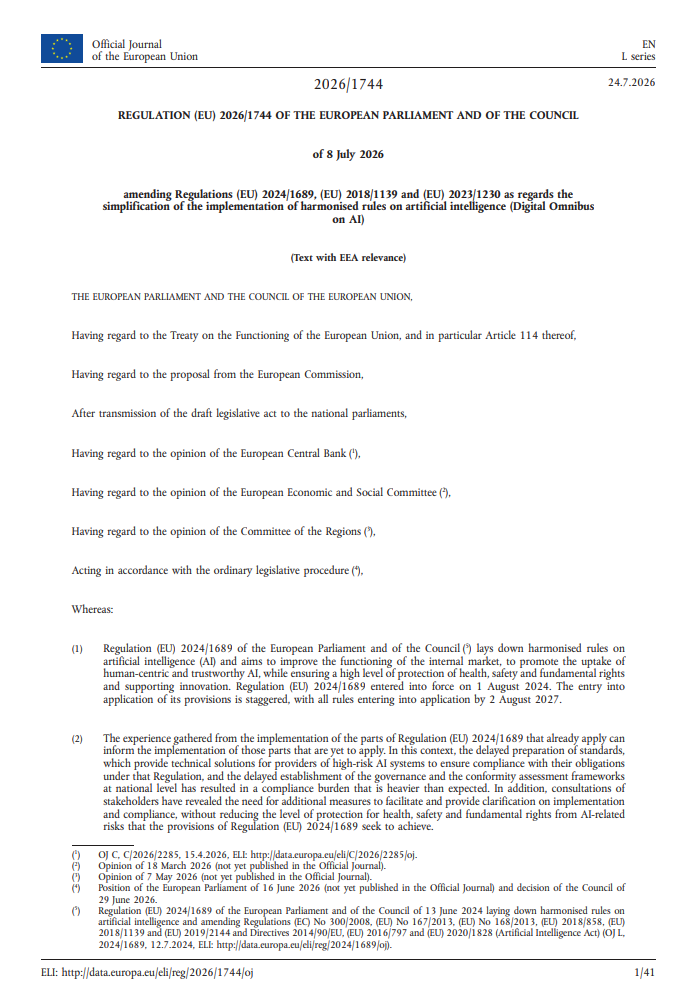
EU Publishes Regulation (EU) 2026/1744: The Digital Omnibus on Artificial Intelligence
The European Parliament and the Council of the European Union have published Regulation (EU) 2026/1744, commonly referred to as the "Digital Omnibus on Artificial Intelligence".
The Regulation introduces targeted amendments to Regulation (EU) 2024/1689 (the EU AI Act), Regulation (EU) 2018/1139 (Civil Aviation), and Regulation (EU) 2023/1230 (Machinery) to simplify regulatory implementation, reduce administrative burdens, and eliminate duplicative compliance requirements while preserving high safety and fundamental rights protections.
Purpose and Rationale for Implementation Relief
Following the entry into force of the EU AI Act in August 2024, feedback from industry stakeholders and national authorities highlighted significant compliance challenges. Delays in the availability of harmonised standards, common specifications, and national governance frameworks created risks of uneven enforcement and excessive compliance costs.
In response, the Digital Omnibus amends key provisions of the AI Act to provide a more workable, risk-proportionate, and predictable regulatory framework for economic operators across the internal market.
Staggered Implementation Dates and Extended Timelines
To ensure economic operators and notified bodies have adequate time to prepare, Regulation (EU) 2026/1744 postpones the entry into application of high-risk AI obligations set out in Chapter III, Sections 1, 2, and 3:
Annex III High-Risk AI Systems: The application date for standalone high-risk AI use-cases listed in Annex III is deferred to 2 December 2027.
Annex I Embedded High-Risk AI Systems (Medical Devices): For AI systems classified as high-risk under Article 6(1) because they are safety components or products covered by Union harmonisation legislation (including Regulation (EU) 2017/745 on Medical Devices and Regulation (EU) 2017/746 on In Vitro Diagnostic Medical Devices), the application date is deferred to 2 August 2028.
Generative AI Transition: Providers of generative AI systems placed on the market before 2 August 2026 are granted a 4-month transition period until 2 December 2026 to comply with marking and transparency requirements under Article 50(2).
Streamlined Conformity Assessments and Unified Notified Body Designation
A primary objective of the Digital Omnibus is to reduce administrative duplication for products subject to both AI Act requirements and sectoral legislation such as the EU MDR and IVDR.
Key structural changes include:
Unified Designation Procedure: Notifying authorities must establish a single application and unified assessment procedure for conformity assessment bodies applying for designation under both the AI Act and sectoral product legislation (e.g., MDR/IVDR).
18-Month Interim Power: Notified bodies already designated under Sectoral Annex I legislation are granted temporary power for 18 months from 27 July 2026 to assess AI Act high-risk conformity alongside sectoral audits, provided basic competence requirements are met.
Single Quality Management Integration: High-risk AI providers can integrate AI Act Quality Management System (QMS) requirements directly into their existing sectoral QMS (e.g., EN ISO 13485 framework) under Article 17(3).
Limitation of Duplicate Obligations: The European Commission is empowered to adopt delegated acts by 2 August 2027 to limit AI Act requirements where sectoral legislation provides an equivalent level of protection.
Refined Definitions: Safety Components, SMEs, and AI Literacy
The Regulation introduces key conceptual clarifications to prevent over-regulation:
Safety Component Definition: Article 3(14) is amended to specify that an AI system qualifies as a safety component only if its intended purpose is to prevent or mitigate risks to health and safety. Systems intended solely for user assistance, performance optimization, automation, or convenience are explicitly excluded.
Inclusion of Small Mid-Caps (SMCs): Formal definitions for SMEs and Small Mid-Cap Enterprises (SMCs) are introduced, extending simplified technical documentation forms and QMS relief to growing mid-tier companies.
Proportionate AI Literacy: Article 4 is modified from a rigid legal mandate into a flexible requirement for providers and deployers to support staff AI literacy through proportionate training and resources.
Enhanced Governance, Sandbox Support, and Prohibited AI
The Digital Omnibus also updates broader governance, testing, and enforcement provisions:
EU-Level AI Sandboxes & Real-World Testing: Establishes an EU-level regulatory sandbox managed by the AI Office with priority access for SMEs/SMCs and extends real-world testing provisions outside sandboxes.
Bias Detection Legal Basis: Article 4a creates an explicit legal basis for providers and deployers to process special categories of personal data (e.g., health data) strictly necessary for bias detection and correction under strict privacy safeguards.
Explicit Prohibitions: Article 5 is expanded to prohibit AI systems designed or used to generate non-consensual intimate material or child sexual abuse material, while safeguarding legitimate medical, diagnostic, and research applications.
Impact on Medical Device and SaMD Manufacturers
For manufacturers of Software as a Medical Device (SaMD) and AI-enabled medical technology operating in the European Union, Regulation (EU) 2026/1744 delivers substantial relief:
Provides an extended timeline until 2 August 2028 to achieve full AI Act compliance for high-risk medical devices;
Eliminates duplicate audits by allowing unified MDR/IVDR and AI Act Notified Body assessments;
Enables single-system integration of AI Act QMS requirements into existing ISO 13485 quality systems;
Reduces uncertainty around software categorization by refining the definition of safety components;
Expands access to regulatory sandboxes and real-world clinical testing frameworks.
By harmonizing the AI Act with established medical device regulatory pathways, the Digital Omnibus reduces legal uncertainty, lowers compliance costs, and accelerates the safe deployment of AI-driven healthcare solutions across the European Union.