FDA Issues Guidance on Cancer Clinical Trial Eligibility: Laboratory Values
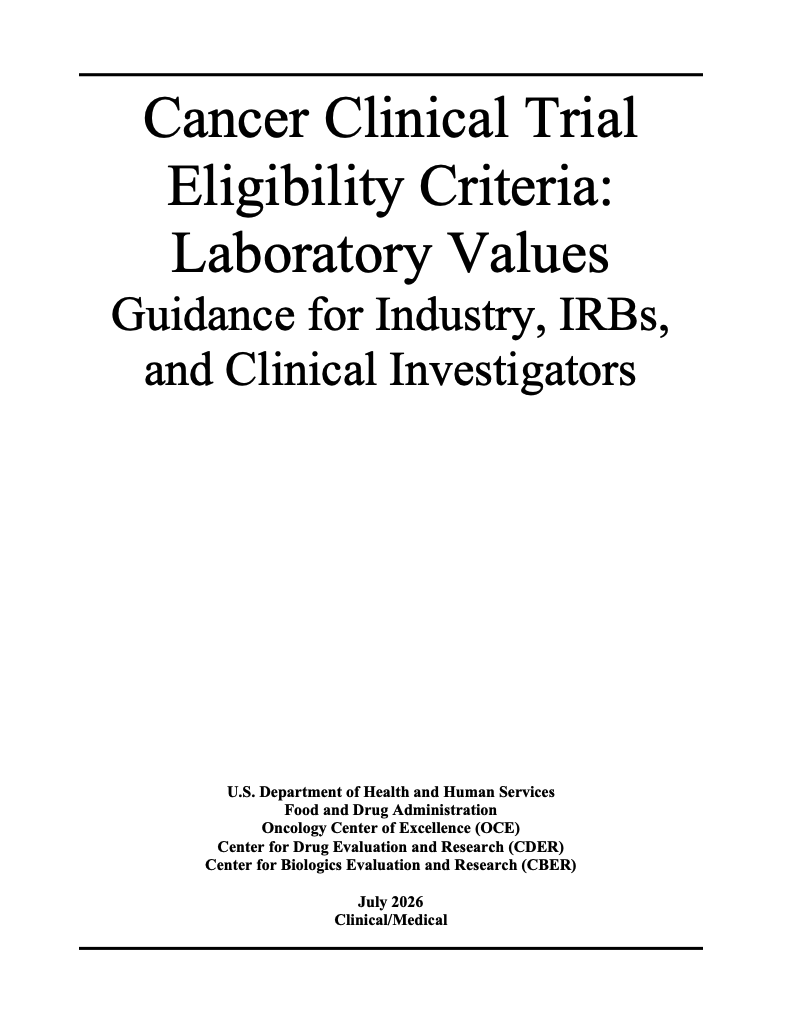
The U.S. Food and Drug Administration (FDA), through its Oncology Center of Excellence (OCE), Center for Drug Evaluation and Research (CDER), and Center for Biologics Evaluation and Research (CBER), has published final guidance titled "Cancer Clinical Trial Eligibility Criteria: Laboratory Values".
The guidance provides clinical trial sponsors, institutional review boards (IRBs), and clinical investigators with recommendations on establishing evidence-based laboratory eligibility criteria in adult oncology clinical trials to minimize unnecessary patient exclusions while protecting subject safety.
Purpose and Rationale for Modernizing Laboratory Values
Laboratory value-based eligibility criteria are among the most common inclusion and exclusion parameters in clinical trials. Protocols frequently enforce strict baseline thresholds for renal, hepatic, and bone marrow function to safeguard patients against organ toxicity or altered drug clearance.
However, the FDA highlights that template laboratory criteria are often carried forward mechanically across trial phases without scientific justification:
Unnecessary Exclusions: Strict renal and hepatic cut-offs serve as a leading barrier to enrollment, disproportionately excluding older cancer patients who frequently exhibit mild organ dysfunction without experiencing adverse clinical outcomes.
Demographic Disparities: Standard reference ranges derived from healthy populations fail to account for benign demographic variations. For example, individuals with the Duffy null phenotype (common among African American populations) exhibit lower absolute neutrophil counts (ANC) without increased infection risk, leading to racial disparities in trial access when rigid ANC criteria are enforced.
Lack of Lifecycle Evolution: Analyses of industry-sponsored oncology trials reveal minimal variation in laboratory criteria between Phase 1 and Phase 3 studies, indicating a failure to relax early-phase safety restrictions as clinical experience and pharmacokinetic data accumulate.
Scientific Justification for Laboratory Exclusion Criteria
The FDA recommends that laboratory-based exclusion criteria be customized to the investigational agent's specific mechanism of action, pharmacokinetics, pharmacodynamics (PK/PD), metabolism, clearance routes, and anticipated toxicity profile.
Key guidance recommendations include:
Drug-Specific Tailoring: If an investigational drug is not eliminated by the liver and does not exhibit hepatotoxicity, hepatic entry criteria should be sufficiently broad (e.g., excluding only patients with liver enzyme elevations multiple-fold above the upper limit of normal) rather than imposing routine exclusions.
Precision Protocol Writing: Protocols should avoid blanket statements requiring values to be "within normal limits" when a less restrictive threshold is clinically sufficient. For example, in QT-prolonging drug trials, requiring electrolyte levels to be "above the lower limit of normal" prevents the unnecessary exclusion of patients with slightly elevated, non-hazardous levels.
Accounting for Inter-Laboratory Variation: Protocols should accommodate variations across testing facilities by utilizing reference-based ranges or broader threshold windows rather than rigid absolute numerical cut-offs.
Accounting for Real-World Variations and Organ Impairment
To ensure clinical trial populations mirror the real-world patients expected to receive the drug upon approval, sponsors are encouraged to design protocols that accommodate baseline organ impairment and non-harmful laboratory abnormalities:
Target Population Representation: In trials evaluating treatments for renal, urothelial, or hepatic cancers, allowing patients with pre-existing organ dysfunction provides vital safety and efficacy data for high-unmet-need populations.
Dosing Adjustment Strategies: Conducting early organ impairment and pharmacokinetic studies enables sponsors to establish modified dosing regimens, allowing broader enrollment in pivotal late-phase trials.
Allowance for Repeat Testing: Mild laboratory abnormalities in cancer patients frequently represent transient fluctuations or manifestations of the underlying malignancy. Protocols should permit repeat testing within a defined timeframe prior to final eligibility determination.
Lifecycle Re-Assessment in Pivotal Phase 2/3 Studies
The FDA emphasizes that laboratory entry criteria should evolve dynamically throughout the drug development lifecycle.
While conservative laboratory limits are appropriate for first-in-human or first-in-class agents with uncharacterized human safety profiles, criteria should be systematically re-evaluated and relaxed as clinical data accumulates. In randomized Phase 2 and Phase 3 trials, between-arm comparisons effectively isolate drug-induced adverse events from baseline laboratory variations, making overly restrictive laboratory exclusions unnecessary and scientifically unjustified.
Impact on Clinical Trial Sponsors and Drug Developers
For biotechnology companies, pharmaceutical sponsors, and contract research organizations (CROs), this guidance requires a systematic update to standard oncology protocol templates and development workflows.
Sponsors should focus on:
Reviewing template protocols to eliminate unnecessary "within normal limits" laboratory restrictions;
Tailoring renal, hepatic, and hematologic entry criteria directly to the drug's PK/PD and elimination profile;
Incorporating demographic considerations, such as Duffy null-adjusted ANC thresholds, into global protocols;
Conducting early organ impairment and DDI studies to support modified dosing in broader patient cohorts;
Re-evaluating and loosening early-phase laboratory exclusions prior to launching pivotal Phase 3 trials;
Permitting protocol-defined repeat laboratory testing for non-critical, transient abnormalities.
By implementing these recommendations, sponsors can accelerate clinical trial accrual, enhance demographic and clinical diversity, and generate robust real-world evidence supporting safe drug utilization in oncology practice.