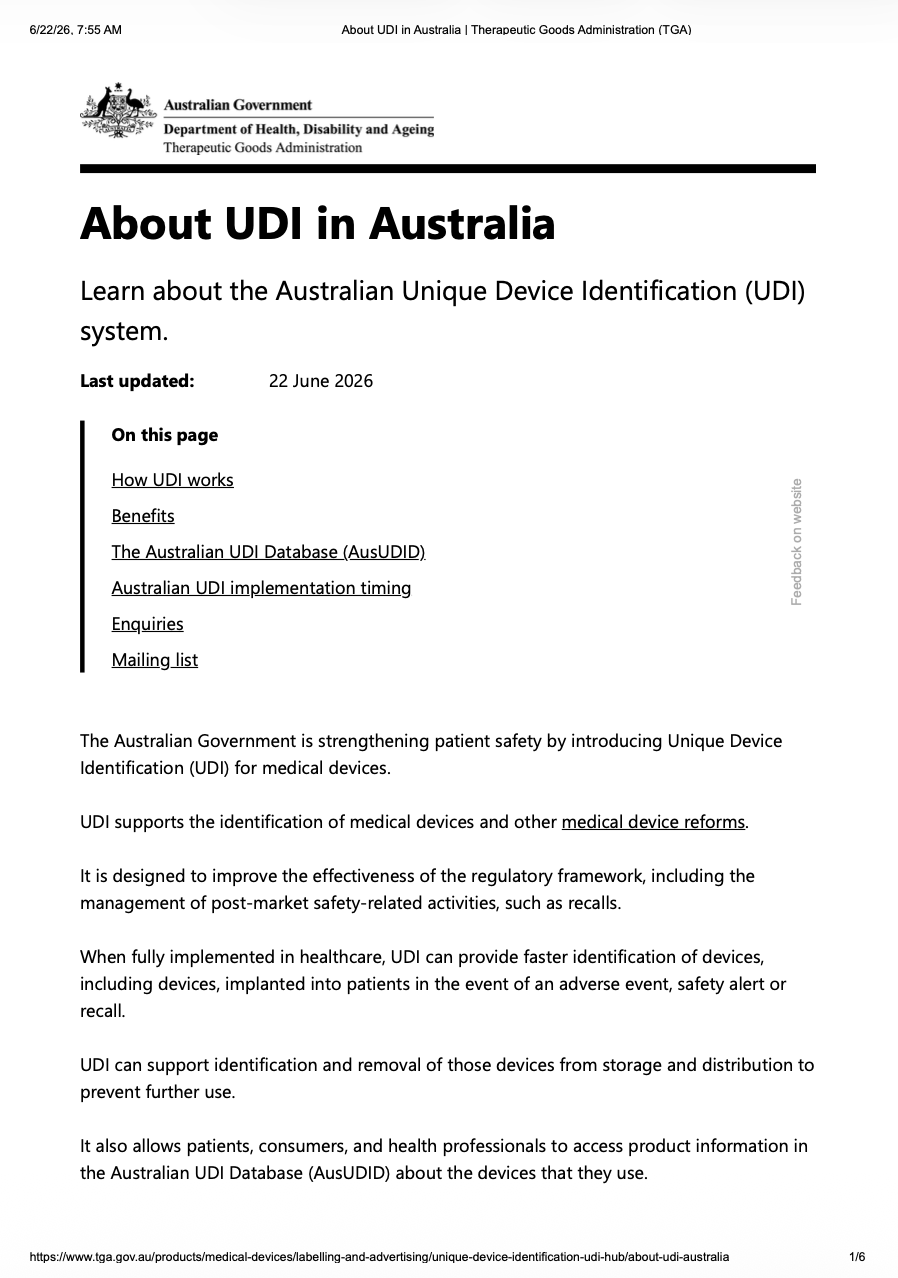
TGA Introduces Australia's UDI System with Phased Implementation Through 2029
The Therapeutic Goods Administration (TGA) has published updated information on the implementation of the Unique Device Identification (UDI) system in Australia, an initiative aimed at strengthening patient safety and improving the identification and traceability of medical devices throughout their lifecycle.
According to the TGA, the UDI system is designed to support the identification of medical devices and other regulatory reforms, contributing to more effective post-market surveillance activities, including safety alerts and product recalls.
Once fully implemented across the Australian healthcare system, UDI will enable faster identification of medical devices, including implanted devices, in the event of an adverse event, safety alert, or recall. The system will also facilitate the identification and removal of affected devices from storage and distribution, helping to prevent their further use.
How the UDI System Works
The UDI system assigns a unique identifier to each medical device model.
This identifier consists of two components:
UDI-Device Identifier (UDI-DI), which identifies the device model;
UDI-Production Identifier (UDI-PI), which contains production-specific information, such as the lot or batch number.
The identifiers are issued by organizations recognized by the TGA as Issuing Agencies, which are responsible for ensuring that UDIs are unique and comply with international standards.
Applicable devices must display the UDI on the device label and on all relevant packaging levels in a format that is both human-readable and machine-readable, such as a barcode. For certain reusable medical devices, the UDI may also be directly marked on the device itself.
AusUDID: Australia's UDI Database
The TGA has established the Australian UDI Database (AusUDID) to store UDI-DIs and related information for medical devices supplied in Australia.
Manufacturers or sponsors are responsible for submitting and maintaining device information within the database. The information will be freely accessible to patients, healthcare professionals, consumers, and clinical quality registries.
According to the TGA, the AusUDID does not collect or store patient information, as patient data remains under the responsibility of healthcare institutions.
Implementation Timeline
The implementation of the UDI system will be phased over a five-year period, beginning with higher-risk medical devices.
The TGA has established the following mandatory compliance dates:
1 July 2026 – Class III and Class IIb medical devices;
1 July 2027 – Class IIa medical devices;
1 July 2028 – Class Is medical devices and Class 3 and Class 4 IVDs;
1 July 2029 – Class 1 and Class 2 IVDs.
During the transition period, manufacturers and sponsors can prepare their organizations, update device labels and packaging, prepare their UDI-DIs and associated data, and establish and test methods for submitting information to the AusUDID.
The TGA also states that manufacturers may voluntarily adopt the UDI requirements before the mandatory compliance dates. If they choose to do so, the agency recommends complying with all applicable requirements to reduce potential confusion among end users.
Impact on Manufacturers
For medical device and IVD manufacturers and sponsors supplying products to the Australian market, the implementation of the UDI system requires a gradual transition to meet the new regulatory requirements.
Key obligations outlined by the TGA include assigning UDIs to applicable devices, updating device labeling and packaging, submitting and maintaining device information in the AusUDID, and complying with the implementation timelines established according to the device's risk classification.
The phased implementation approach provides manufacturers and sponsors with the opportunity to prepare their processes in advance of the dates on which compliance with the UDI requirements becomes mandatory.