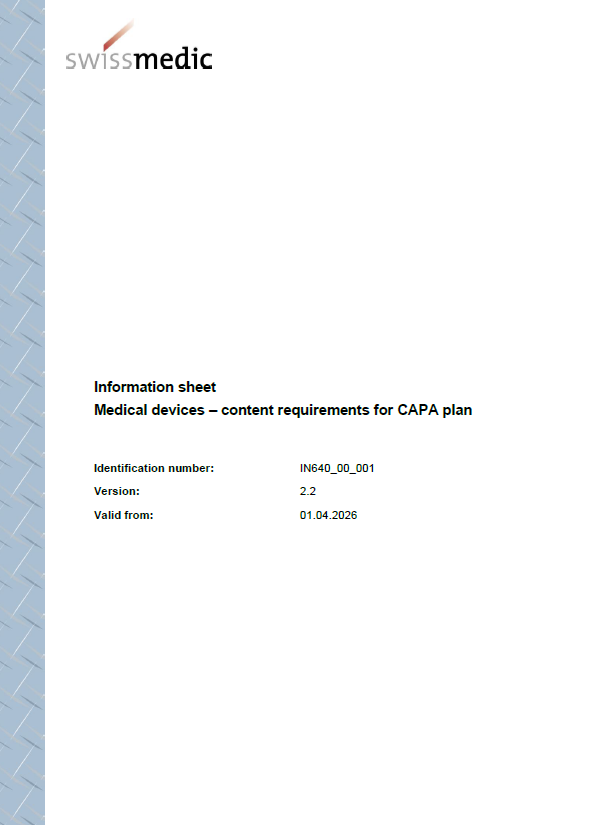
Swissmedic Updates CAPA Plan Content Requirements for Medical Devices
Swissmedic has published an updated information sheet on the content requirements for Corrective and Preventive Action (CAPA) plans, applicable to medical devices and in vitro diagnostic devices. The document (version 2.2) will enter into force on 1 April 2026 and provides clarification on regulatory expectations during market surveillance activities.
What is the purpose of the update?
The guidance outlines minimum content requirements for CAPA plans requested by Swissmedic when non-conformities (NCs) are identified during inspections or other market surveillance activities.
It is specifically aimed at economic operators (including manufacturers, authorised representatives, and importers) and is intended to:
Support the development of structured CAPA plans
Ensure consistent and efficient regulatory processes
Clarify expectations for addressing non-conformities
Key expectations for CAPA plans
Swissmedic emphasises that a CAPA plan must be:
Clear and complete – all non-conformities must be individually addressed
Documented in detail – including responsibilities, actions, methods, and timelines
Traceable and effective – ensuring sustainable resolution and restoration of compliance
Root cause-driven – focused on eliminating underlying causes, not just symptoms
Binding and verifiable – with demonstrated effectiveness
Timely – typically submitted within 30 days (excluding implementation time)
Structured approach: PDCA cycle
The document recommends a process-oriented CAPA approach based on the Deming (PDCA) cycle:
Plan: Define non-conformities, perform root cause and risk analysis, and establish corrective and preventive actions
Do: Implement planned actions and manage their interactions
Check: Verify effectiveness through objective evaluation
Act: Confirm full resolution and drive continuous improvement
This aligns closely with ISO 13485:2016 (Section 8.5) and established quality management practices.
Important regulatory clarification
Swissmedic highlights that:
CAPA plans are not only reactive—economic operators are expected to proactively identify and address non-conformities, even outside inspections
Authorities will review both the CAPA plan and evidence of implementation
If insufficient, additional actions may be required or enforced
What this means for manufacturers
For manufacturers placing devices on the Swiss market, this update reinforces several practical points:
CAPA systems must be inspection-ready: Documentation quality and traceability will be closely scrutinised
Root cause analysis is critical: Superficial fixes are unlikely to be accepted
Timelines matter: The 30-day expectation for CAPA plan submission requires strong internal processes
QMS alignment is essential: CAPA processes should be fully integrated with ISO 13485 and PMS systems
Proactivity is expected: Waiting for authority findings is not compliant with regulatory expectations
Final thoughts
While the document does not introduce entirely new regulatory concepts, it provides clearer expectations and a more structured framework for CAPA plans. For manufacturers, this is a strong signal that CAPA effectiveness and documentation quality remain a key focus area for Swissmedic inspections.
Read the full document below.