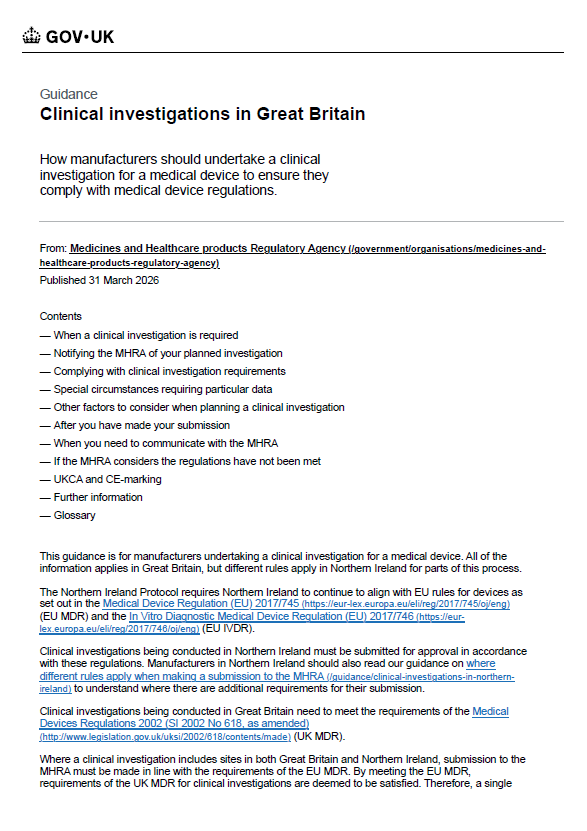
The UK Medicines and Healthcare products Regulatory Agency (MHRA) has published updated guidance on clinical investigations for medical devices in Great Britain, clarifying regulatory expectations under the UK Medical Devices Regulations 2002 (UK MDR) and their interaction with EU requirements.
The guidance, published on 31 March 2026, provides comprehensive direction for manufacturers planning and conducting clinical investigations and highlights several important considerations that may directly impact development strategies, regulatory submissions, and timelines.
Alignment Between Great Britain and EU Frameworks
One of the most notable aspects of the guidance is the continued flexibility for manufacturers to use EU MDR pathways:
Clinical investigations conducted in Northern Ireland must follow EU MDR/IVDR
For multi-site studies (GB + NI), a single EU MDR submission to MHRA is sufficient
Even for GB-only studies, manufacturers may choose to demonstrate compliance with EU MDR instead of UK MDR
What this means for manufacturers:
Opportunity to streamline regulatory strategy across UK and EU markets
Potential to avoid duplication of submissions
Increased importance of aligning documentation with EU MDR standards, even when targeting GB only
When Clinical Investigations Are Required
The MHRA reinforces that clinical investigations are expected in several scenarios, particularly for:
Implantable and Class III devices
Devices with novel technologies or materials
Significant design or performance modifications
Devices intended for new purposes or indications
Situations where preclinical testing cannot replicate clinical conditions
Manufacturer impact:
Early-stage innovation will almost always trigger clinical investigation requirements
Changes to existing devices may invalidate reliance on legacy clinical data
Strong justification is required if clinical data is not generated via investigation
60-Day Notification Requirement Remains Critical
Manufacturers must provide a minimum 60-day notice to MHRA before starting a clinical investigation in Great Britain.
Key elements:
Submission via the IRAS platform
Investigation may proceed only if no MHRA objection is raised within 60 days
Research Ethics Committee (REC) approval is mandatory before initiation
Practical implications:
Regulatory timelines must include both MHRA review and ethics approval
Delays may occur if documentation is incomplete or inconsistent
Coordination between regulatory and clinical teams is essential
Clinical Evidence Expectations Are Reinforced
The guidance reiterates that clinical data is central to demonstrating compliance with safety and performance requirements.
Acceptable sources include:
Scientific literature (with demonstrated equivalence)
Clinical investigation data
Combined evidence approaches
However:
For high-risk devices, clinical investigations are likely unavoidable
Investigations must confirm:
Intended performance under normal conditions
Acceptable benefit-risk profile
Key takeaway:
Manufacturers should expect increased scrutiny on clinical evidence quality, especially for innovative or high-risk devices.
Increased Focus on Study Design and Conduct
The MHRA outlines detailed expectations aligned with BS EN ISO 14155:2020 (Good Clinical Practice), including:
Clearly defined objectives and endpoints
Adequate sample size and duration
Robust adverse event reporting
Full documentation and final reporting
Additional emphasis is placed on:
Realistic study conditions
Justification of control groups (or lack thereof)
Objective and measurable endpoints
Impact for manufacturers:
Poorly designed studies may lead to regulatory objections or delays
Alignment with ISO 14155 is no longer optional—it is expected
Post-Market Clinical Follow-Up (PMCF) Expectations
The guidance reinforces that clinical evaluation is not a one-time activity:
Manufacturers must continuously update clinical evidence
PMCF is expected, particularly for:
Innovative devices
High-risk indications
Long-term safety concerns
Strategic implication:
Clinical strategy must extend beyond pre-market approval
PMCF planning should be integrated early in development
Stricter Oversight on Safety Reporting and Study Changes
Manufacturers are required to:
Report all serious adverse events to MHRA without delay
Submit quarterly safety reports
Notify MHRA of any study modifications before implementation
The MHRA retains the authority to:
Suspend or terminate investigations
Withdraw approval if safety concerns arise
What this means:
Increased operational burden on clinical and regulatory teams
Need for robust post-submission monitoring systems
Greater importance of real-time safety data management
Special Scenarios Clarified
The guidance also provides clarity on less straightforward cases:
Prototype devices: Changes may be allowed within one submission unless risk increases
Off-label use: May shift regulatory responsibility to clinicians or institutions
In-house devices: Exemptions apply only under strict conditions
Humanitarian use: Requires prior MHRA authorization
Manufacturer takeaway:
These scenarios require careful regulatory interpretation and early engagement with MHRA.
Read the full document below.