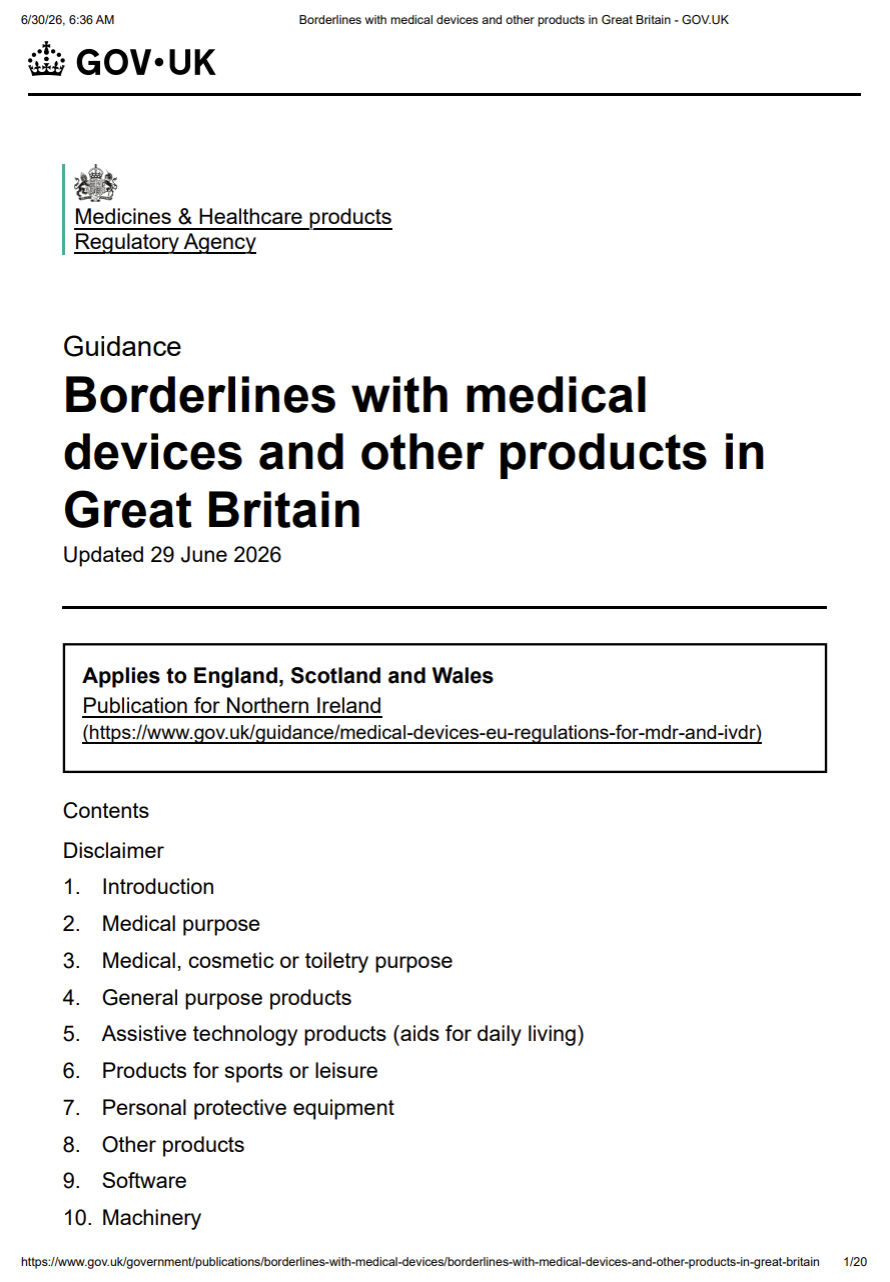
MHRA Updates Guidance on Borderlines with Medical Devices and Other Products in Great Britain
The Medicines and Healthcare products Regulatory Agency (MHRA) has updated its guidance “Borderlines with medical devices and other products in Great Britain”, which presents the MHRA’s current views on the interpretation of medical device legislation as it relates to borderline products.
The guidance applies to England, Scotland and Wales and is specific to products placed on the market in Great Britain, as well as to products conforming to UKCA marking requirements, unless otherwise stated.
The document covers borderline products with general medical devices under Part II of the UK Medical Device Regulations 2002, as amended. It does not cover borderlines with in vitro diagnostic medical devices or active implantable medical devices.
Determining Whether a Product Is a Medical Device
The MHRA explains that manufacturers should not assume that a product considered to be a medical device in another jurisdiction will also be considered a medical device in the UK.
Borderline determinations should be based on the UK definitions of a medical device, the product’s stated intended purpose and its mode of action.
In general, medical devices must have a medical purpose, which is determined by the definition of a medical device. They must also act primarily in a way that is not metabolic, immunological or pharmacological. Where a product has a medical purpose but functions through a metabolic, immunological or pharmacological mode of action, it may fall within the remit of medicinal product regulations instead.
Medical Purpose, Labelling and Claims
The guidance highlights that the UK MDR 2002 does not use the phrase “medical purpose”, but medical devices are considered to be products intended for use in a medical context.
Whether a product has a medical purpose is defined by the manufacturer’s intention for the product, as reflected in its:
labelling;
instructions for use;
promotional material;
mode of action.
The MHRA also notes that not all equipment used in a healthcare environment or by a healthcare professional will be considered a medical device.
Products without a principal intended medical purpose are not considered medical devices, even where disease prevention may be a secondary purpose. However, similar products may be considered medical devices where there is a specific primary intended medical purpose.
The appendix to the guidance lists words and phrases that may contribute to a determination that a product is a medical device, including terms such as “diagnoses”, “monitors”, “pain relief”, “prevents”, “treats” and “treatment”. The guidance also states that general disclaimers, such as “this product is not a medical device”, are not acceptable where medical claims are made or implied elsewhere in labelling, promotional material, websites or online advertisements.
Product Borderlines Covered by the Guidance
The MHRA guidance addresses several product categories where borderline questions may arise, including:
medical, cosmetic or toiletry products;
general purpose products;
assistive technology products;
products for sports or leisure;
personal protective equipment;
software;
machinery;
medical devices and medicinal products;
accessories;
raw materials and component parts;
spare parts;
repairs;
second-hand and fully refurbished devices;
final processing;
custom-made devices;
procedure packs, assembling and processing;
biocides;
other borderlines.
For software, the guidance states that software may be considered a medical device where its purpose fits the definition of a medical device. Software intended to enhance images from x-ray or ultrasound would be considered a medical device, while software that is simply a patient management system or records storage system would not be considered a medical device.
For products that are intended to be used both as medical devices and personal protective equipment, the guidance states that the product should be UKCA marked as a medical device, while also fulfilling the relevant basic health and safety requirements of the UK legislation on personal protective equipment.
For machinery that is also a medical device, the guidance states that the machinery should be UKCA marked as a medical device, while the manufacturer must also fulfil the essential health and safety requirements applicable to machinery where these are more specific than the essential requirements in the UK MDR 2002.
Accessories, Components and Lifecycle Considerations
The guidance defines an accessory as an article which, although not itself a medical device, is specifically intended by its manufacturer to be used together with a medical device so that the medical device can be used in accordance with its intended purpose.
Accessories should be classified in their own right as medical devices and do not necessarily take the classification of the device with which they are intended to be used.
The MHRA also clarifies that raw materials, component parts and products at intermediate stages of manufacture are not normally considered medical devices. However, manufacturers should be aware that raw materials and components may affect the quality and safety of finished medical devices and must take responsibility for their selection, control and compatibility with the finished device.
The guidance also addresses spare parts, repairs, second-hand devices and fully refurbished devices. In particular, fully refurbished medical devices are considered to fall within the requirements of the medical device regulations and require UKCA marking by the person undertaking the full refurbishment, who is considered the manufacturer under the regulations.
Impact on Medical Device and IVD Manufacturers
For medical device manufacturers placing products on the Great Britain market, the guidance reinforces the importance of assessing borderline products by reference to the UK MDR 2002, the product’s intended purpose and its mode of action.
Manufacturers should pay particular attention to:
how the product’s intended purpose is described in labelling, instructions for use and promotional material;
whether medical claims are made or implied, including on websites or online advertisements;
whether the product acts primarily in a physical way or through a metabolic, immunological or pharmacological mode of action;
whether a product is a medical device, an accessory, a medicinal product, PPE, machinery, a biocide or another type of product;
whether components, spare parts, refurbished devices or procedure packs create additional regulatory obligations;
whether UKCA marking is required under the UK MDR 2002.
For IVD manufacturers, the guidance is also relevant from a scope perspective because it expressly states that it does notcover borderlines with in vitro diagnostic medical devices. IVD-specific borderline questions are therefore outside the scope of this document.
Manufacturers uncertain about the status of a product should consult the relevant legislation and available guidance. The MHRA also states that, where manufacturers remain uncertain after consulting the guidance documents, they should seek further advice from the agency.