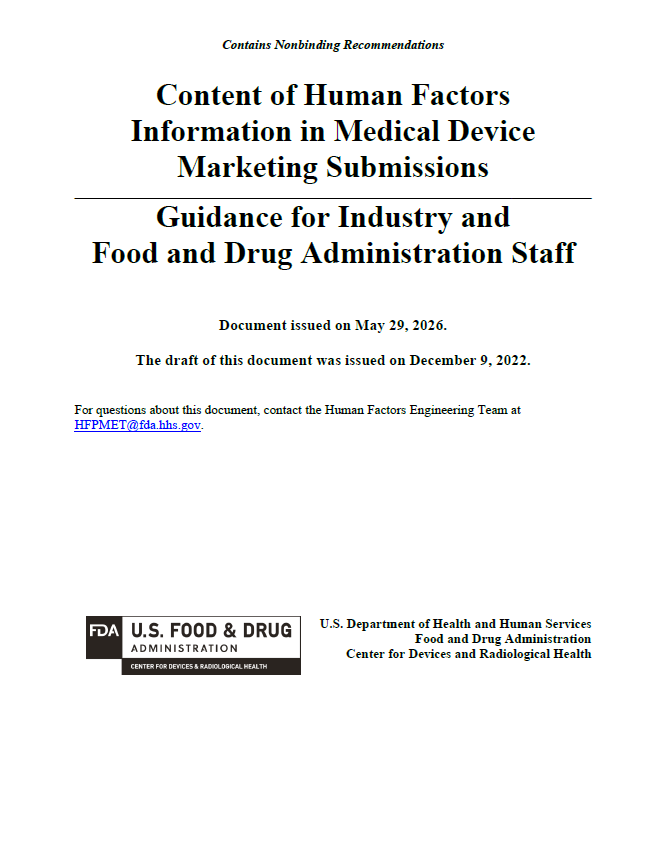
FDA Finalizes Risk-Based Guidance on Human Factors Information in Medical Device Submissions
The U.S. Food and Drug Administration (FDA) has issued its final guidance, “Content of Human Factors Information in Medical Device Marketing Submissions,” introducing a risk-based framework to help determine the level of human factors (HF) documentation expected in medical device premarket submissions.
The guidance applies to devices submitted to FDA’s Center for Devices and Radiological Health (CDRH), including 510(k), De Novo, PMA, and HDE submissions.
A key change is the introduction of three Human Factors Submission Categories, which are intended to align the amount of human factors information provided with the level of use-related risk associated with a device or device modification.
Under the framework, manufacturers are expected to evaluate whether changes affect:
The device user interface;
Intended users;
Intended uses;
Use environments;
Training;
Labeling;
Critical tasks associated with device use.
Depending on the outcome of this assessment, submissions may require only a high-level human factors summary, a documented rationale supporting the absence of additional testing, or a comprehensive Human Factors Engineering/Usability Engineering (HFE/UE) report that includes human factors validation testing.
The guidance places particular emphasis on the identification of critical tasks—tasks that, if performed incorrectly or omitted, could result in serious harm or compromised medical care. FDA also provides recommendations for documenting use-related risk analyses, risk control measures, residual risks, and validation activities.
In addition to outlining submission expectations, the document includes numerous examples covering modifications to existing devices and new device submissions. These examples illustrate how FDA evaluates changes to user interfaces, training, labeling, reprocessing instructions, intended user populations, and other factors that may influence use-related risk.
Why this matters for manufacturers
For manufacturers, the guidance provides greater clarity on when FDA is likely to expect human factors validation data and when a documented rationale may be sufficient.
Companies planning software updates, user interface modifications, labeling changes, expanded indications, or new user populations should carefully assess whether such changes impact critical tasks or introduce new use-related risks. These factors may significantly influence the level of human factors evidence expected within a submission.
While the guidance is specific to FDA submissions, its principles are consistent with established human factors and risk management practices already familiar to many manufacturers through standards such as IEC 62366-1 and ISO 14971.
The final guidance was issued on 29 May 2026. FDA states that it generally does not expect manufacturers to include the newly recommended information in submissions received before 1 August 2026, although such information may be reviewed if provided.
Read the full document below.