FDA Replaces 25-Year-Old Bioequivalence Statistical Guidance with Major Update
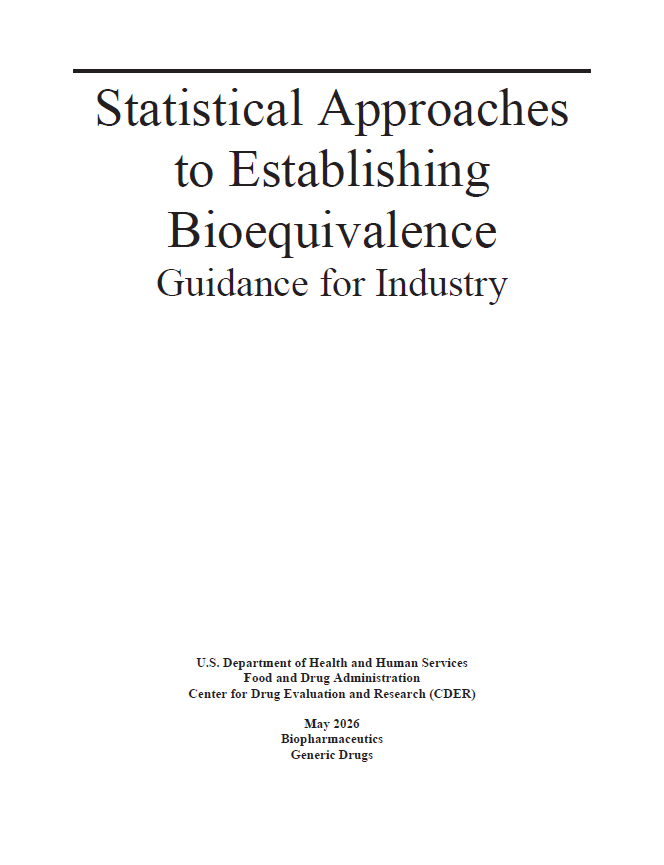
The U.S. Food and Drug Administration (FDA) has issued a new version of its guidance Statistical Approaches to Establishing Bioequivalence, replacing the previous document published in 2001. The update reflects significant advances in statistical science, clinical study design and bioequivalence assessment methodologies that have emerged over the last two decades.
Bioequivalence studies remain a cornerstone of generic drug development and post-approval product changes. While the fundamental principle of demonstrating comparable exposure between a test and reference product remains unchanged, the FDA has substantially expanded its recommendations on how bioequivalence can be assessed in increasingly complex development scenarios.
Modernising Bioequivalence Assessment
One of the most notable aspects of the new guidance is the FDA's recognition of modern statistical approaches that were largely absent from the 2001 version.
The Agency now explicitly discusses adaptive study designs, sparse sampling strategies and model-based approaches that may support bioequivalence assessments when traditional study designs are not optimal. The guidance also encourages applicants to engage with the FDA when proposing innovative methodologies, reflecting a growing regulatory openness towards science-driven alternatives to conventional approaches.
This is particularly relevant for developers of complex products, where standard crossover bioequivalence studies may not always provide the most efficient or scientifically appropriate solution.
Increased Focus on Study Planning and Data Integrity
The updated guidance incorporates concepts from the ICH E9(R1) framework by introducing recommendations on estimands and intercurrent events.
Applicants are encouraged to prospectively define how events such as treatment discontinuations, protocol deviations or missing observations will be handled during analysis. The document also provides substantially expanded recommendations regarding missing data management, sensitivity analyses and statistical assumptions.
For manufacturers, this signals a continued regulatory expectation that statistical considerations should be integrated into development planning from the earliest stages rather than being addressed retrospectively during submission preparation.
New Recommendations for Highly Variable and Narrow Therapeutic Index Drugs
The FDA has also expanded its discussion of products that present unique bioequivalence challenges.
For highly variable drugs, the guidance reinforces the use of replicate crossover study designs and reference-scaled average bioequivalence approaches when appropriate. For narrow therapeutic index (NTI) products, the FDA recommends fully replicated study designs and additional assessments of within-subject variability to ensure adequate control of therapeutic equivalence.
These recommendations are intended to support robust decision-making while recognising that traditional bioequivalence acceptance criteria may not always be optimal for certain product categories.
Broader Use of In Vitro and Alternative Approaches
The guidance also provides updated recommendations for several specialised bioequivalence scenarios, including:
Population bioequivalence approaches;
In vitro release testing (IVRT);
In vitro permeation testing (IVPT);
Comparative studies for abuse-deterrent formulations;
Statistical assessment of particle size distribution profiles;
Comparative clinical endpoint bioequivalence studies.
These sections demonstrate the increasing diversity of evidence that regulators may consider when assessing equivalence, particularly for locally acting and complex drug products.
What Manufacturers Should Consider
Although the guidance is directed primarily at sponsors of INDs, NDAs and ANDAs, it provides valuable insight into the FDA's current regulatory expectations.
Manufacturers planning future bioequivalence studies should evaluate whether existing development strategies, statistical analysis plans and study protocols remain aligned with the Agency's updated recommendations. Particular attention may be required for products involving adaptive methodologies, highly variable pharmacokinetic profiles, narrow therapeutic indices or alternative bioequivalence approaches.
More broadly, the document reflects a continued shift towards risk-based, scientifically justified and increasingly flexible regulatory assessment frameworks. While the core bioequivalence principles remain unchanged, the tools available to demonstrate equivalence continue to evolve.
The guidance was published by FDA's Center for Drug Evaluation and Research (CDER) in May 2026 and replaces the Agency's previous guidance of the same title issued in February 2001.
Read the full document below.