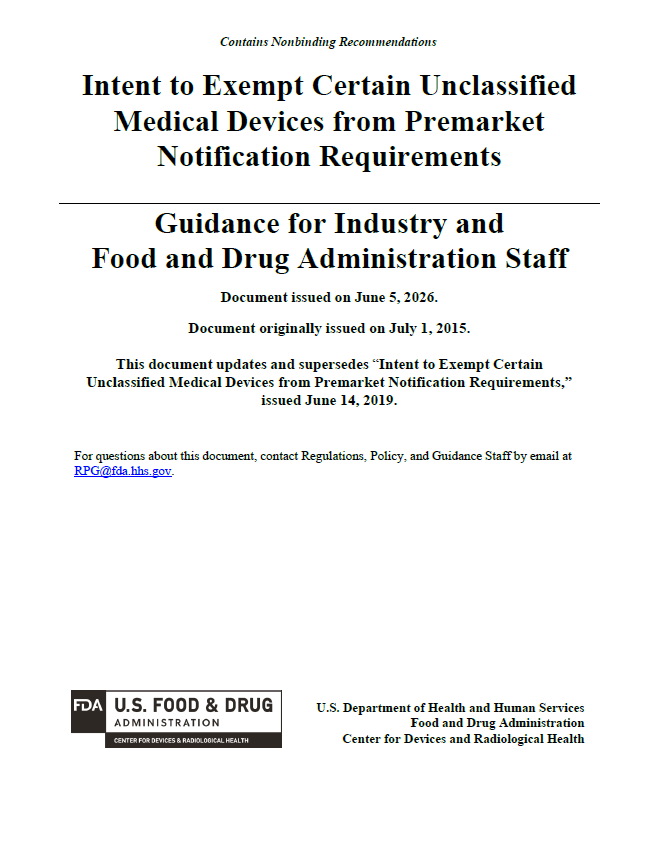
The U.S. Food and Drug Administration (FDA) has updated its guidance “Intent to Exempt Certain Unclassified Medical Devices from Premarket Notification Requirements”, adding five additional preamendment unclassified medical device types to the list of products for which the Agency does not intend to enforce premarket notification (510(k)) requirements. The revised guidance was issued on 5 June 2026 and supersedes the previous version published in June 2019.
The guidance describes FDA’s current position regarding certain low-risk unclassified medical devices that the Agency believes meet the standards for exemption from premarket notification requirements. Until a formal exemption is established, or unless new information changes the Agency’s assessment, FDA states that it does not intend to enforce compliance with 510(k) requirements for the devices identified in the guidance and does not expect manufacturers to submit 510(k) notifications for these products.
Background
The guidance forms part of FDA’s broader effort to reduce regulatory burden for lower-risk medical devices where premarket notification may no longer be necessary to provide reasonable assurance of safety and effectiveness. According to the document, previous versions of the guidance included both classified and unclassified device types. However, following legislative changes introduced through the 21st Century Cures Act, many classified devices have already been formally exempted from 510(k) requirements and subsequently removed from the guidance. The current version therefore focuses exclusively on certain unclassified medical devices that FDA believes are appropriate candidates for exemption.
The June 2026 update specifically notes that five additional preamendment unclassified devices have been added to the guidance. These devices are identified under the following FDA product codes:
LDK – Optical contour sensing devices
LZW – Spine curvature monitors
MVV – Acupressure devices
MIG – Isoniazid test strips
LXQ – Eye cups
These products join a number of other unclassified devices already covered by the guidance, including hearing protection devices, speech training aids for hearing-impaired individuals, hemorrhoid cushions, device disinfectant alcohol pads, nail prostheses, fertility diagnostic devices and several other established device types.
What Does This Mean for Manufacturers?
For manufacturers of devices falling within the affected product codes, the update provides greater regulatory clarity regarding FDA’s current enforcement approach. The Agency explicitly states that it does not intend to enforce compliance with 510(k) requirements for the listed devices and does not expect manufacturers to submit 510(k) notifications while this policy remains in place.
However, manufacturers should be aware that the guidance is limited to premarket notification requirements and does not affect other regulatory obligations. FDA specifically notes that the devices remain subject to requirements related to establishment registration and device listing, labeling, quality management system requirements under 21 CFR Part 820, medical device reporting, and other applicable statutory and regulatory provisions.
The guidance also clarifies that FDA does not intend to extend this policy to combination products, including single-entity products containing antimicrobial agents, even if they fall within one of the listed product codes.
Considerations for Manufacturers
Manufacturers with products that fall within the listed FDA product codes should review the updated guidance and assess whether the Agency’s current enforcement policy applies to their devices. While the document may reduce the need for premarket notification submissions for certain established product types, companies remain responsible for maintaining compliance with all other applicable FDA requirements.
For organisations operating internationally, the update also highlights the importance of understanding differences between regulatory pathways across jurisdictions. Although FDA may not currently expect 510(k) submissions for the devices identified in the guidance, manufacturers must continue to ensure compliance with any applicable requirements in other markets where their products are placed on the market.
The update represents FDA’s latest effort to identify device categories that may no longer require premarket notification oversight, while maintaining the broader regulatory controls that apply to medical device manufacturers. As FDA continues to review low-risk and well-established device types, manufacturers should monitor future updates that may further affect regulatory obligations in the U.S. market.
Read the full document below.