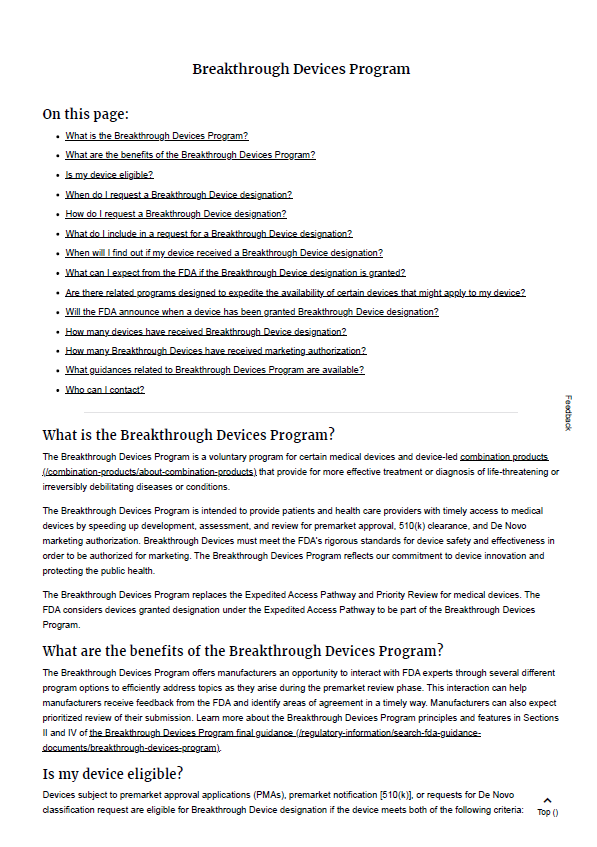
The U.S. Food and Drug Administration (FDA) has updated the statistics for its Breakthrough Devices Program, reporting that a total of 1,284 devices had received Breakthrough Device designation as of 31 March 2026.
According to the FDA, 1,264 designations were granted by the Center for Devices and Radiological Health (CDRH), while 20 were granted by the Center for Biologics Evaluation and Research (CBER). The figures include devices originally designated under the Expedited Access Pathway (EAP), the programme that preceded the current Breakthrough Devices Program.
Established to support innovation in medical technology, the Breakthrough Devices Program is a voluntary FDA initiative intended for certain medical devices and device-led combination products that may provide more effective treatment or diagnosis of life-threatening or irreversibly debilitating diseases or conditions. The programme aims to facilitate patient access to innovative technologies by accelerating device development, assessment, and regulatory review while maintaining FDA standards for safety and effectiveness.
Eligibility Criteria
To be eligible for Breakthrough Device designation, a device must satisfy two statutory criteria.
First, the device must provide for more effective treatment or diagnosis of a life-threatening or irreversibly debilitating human disease or condition.
Second, the device must meet at least one of the following requirements:
Represent breakthrough technology;
Address a situation where no approved or cleared alternatives exist;
Offer significant advantages over existing approved or cleared alternatives; or
Be in the best interest of patients through improved device availability.
The FDA notes that devices intended to follow the Premarket Approval (PMA), 510(k), or De Novo pathways may all be eligible for designation, provided these criteria are met.
Regulatory Benefits for Manufacturers
Manufacturers can request Breakthrough Device designation at any time before submitting their marketing application. Requests are submitted through the FDA’s Q-Submission Program and should include information describing the device, its intended use, regulatory history, justification against the statutory criteria, and the anticipated regulatory pathway.
Once designation is granted, sponsors may benefit from increased interaction with FDA review teams during device development. The agency highlights several programme features, including sprint discussions, data development plan discussions, and clinical protocol agreements. Designated devices also receive prioritised review for future submissions, including Q-Submissions, Investigational Device Exemption (IDE) applications, and marketing submissions.
The FDA states that it generally communicates its designation decision within 60 calendar days of receiving a request, provided sufficient information has been submitted to support the review.
Market Authorisations Continue to Grow
The agency also reported that 198 Breakthrough Devices had received marketing authorisation as of 31 March 2026. This total includes 193 devices reviewed through CDRH and five reviewed through CBER.
The list of authorised devices spans a wide range of technologies and therapeutic areas, including cardiovascular devices, orthopaedic implants, diagnostic tests, imaging solutions, neurology products, and software-based technologies.
According to FDA data, the clinical panels with the highest number of granted Breakthrough Device designations are:
Cardiovascular – 260 designations
Neurology – 200 designations
Orthopedic – 176 designations
These are followed by Gastroenterology & Urology, General & Plastic Surgery, Microbiology, Immunology, Pathology, and Radiology.
What This Means for Manufacturers
For manufacturers developing novel technologies targeting serious or debilitating medical conditions, the FDA’s latest figures demonstrate the continued use of the Breakthrough Devices Program across a broad range of clinical specialties.
Although designation does not reduce the evidentiary requirements needed to obtain FDA marketing authorisation, it provides an opportunity for earlier engagement with the agency during product development and offers access to programme-specific review mechanisms. Manufacturers planning U.S. market entry may therefore wish to assess whether their devices meet the eligibility criteria and whether a Breakthrough Device designation request could form part of their broader regulatory strategy.
The FDA also notes that devices not eligible for Breakthrough Device designation may still be candidates for other expedited programmes, such as the Safer Technologies Program (STeP), depending on their intended use and risk profile.
Read the full document below.