FDA Adopts ICH M11 CeSHarP Guidance: What Sponsors Need to Know About the Future of Clinical Trial Protocols
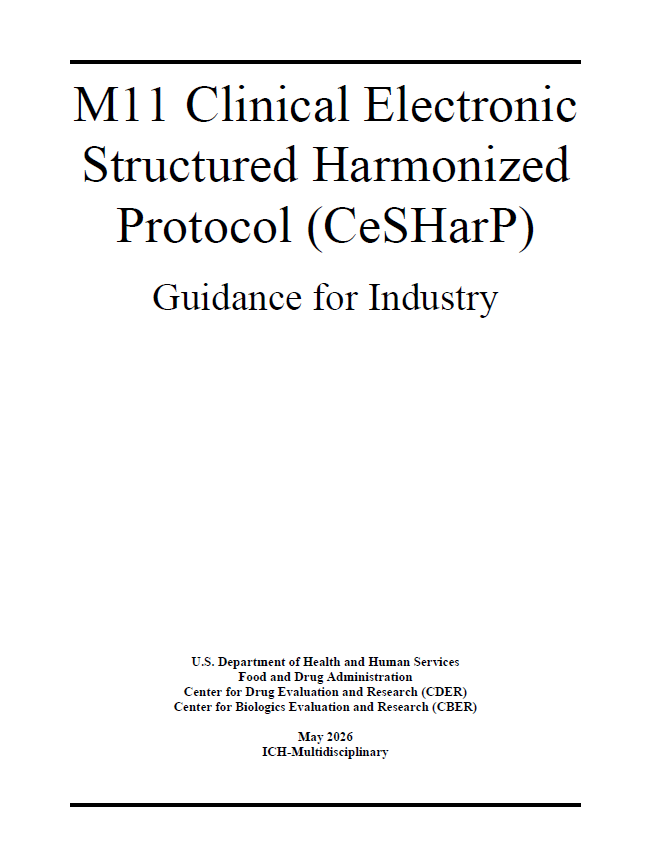
The U.S. Food and Drug Administration (FDA) has officially adopted the ICH M11 Guideline through the publication of the guidance "M11 Clinical Electronic Structured Harmonized Protocol (CeSHarP)." The document represents an important milestone in the ongoing global effort to standardize clinical trial documentation and improve the efficiency of protocol development, review, and execution across regulatory regions.
The guidance follows the adoption of ICH M11 at Step 4 in November 2025 and introduces a harmonized framework for structuring clinical trial protocols and enabling their electronic exchange between sponsors, investigators, ethics committees, and regulatory authorities.
Why Was ICH M11 Developed?
Clinical trial protocols are among the most important documents in the development of medicinal products. They define study objectives, trial design, methodology, statistical considerations, operational procedures, and patient safety measures.
However, despite the central role of protocols in clinical research, the ICH notes that there has historically been no globally harmonized standard governing how protocols should be organized and structured. As a result, significant differences exist between sponsors regarding format, terminology, content placement, and document architecture.
According to the FDA guidance, this variability contributes to inefficiencies in protocol preparation, review, searching, assessment, and execution. Regulators, investigators, ethics committees, and study teams often need to navigate documents that present similar information in different locations and formats.
The M11 initiative was developed to address these challenges by creating a common protocol framework that can be used globally.
What Exactly Is CeSHarP?
CeSHarP stands for Clinical Electronic Structured Harmonized Protocol.
The framework consists of two key components:
The M11 Template
The Template provides a harmonized structure for clinical trial protocols, including:
Standardized section headings;
Common table of contents;
Consistent content placement;
Guidance for protocol authors;
Core content expected across interventional clinical trials.
The intention is not to dictate how studies should be designed, but rather how protocol information should be organized and presented.
The Technical Specification
The Technical Specification complements the Template by defining the structured data elements, attributes, and business rules required for electronic exchange of protocol content.
Together, these documents support the creation of an open, interoperable, and non-proprietary framework for sharing protocol information digitally between stakeholders.
Which Clinical Trials Are Covered?
The M11 framework applies broadly to interventional clinical trials involving medicinal products across all phases of development and therapeutic areas. This includes:
Human pharmacology studies;
Exploratory clinical trials;
Confirmatory clinical trials;
Post-approval studies.
The scope also extends to a wide range of product categories, including:
Pharmaceuticals;
Biologics;
Vaccines;
Drug-device combination products developed as drugs;
Cell therapies;
Gene therapies.
What Does This Mean for Sponsors?
Although the guidance does not introduce new scientific, clinical, or regulatory requirements for protocol content, it signals a significant shift toward greater standardization and digitalization in clinical development.
For sponsors conducting multinational studies, one of the most immediate benefits may be improved consistency across global development programs. When protocol information is presented in a predictable structure, regulatory review may become more efficient and collaboration between global study teams may be simplified.
The FDA also highlights several objectives built into the M11 framework, including:
Facilitating protocol development and amendments;
Supporting protocol review by regulators;
Enabling electronic exchange of protocol information;
Promoting content reuse;
Supporting clinical trial transparency initiatives;
Improving standardized data capture processes.
A Foundation for Future Digital Regulatory Processes
One of the most significant aspects of M11 may be its long-term role in supporting digital regulatory ecosystems.
The FDA notes that protocol content structured according to M11 can be electronically exchanged using current and future technologies. In practical terms, this creates the foundation for greater automation, interoperability, and reuse of protocol information throughout the clinical trial lifecycle.
The guidance also specifically mentions the potential for protocol information to be reused in:
Clinical trial management processes;
Regulatory review activities;
Clinical trial registries;
Transparency initiatives;
Standardized clinical data collection systems.
For organizations investing in digital clinical operations, M11 represents another step toward structured data-driven regulatory interactions.
What M11 Does Not Do
Importantly, M11 should not be viewed as a guide for designing better clinical studies.
The FDA explicitly states that neither the guidance, the Template, nor the Technical Specification establish how a trial should be designed or what constitutes a scientifically robust protocol. Instead, the framework focuses on standardizing where information is presented and how it can be exchanged electronically.
Likewise, the guidance does not replace existing regulatory requirements related to protocol content. Sponsors must continue to comply with applicable regulations and other relevant ICH guidelines.
Looking Ahead
The adoption of ICH M11 by the FDA reflects a broader regulatory trend toward harmonization, structured content, and digital interoperability across the global clinical research environment.
While implementation will likely occur progressively across organizations and technology platforms, sponsors involved in international drug, biologic, vaccine, and advanced therapy development should begin evaluating how the M11 Template and Technical Specification can be incorporated into future protocol authoring processes.
As regulatory authorities continue to move toward structured data standards, organizations that prepare early may be better positioned to benefit from more efficient protocol management, review, and submission processes in the years ahead.
Read the full document below.