Team-NB Proposes Risk-Adaptive Surveillance System under the IVDR
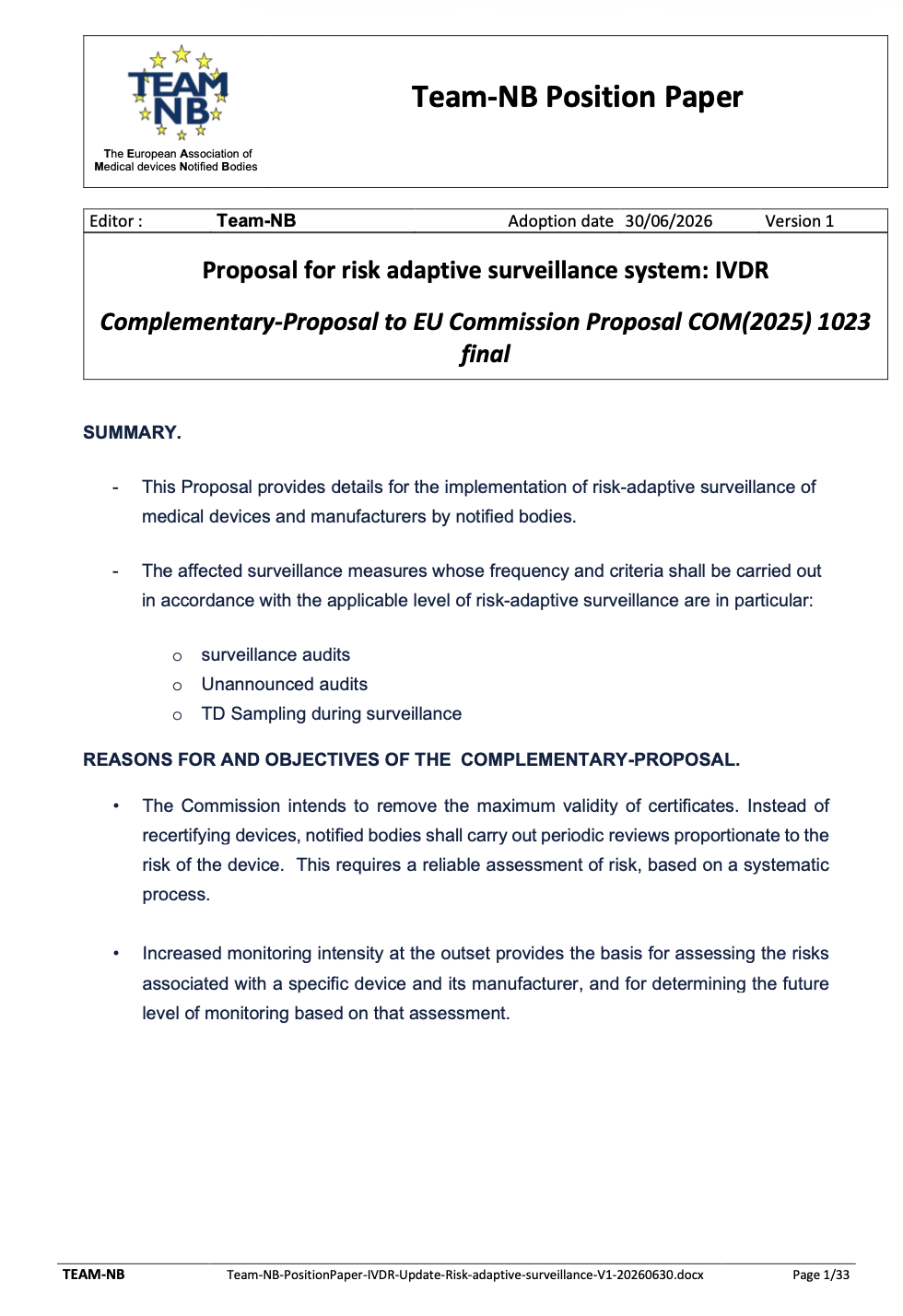
Team-NB, the European Association of Medical Devices Notified Bodies, has published a position paper titled “Proposal for risk adaptive surveillance system: IVDR”, adopted on 30 June 2026.
The document is presented as a complementary proposal to the European Commission Proposal COM(2025) 1023 finaland provides details for the implementation of risk-adaptive surveillance of medical devices and manufacturers by notified bodies under the In Vitro Diagnostic Medical Devices Regulation (EU) 2017/746.
According to Team-NB, the European Commission intends to remove the maximum validity of certificates. Instead of recertifying devices, notified bodies would carry out periodic reviews proportionate to the risk of the device. Team-NB states that this requires a reliable and systematic risk assessment process.
Key Elements of the Proposal
The proposed risk-adaptive surveillance system would affect, in particular:
surveillance audits;
unannounced audits;
technical documentation sampling during surveillance.
Team-NB proposes the introduction of a new Article 48c, establishing the core legal framework and principles for risk-adaptive surveillance during the life cycle of a device.
Under the proposal, the level of surveillance would determine the intensity, frequency and modalities of activities such as surveillance audits, unannounced audits, technical documentation sampling, product sampling, review of post-market surveillance data and for-cause surveillance measures.
Surveillance Levels
The proposal sets out three levels of risk-adaptive surveillance:
initial/enhanced surveillance level;
medium surveillance level;
reduced surveillance level.
Following completion of the initial conformity assessment, the manufacturer, or where appropriate the relevant device group, would be assigned to the initial/enhanced surveillance level.
A reduction in surveillance level would be stepwise and time-based, while re-escalation could occur immediately where a triggering event occurs. The proposal indicates that the surveillance level could be lowered at the earliest three years after initial completion of the conformity assessment procedure.
Triggers for Re-Escalation
The proposal identifies several events and circumstances that notified bodies should consider when determining whether the surveillance level should be reduced or increased.
These include serious incidents, field safety corrective actions, major or recurrent non-conformities, failure to implement corrective and preventive actions, deficiencies in the quality management system, post-market surveillance indicators, delayed or inadequate responses to notified body requests, and credible information from third parties.
The proposal also states that notified bodies should retain the ability to conduct for-cause surveillance measures at any time where justified by specific concerns or evidence.
Impact on IVD Manufacturers
For IVD manufacturers, the proposal could have important implications for how surveillance is planned and conducted after certification.
Manufacturers may need to pay particular attention to:
the quality and completeness of post-market surveillance data;
timely reporting and submission obligations;
the effectiveness of corrective and preventive actions;
responses to notified body requests;
quality management system maturity;
technical documentation readiness;
performance evaluation and clinical performance evidence;
PSUR updates for Class C and Class D devices.
The proposal also includes changes relating to the Periodic Safety Update Report (PSUR). In particular, Class D manufacturers would update the PSUR at least annually, while Class C manufacturers would update the PSUR in the first year after certificate issuance and every two years thereafter, or when there is a significant change in the benefit-risk determination or in the acceptability of erroneous results.
For manufacturers, the proposal highlights the importance of maintaining consistent compliance throughout the device life cycle. A strong compliance and post-market performance history may support a lower surveillance level, while unresolved issues or poor documentation quality may lead to increased scrutiny.