IMDRF Publishes 2026 Document Implementation Report
IMDRF has published its 2026 Document Implementation Report, providing the self-identified implementation status of IMDRF technical documents across member jurisdictions.
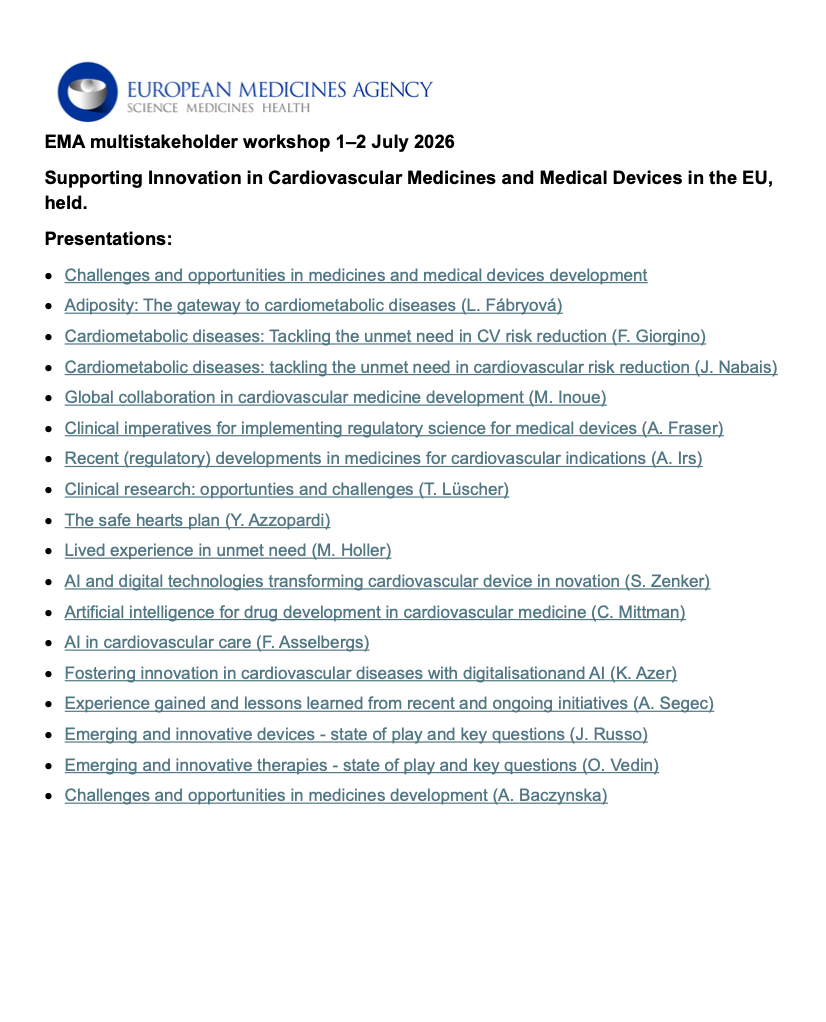
EMA Holds Multistakeholder Workshop on Innovation in Cardiovascular Medicines and Medical Devices
EMA held a multistakeholder workshop on supporting innovation in cardiovascular medicines and medical devices in the EU, covering unmet needs, regulatory science, AI, digital technologies and emerging therapies.
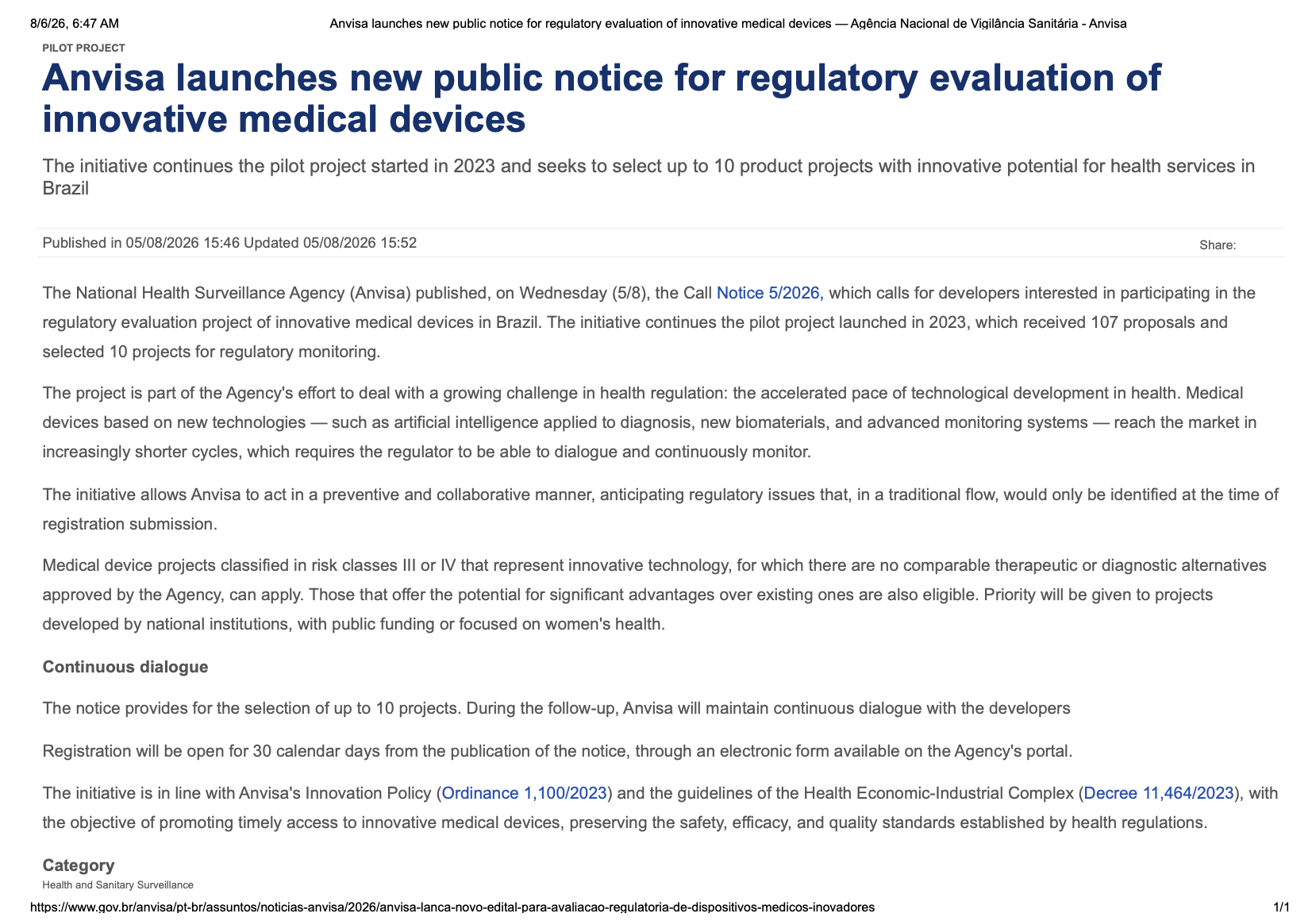
Anvisa Launches New Call for Regulatory Evaluation of Innovative Medical Devices
Anvisa has launched Call Notice 5/2026 to select up to 10 innovative medical device projects for regulatory evaluation and continuous dialogue in Brazil.

TGA Updates Guidance on Selection Criteria for Medical Device Application Audits
The TGA has updated its guidance on how medical device applications are selected for audit before inclusion in the ARTG, including mandatory audits, non-mandatory audit criteria, regulatory reforms, UDI and post-market signals.
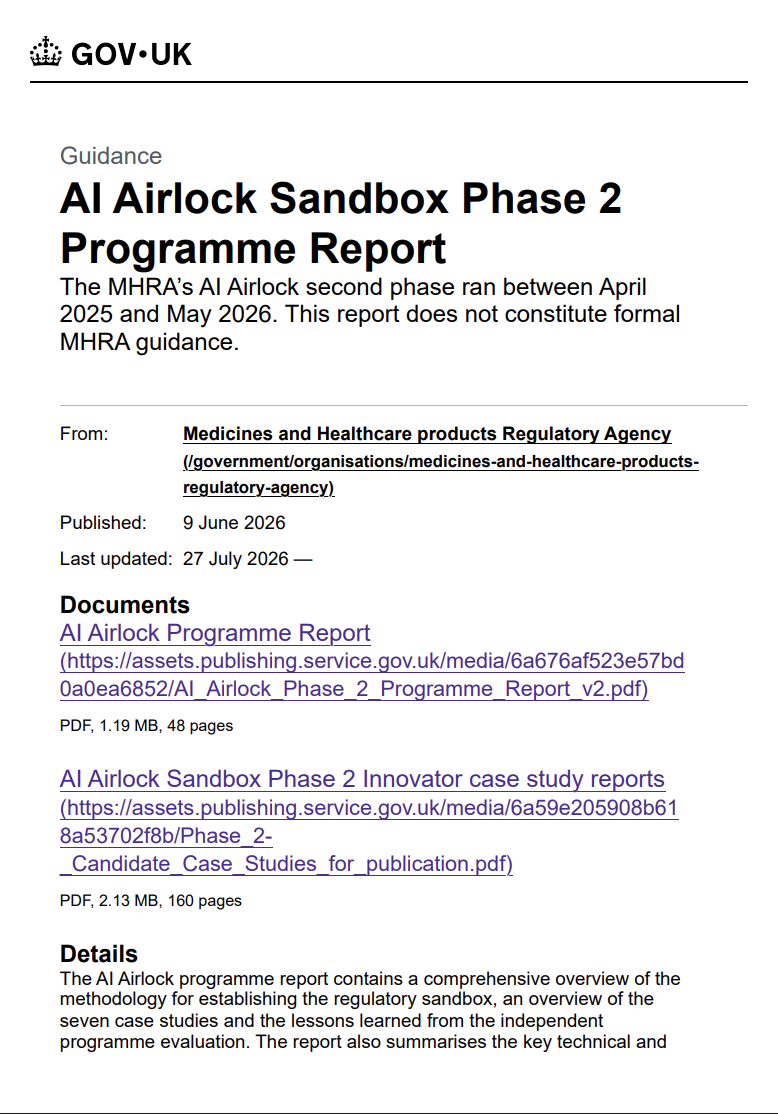
MHRA Releases AI Airlock Sandbox Phase 2 Programme Report
MHRA releases its AI Airlock Sandbox Phase 2 report, detailing regulatory insights on AI validation, PCCPs, generative AI, and real-world PMS.
EU Publishes Regulation (EU) 2026/1744: The Digital Omnibus on Artificial Intelligence
European Union publishes Regulation (EU) 2026/1744 (Digital Omnibus on AI), amending the EU AI Act to streamline compliance, adjust timelines, and relieve SMEs.

NIST Highlights Need for Continuous Security Monitoring of AI Systems
NIST has published a news release on a mathematical proof supporting the transition from a “one and done” AI security model to continuous monitoring and updating.

European Commission Publishes Consolidated Version of the AI Act Incorporating Digital Omnibus Amendments
The European Commission has published an unofficial consolidated version of the AI Act incorporating the Digital Omnibus amendments, providing an updated reference for manufacturers and other stakeholders.

ANVISA Launches Public Consultation to Review the Regulatory Framework for Medical Device Vigilance
ANVISA has launched a public call for contributions to support the revision of Brazil's medical device vigilance regulatory framework, seeking feedback from medical device registration holders on post-market surveillance requirements and future regulatory developments.

European Parliament briefing highlights implementation of the EU Artificial Intelligence Act
A new European Parliament briefing provides an overview of the EU Artificial Intelligence Act, including its risk-based framework, implementation timeline, and key provisions relevant to AI systems, including those used in medical devices.

FDA Classifies Radiological Machine Learning-Based Quantitative Imaging Software with Predetermined Change Control Plans as Class II Devices
The FDA has classified radiological machine learning-based quantitative imaging software with predetermined change control plans as Class II medical devices, establishing special controls to support the safe development and regulatory oversight of AI-enabled imaging software.
MHRA Publishes AI Airlock Phase 2 Report on Regulatory Challenges for AI Medical Devices
The MHRA has published the Phase 2 report of its AI Airlock programme, highlighting regulatory challenges related to AI medical devices, AI-powered IVDs, performance evaluation, post-market surveillance and lifecycle change management.
European Commission Publishes Third Version of Living Guidelines on the Responsible Use of Generative AI in Research
The European Commission has released Version 3 of its Living Guidelines on the Responsible Use of Generative AI in Research. Learn what the new recommendations mean for medical device manufacturers, clinical evaluation, data protection and research activities.
EU Reaches Provisional Agreement to Simplify AI Act Implementation
The EU Council and Parliament reached a provisional agreement to simplify the AI Act, including delayed deadlines for high-risk AI systems and clarifications for manufacturers.
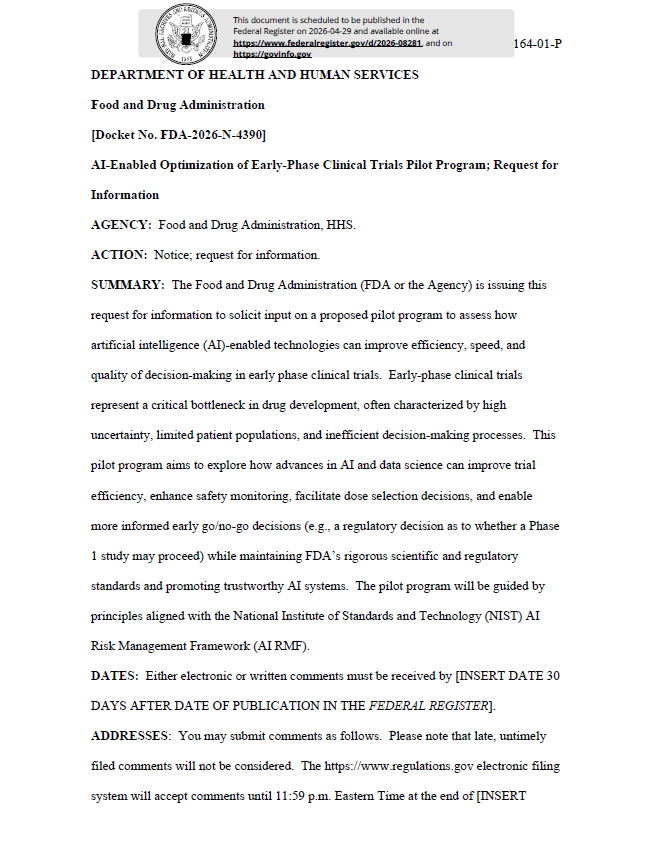
FDA launches consultation on AI use in early-phase clinical trials
FDA opens consultation on a pilot program to assess artificial intelligence in early-phase clinical trials, focusing on efficiency, safety, and decision-making.
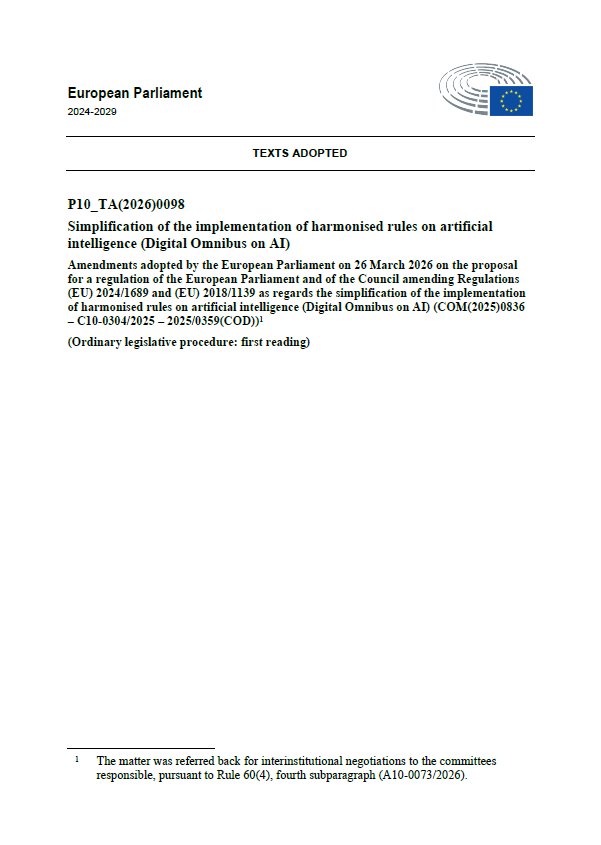
European Parliament Adopts Amendments to Simplify AI Act Implementation (“Digital Omnibus on AI”)
EU Parliament adopts AI Act simplification package. Key changes impact high-risk AI timelines, MDR alignment, and compliance requirements.

MHRA launches "AI Airlock": new regulatory sandbox for medical devices based on Artificial Intelligence
The AI Airlock initiative, launched by the MHRA, is an innovative regulatory sandbox designed to support the development and evaluation of Artificial Intelligence medical devices (AIaMD). This controlled regulatory environment allows manufacturers of AI-based medical technology to test compliance approaches, clinical evidence and algorithmic validation prior to formal submission. With a focus on adaptive machine learning models, algorithmic security and continuous monitoring, AI Airlock represents a strategic opportunity to accelerate market access with UKCA compliance.

MDCG 2019-11 Rev.1 - New guidance on qualification and classification of software as a medical device or in vitro diagnostic medical device
The new revised version of the MDCG 2019-11 (Rev.1) clarifies the qualification and classification of software as a medical device (MDSW ) and in vitro diagnostic software (IVD), in the context of the MDR and IVDR. The document covers classification rules, integration with AI Act and EHDS, and includes practical and up-to-date examples. Smart MDR supports MDSW manufacturers in managing compliance and technical documentation.

MDCG publishes guide on the joint application of the MDR, IVDR and AI Act: what manufacturers should know
The new MDCG 2025-6 guide, published in June 2025, clarifies the joint application of the AI Act and the European MDR/IVDR regulations for medical devices and IVDs with artificial intelligence systems. The document addresses classification, risk management, life cycle, technical documentation and post-market monitoring. Smart MDR supports manufacturers in integrating these requirements into their quality management system and preparing for audits.

Is your organization prepared for the AI literacy requirements under the EU AI Act?
The European Union's AI Act establishes new legal obligations for all organizations that develop or use artificial intelligence systems. Article 4 of the AI Act, applicable since February 2, 2025, requires companies to ensure an adequate level of AI literacy among their employees and service providers.