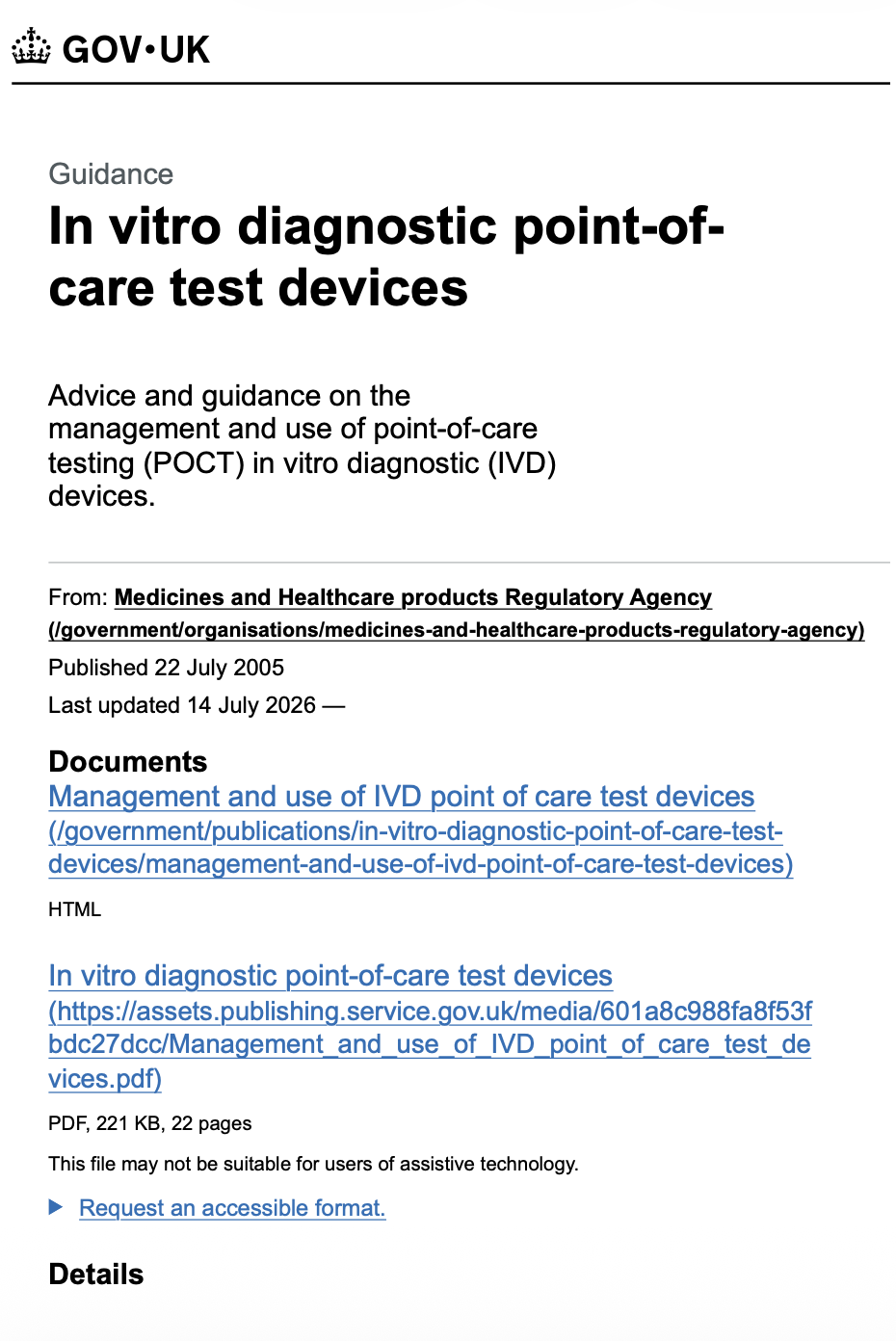
The Medicines and Healthcare products Regulatory Agency (MHRA) has updated its guidance “In vitro diagnostic point-of-care test devices”, last updated on 14 July 2026.
The guidance provides advice on the management and use of point-of-care testing (POCT) in vitro diagnostic devices.
Scope of the Guidance
The MHRA guidance is intended for people involved in the management and use of POCT services in primary and secondary care.
According to the document, this includes:
managerial staff;
scientific staff;
technical staff;
clinical staff;
nursing staff.
Although many of the issues are relevant to POCT in a hospital environment, the MHRA states that the principles also apply to other settings, including outpatient clinics, community care, GP practices, community providers and primary care settings.
Relevance of POCT Management
Point-of-care testing can support testing closer to the patient and may be used across several healthcare environments.
The updated MHRA page reinforces the importance of appropriate management, oversight and use of IVD point-of-care test devices across different care settings.
Impact on IVD Manufacturers
For IVD manufacturers supplying point-of-care test devices in the UK, the updated guidance is relevant because it highlights the environments and user groups involved in POCT services.
Manufacturers should pay particular attention to:
intended users and use environments;
instructions for use suitable for clinical and non-laboratory settings;
training and support needs for POCT users;
device performance in primary, secondary and community care settings;
usability and risk management considerations;
post-market feedback from varied healthcare environments;
alignment with UK requirements for IVD devices.
For manufacturers, the guidance reinforces the importance of designing, documenting and supporting POCT devices with the practical realities of use across hospital, community and primary care environments in mind.