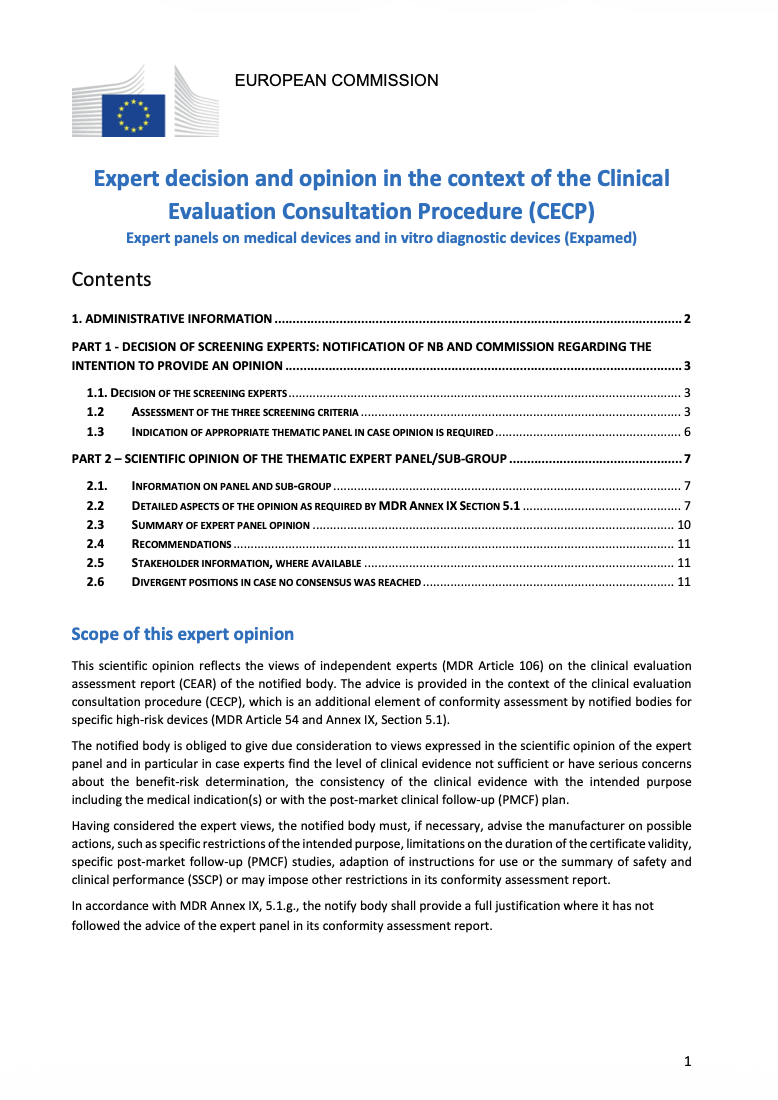
The European Commission’s expert panels on medical devices and in vitro diagnostic devices have published an expert decision and scientific opinion under the Clinical Evaluation Consultation Procedure (CECP).
The opinion concerns a Class III implantable dual-chamber leadless pacemaker intended to provide bradycardia pacing as a pulse generator with built-in battery and electrodes for implantation in the right ventricle and right atrium.
The CECP dossier was received on 19 January 2024, and the scientific opinion was issued on 28 March 2024 by the Circulatory System expert panel.
Context of the CECP Opinion
The CECP is an additional element of conformity assessment under the Medical Device Regulation (EU) 2017/745, applicable to certain high-risk medical devices.
The document explains that the scientific opinion reflects the views of independent experts on the notified body’s Clinical Evaluation Assessment Report.
The notified body must give due consideration to the views expressed by the expert panel. Where the notified body does not follow the expert panel’s advice, it must provide a full justification in its conformity assessment report.
Screening Decision
The screening experts decided to provide a scientific opinion.
The decision was based on the novelty of the device, which is described as a multi-chamber leadless pacer system new to the European market.
The document highlights that parts of the system, including atrial leadless pacemaker stimulation, are highly innovative. It is also described as the first leadless pacemaker designed to be implanted for sensing and pacing in the right atrium, with no similar comparable devices.
Expert Panel Assessment
The expert panel confirmed that the notified body’s assessment was thorough and sufficiently detailed.
The panel considered that the notified body and the manufacturer had adequately evaluated the qualitative and quantitative aspects of clinical safety.
The opinion also states that the clinical evidence submitted by the manufacturer matched the intended purpose and medical indications claimed for the device.
Key Safety and Performance Considerations
The expert panel identified several areas requiring attention.
The document discusses potential risks linked to the novelty of the system, including:
cardiac wall perforation;
cardiac tamponade;
vascular access complications;
cardiac arrhythmia;
atrial leadless pacemaker dislodgement;
threshold elevation of the right atrial leadless pacemaker.
The panel also noted potential benefits, including the possibility of expanding the patient groups that may benefit from a leadless dual-chamber pacemaker compared with a leadless single-chamber pacemaker.
PMCF and PMS Considerations
The expert panel agreed that the clinical evidence was consistent with the post-market clinical follow-up plan.
However, the panel noted that clinical outcomes beyond 12 months of follow-up were still unknown and should be assessed using long-term clinical data from the planned real-world evidence study.
The expert panel recommended special consideration in the context of post-market surveillance, particularly for serious adverse device effects involving atrial fibrillation, dislodgement and threshold elevation of the right atrial leadless pacemaker.
Impact on Medical Device Manufacturers
For manufacturers of high-risk and implantable medical devices, this CECP opinion reinforces the importance of robust clinical evaluation and post-market planning under the MDR.
Manufacturers should pay particular attention to:
clinical evidence for novel technologies;
justification of benefit-risk determinations;
consistency between clinical evidence, intended purpose and indications;
PMCF planning for long-term outcomes;
PMS monitoring of device-specific risks;
comparison with state-of-the-art and relevant alternatives;
notified body interaction during conformity assessment;
expert panel recommendations and their potential impact on certification.
For manufacturers developing innovative Class III implantable devices, the opinion highlights the importance of anticipating additional scrutiny where device novelty, limited comparability and residual clinical uncertainties are present.