MDCG Updates Guidance on Standardisation for Medical Devices
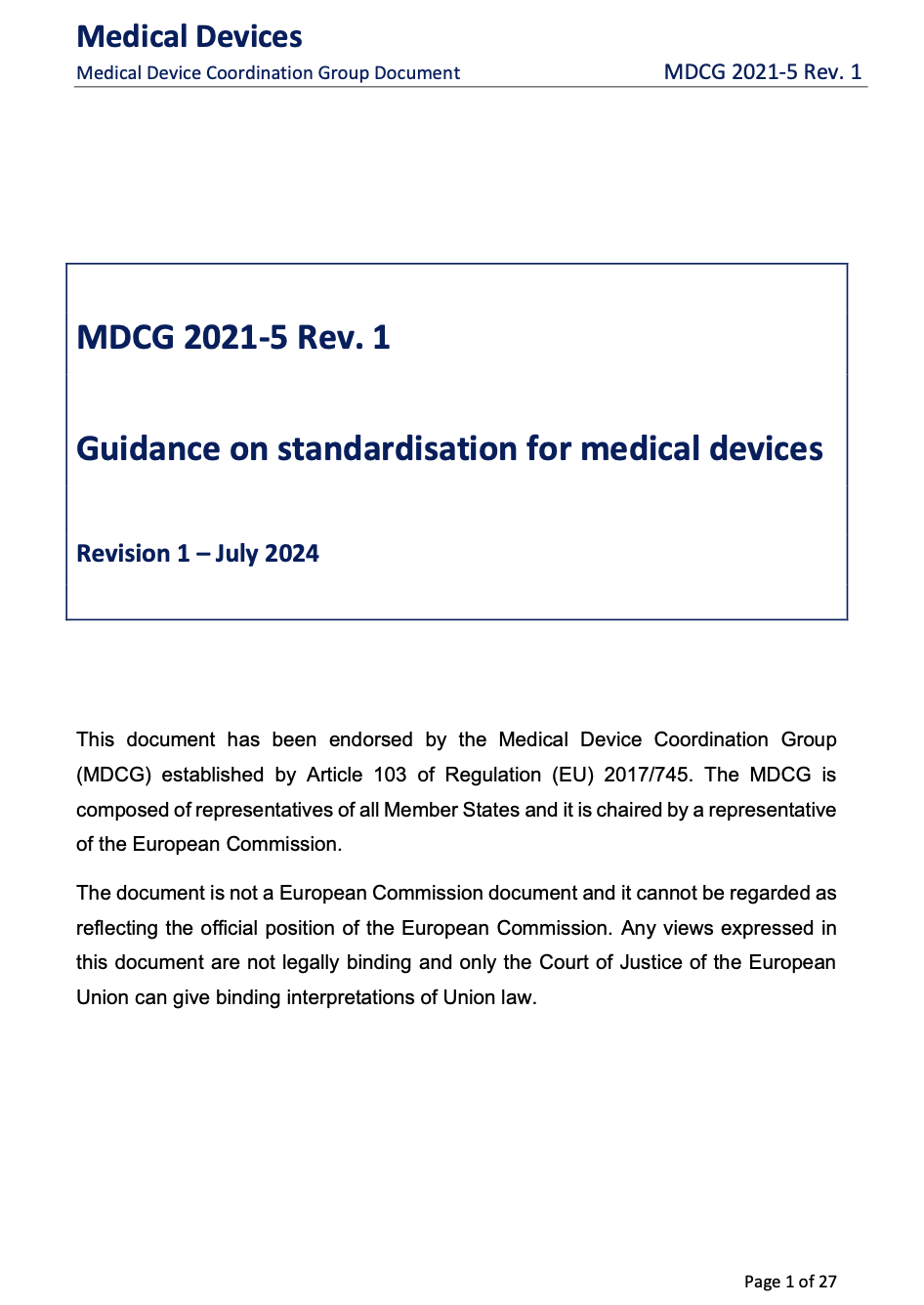
The Medical Device Coordination Group (MDCG) has published MDCG 2021-5 Rev. 1, titled “Guidance on standardisation for medical devices”.
Revision 1, dated July 2024, provides updated guidance on different aspects of standards in the medical device sector, in support of requirements under the applicable EU legislation.
The guidance applies in the context of Regulation (EU) 2017/745 on medical devices (MDR) and Regulation (EU) 2017/746 on in vitro diagnostic medical devices (IVDR).
Main Changes in Revision 1
The revised guidance includes several updates, including:
removal of references to the previous Directives and integration of references to the Regulations;
updated footnotes and links;
additional references to communications, guidelines and task force work;
new considerations on EN ISO 15189 and ISO 14155:2011;
references to the MDR/IVDR standardisation request and its amendments;
updates on HAS consultants;
additional considerations on information and clarification by CEN, CENELEC and their Technical Committees;
updates on IMDRF;
updated discussion on the concept of “state of the art”;
new sections on Court of Justice of the European Union rulings, European Pharmacopoeia and common specifications.
Harmonised Standards and Presumption of Conformity
The guidance explains that harmonised European standards play an important role in the EU medical device regulatory framework.
Products designed and manufactured according to applicable harmonised European standards, whose references are published in the Official Journal of the European Union (OJEU), benefit from a presumption of conformity with the relevant legal requirements.
However, the MDCG reiterates that, as a general principle, the use of standards remains voluntary.
Manufacturers may choose to apply harmonised standards, non-harmonised standards, international or national standards, or develop their own technical solutions, provided they can demonstrate compliance with applicable legal requirements.
Annex Z and Legal Clarity
The guidance highlights the role of Annex Z in harmonised European standards.
Annex Z explains the relationship between the clauses of a harmonised standard and the legal requirements that the standard aims to cover.
According to the guidance, without an adequate Annex Z, a harmonised standard lacks the necessary legal clarity and cannot be referenced in the OJEU. As a result, its voluntary use cannot confer presumption of conformity.
State of the Art
Revision 1 includes updated considerations on the concept of “state of the art”.
The guidance explains that EU medical device legislation requires manufacturers to take into account the generally acknowledged state of the art. However, “taking into account” is different from “compliance”.
The MDCG notes that the most recent versions of standards are commonly considered to reflect the state of the art. However, compliance with the latest version of a standard that has not been published in the OJEU does not automatically imply compliance with EU legal requirements.
Common Specifications and Other References
The guidance also addresses common specifications, which are defined under the MDR and IVDR as technical and/or clinical requirements, other than standards, that provide a means of complying with legal obligations applicable to a device, process or system.
Revision 1 also adds content on the European Pharmacopoeia and rulings of the Court of Justice of the European Union relevant to standardisation.
Impact on Medical Device and IVD Manufacturers
For medical device and IVD manufacturers, the revised MDCG guidance reinforces the importance of understanding how standards support regulatory compliance under the MDR and IVDR.
Manufacturers should pay particular attention to:
identifying applicable harmonised standards;
checking whether references are published in the OJEU;
understanding the scope of presumption of conformity;
reviewing Annex Z carefully;
distinguishing between voluntary use of standards and legal requirements;
documenting alternative technical solutions where standards are not applied;
assessing the state of the art;
considering common specifications where applicable;
ensuring technical documentation reflects the chosen compliance strategy.
For manufacturers, the guidance is especially relevant when preparing technical documentation, performing conformity assessment, interacting with notified bodies and maintaining compliance with evolving standards and regulatory expectations.