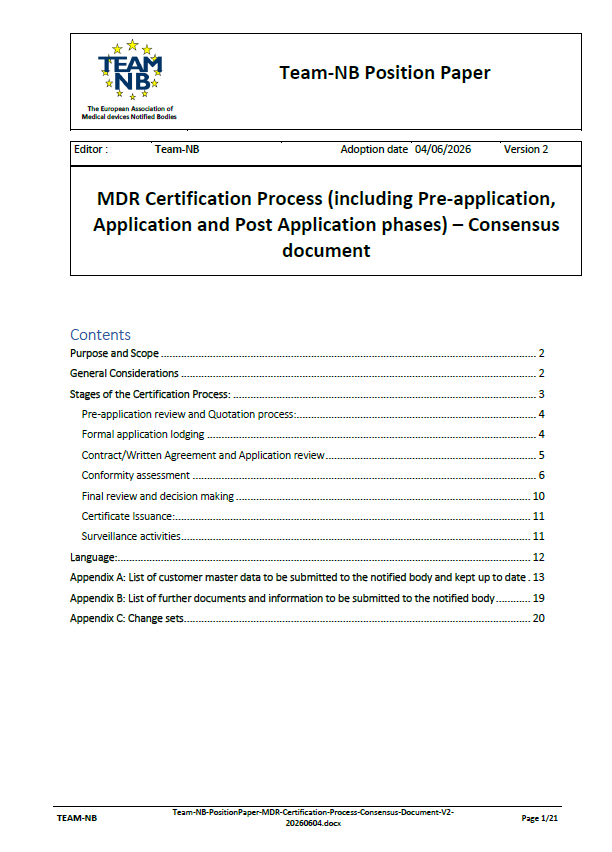
Team-NB, the European Association of Medical Devices Notified Bodies, has published Version 2 of its consensus document describing the MDR certification process, including pre-application, application and post-application phases under Regulation (EU) 2017/745 (MDR). The document was adopted on 4 June 2026 and aims to provide a detailed description of the certification pathway used by Notified Bodies when assessing medical devices under the MDR.
According to Team-NB, the document was developed through a review of the application processes and associated documentation used by individual Team-NB members, with the objective of harmonising these processes where possible. The guidance applies both to legacy devices transitioning to MDR under Article 120 and to devices that have not previously been certified under the Medical Devices Directives.
The document is aligned with the requirements of MDR Annex VII, Sections 4.2 and 4.3, which establish the requirements applicable to pre-application and application activities performed by Notified Bodies. It does not cover applications for Article 16 certificates, Article 117 Notified Body opinions, recertification activities under Annex VII Section 4.11, or conformity assessments performed under Annex X together with Annex XI Part B.
Harmonised Description of the Certification Process
The consensus document describes the complete certification pathway, dividing it into a number of distinct stages:
Initial contact and pre-application submission;
Pre-application review and quotation process;
Formal application lodging;
Contract or written agreement and application review;
Conformity assessment;
Final review and decision making;
Certificate issuance; and
Surveillance activities.
Team-NB notes that the European Commission study supporting the monitoring of medical device availability on the EU market found that, for the majority of MDR applications, the period from application submission to conclusion of the written agreement takes between one and three months. The document states that providing greater clarity on application requirements is intended to establish a common understanding and minimise incomplete submissions received by Notified Bodies.
Pre-Application and Quotation Activities
The document explains that MDR requires Notified Bodies to perform a preliminary review before issuing quotations for conformity assessment services. During this phase, manufacturers or their authorised representatives are expected to provide information enabling the Notified Body to verify that the products fall within the scope of the MDR and that the proposed classification is appropriate.
Based on the information submitted regarding the manufacturer, manufacturing sites, suppliers, subcontractors and devices, the Notified Body may prepare a quotation for conformity assessment services. Additional information or clarification requests may be issued where necessary to support quotation preparation.
Formal Application Requirements
For manufacturers proceeding with certification, the document describes the minimum information expected during formal application.
This includes documentation required for assessment of the quality management system under Annex IX Section 2.1 or Annex XI Part A Section 6.1. For Class III devices and Class IIb devices requiring product certification, manufacturers are also expected to submit documentation in accordance with Annex IX Chapter II Section 4.2.
The document states that Notified Bodies require information relating to intended purpose, qualification as a medical device and device classification, including justification where these elements are not self-evident. Applications should be accompanied by a formal application letter or form signed by an authorised representative of the manufacturer or authorised representative.
For legacy devices transitioning to MDR, Team-NB notes that full technical documentation does not necessarily need to be submitted at the application stage. Instead, sufficient information should be provided to allow verification of device qualification, classification and conformity assessment route, together with a plan for submission of technical documentation.
Application Review and Acceptance
The document describes the elements that Notified Bodies are expected to review once a formal application has been submitted.
These include:
Completeness of the application;
Qualification of the products covered by the application;
Suitability of the selected conformity assessment procedure;
Availability of the required Notified Body designation;
Availability of sufficient resources to perform the assessment.
Following this review, the Notified Body may either accept or refuse the application. The document states that refusals and manufacturer withdrawals are notified through EUDAMED.
Conformity Assessment Activities
The consensus document provides a detailed overview of conformity assessment activities performed after application acceptance.
For Class IIa, Class IIb and Class III devices, assessments typically include:
Quality management system audits;
Technical documentation assessments;
Clinical evaluation assessments;
Device testing where required by the selected conformity assessment route.
The document also explains how technical documentation reviews are performed under MDR.
Technical documentation is assessed systematically for Class III devices and Class IIb implantable devices, with the exception of certain well-established technologies identified in Article 52(4). For Class IIa devices, Class IIb non-implantable devices and Class IIb well-established technologies, sampling approaches are applied in accordance with MDCG 2019-13.
Team-NB further states that Notified Bodies are required to consider applicable Common Specifications, MDCG guidance documents, best-practice documents and harmonised standards during assessments, even where manufacturers do not claim conformity with those documents.
Additional Procedures for Certain Device Types
The document summarises several additional procedures that may apply depending on device characteristics.
These include:
Clinical Evaluation Consultation Procedure (CECP) for certain Class III implantable devices and Class IIb active devices intended to administer or remove medicinal substances;
Consultation procedures involving the European Medicines Agency (EMA) or national competent authorities for devices incorporating medicinal substances;
Consultations with human tissue and cell competent authorities for devices incorporating non-viable human derivatives;
Consultation procedures under Regulation (EU) No 722/2012 for devices incorporating specified animal tissues or derivatives;
Consultation procedures for Rule 21 devices composed of, or containing, substances absorbed or locally dispersed in the human body.
New Detail on Data and Documentation Expectations
A significant portion of the document is dedicated to the information expected from manufacturers during pre-application and application phases.
Appendix A introduces a detailed list of customer master data that should be submitted to the Notified Body and maintained throughout the certification lifecycle. This includes information relating to:
Legal manufacturers;
Authorised representatives;
Critical suppliers and subcontractors;
Devices;
Sterilisation processes.
The appendix also identifies numerous data elements linked to EUDAMED fields, including SRNs, Basic UDI-DIs, EMDN codes, classification information and device identification data.
Appendix B provides a separate list of additional documents and information expected during the certification process, including quality management system documentation, evidence of business registration, previous application history and requested conformity assessment routes.
Introduction of Change Sets
The document also includes a dedicated appendix describing the concept of “change sets”.
According to Team-NB, information submitted to Notified Bodies should not change independently but should be managed through documented change sets initiated either by the manufacturer or by the Notified Body. The appendix describes the minimum information expected within a change set, including identification, contact details, status and supporting information related to the proposed change.
The document further states that manufacturers and Notified Bodies should be capable of managing overlapping change sets and merging them once approved or completed.
Surveillance Activities After Certification
The final section describes activities that take place after certificate issuance.
According to Team-NB, surveillance programmes may include:
Annual quality management system audits;
Assessment of Periodic Safety Update Reports (PSURs);
Validation of Summary of Safety and Clinical Performance (SSCP) documents;
Technical documentation sampling activities;
Assessment of vigilance data;
Unannounced audits.
The document states that unannounced audits are conducted at least once every five years and may take place at manufacturer sites or at supplier and subcontractor facilities. Manufacturers are also required to notify Notified Bodies of substantial changes affecting devices or quality management systems, which may trigger additional conformity assessment activities.
The Team-NB consensus document is intended to provide a harmonised description of MDR certification activities and the information expected from manufacturers throughout the certification lifecycle, from pre-application through post-certification surveillance.
Read the full document below.