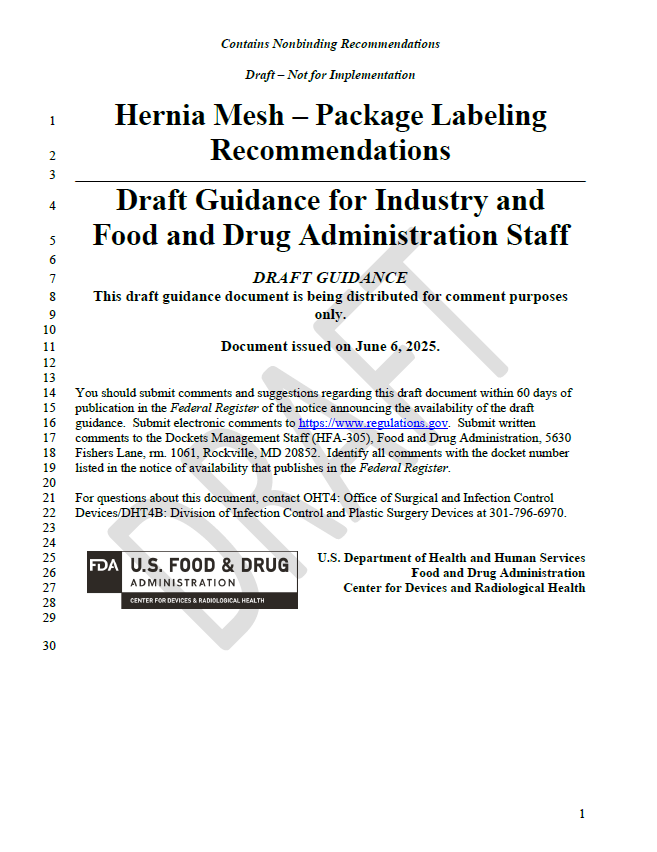
FDA publishes labeling recommendations for hernia mesh: focus on safety and proper device selection
The FDA has issued a draft guidance with recommendations for the labeling of surgical meshes used in hernia repairs, following growing concerns about adverse events associated with the poor selection of these devices. Since 2019, the Agency has received more than 86,000 reports of adverse events related to these meshes, including cases of recurrences, infections, chronic pain and adhesions.
Purpose of the document
The proposal aims to improve the quality of the labelling on the packaging of these devices, providing more complete and standardized information to help healthcare professionals select the appropriate surgical mesh depending on the type of hernia, anatomical location and surgical technique.
Content recommendation for labeling
The FDA recommends that labels include, where applicable:
Composition of the net: type of material, presence of biological components, antimicrobial additives;
Physical characteristics: dimensions, thickness, density, type of fiber, pore size;
Mechanical properties: tensile and breaking strength, absorption time (for absorbable meshes);
Instructions for use: recommended anatomical location, ideal method of attachment, removal guidelines.
Scope of guidance
This draft guideline applies exclusively to surgical meshes for hernia repair, excluding products with other indications such as orthopaedics, gynaecology, aesthetics or urology.
Non-binding nature and implementation
Although this guidance is not legally binding, the FDA strongly encourages manufacturers to proactively adopt these recommendations, including in current labeling and future regulatory submissions. The aim is to increase transparency, traceability and patient safety by promoting more consistent practices in the sector.
Be Smart. Be Compliant.