FDA publishes draft guidance on the transfer of 510(k) clearances: clarifications on obligations, registration and labeling
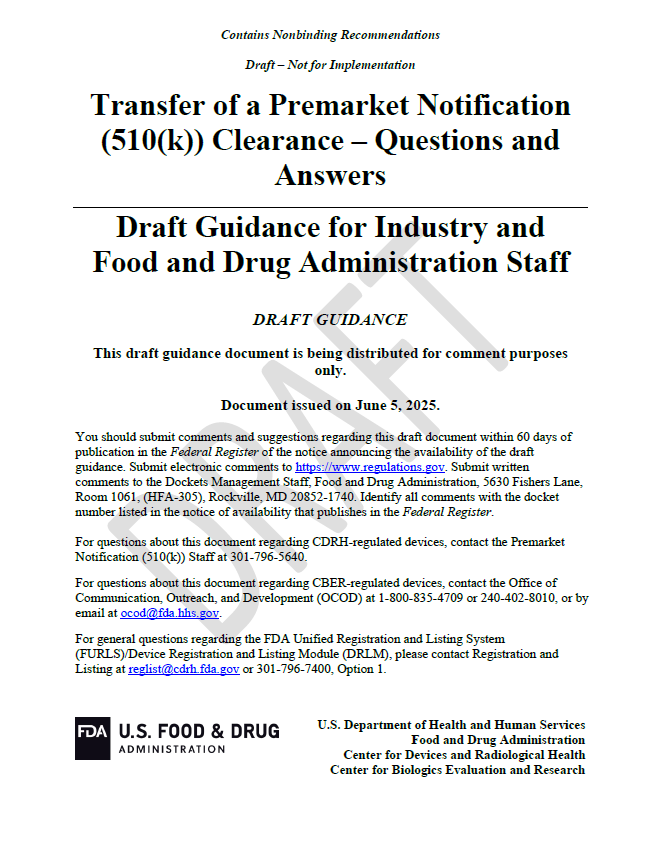
On June 5, 2025, the Food and Drug Administration (FDA) published a draft guidance entitled "Transfer of a Premarket Notification (510(k)) Clearance - Questions and Answers", with the aim of clarifying frequently asked questions related to the transfer or sale of 510(k) clearances between companies. This proposal applies to situations where a new 510(k) submission is not required, but where correct regulatory management remains mandatory.
What is a 510(k) clearance?
A 510(k) clearance is the process by which the FDA recognizes that a medical device is substantially equivalent to another legally marketed device, thus allowing it to enter the US market. In many cases, this clearance becomes a strategic asset for companies wishing to market, transfer or acquire approved devices.
When is a new 510(k) not needed?
Under the proposed guidance, a new 510(k) is not required when:
The device remains without significant modifications to its characteristics, performance or intended use;
The transfer concerns only the ownership of the authorization (for example, after an acquisition, merger or commercial assignment);
The new owner assumes full responsibility for the device and for compliance with the applicable regulatory requirements.
Main obligations of the new owner
Even without the need for a new submission, the transfer of a 510(k) authorization requires strict compliance with a number of formal obligations:
Registration in the FDA's FURLS/DRLM system: the new holder must register within 30 days of starting the regulated activity;
Device Listing update: the original 510(k) number must be correctly associated with the new holder;
Updated labeling: all device materials must reflect the new manufacturer, including UDI (Unique Device Identification) data, where applicable;
Document management: the new holder must keep all technical documents, compliance records and evidence of equivalence;
Exclusivity of ownership: only one entity can be considered the holder of an active 510(k) authorization at any given time.
Risks of non-compliance
The guidance highlights that failures to update the register, list the device or label it can lead to the product being considered adulterated or improperly labeled, with serious legal and commercial consequences.
In addition, certain entities such as sterilizers, reconditioners and contract repackagers must use the existing 510(k) number, but are not considered holders.
Final considerations
Although non-binding, this draft guidance represents the FDA's current understanding of the responsible management of 510(k) clearances. The clarification of the rules is intended to ensure transparency, traceability and protection of public health, even in contexts of corporate change or portfolio reorganization.
If you are planning to acquire a 510(k) cleared device or reorganize the ownership of your submissions, please contact us.
Be Smart. Be Compliant.