2026 MDSAP Forum Outcome Statement Highlights Global Expansion and EU Alignment
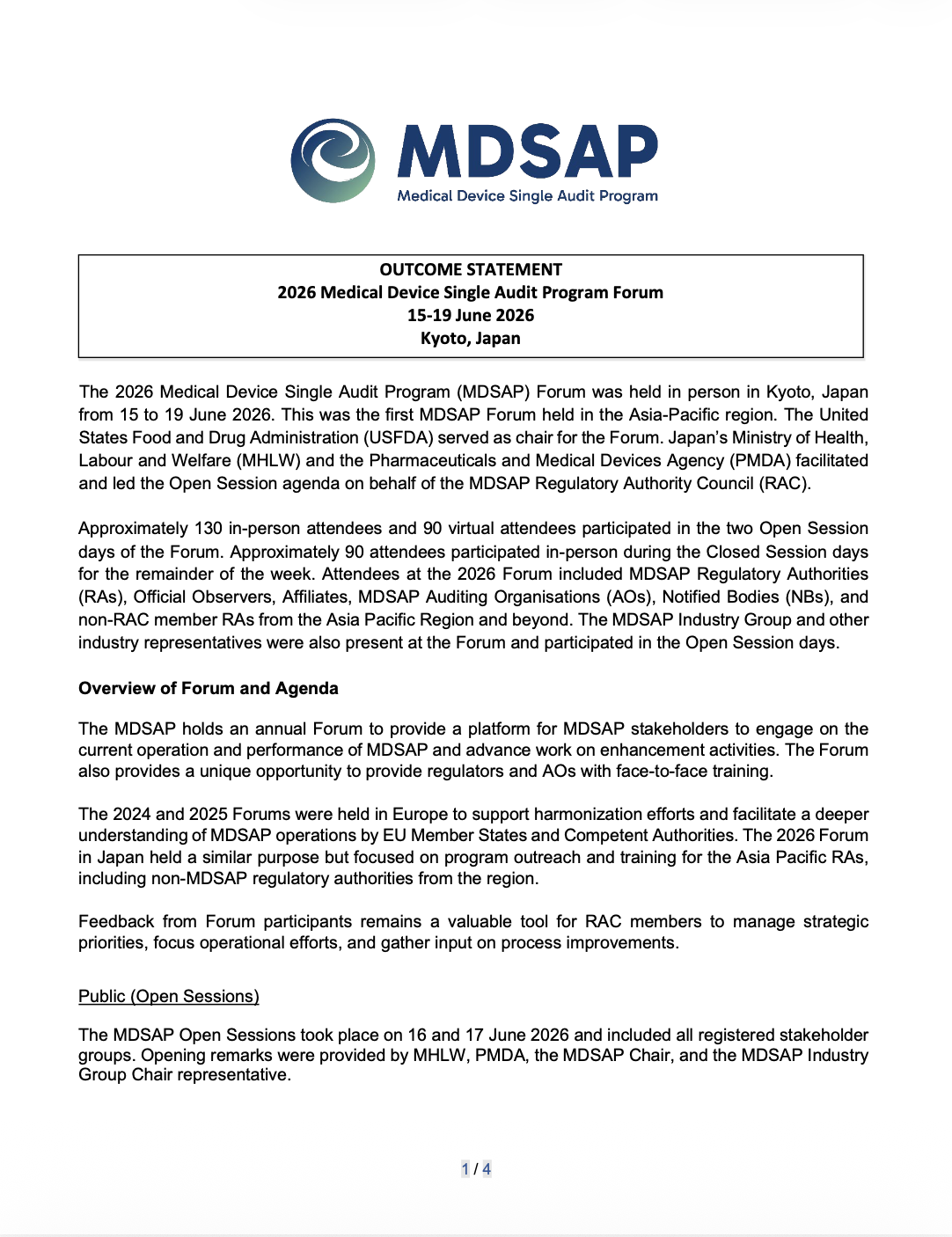
The Regulatory Authority Council (RAC) of the Medical Device Single Audit Program (MDSAP) has published its official Outcome Statement summarizing key outcomes, performance metrics, and strategic initiatives from the 2026 MDSAP Forum.
Hosted in Kyoto, Japan, from 15 to 19 June 2026, the event marked the first MDSAP Forum held in the Asia-Pacific region. Chaired by the U.S. Food and Drug Administration (FDA) with local support from Japan's Ministry of Health, Labour and Welfare (MHLW) and the Pharmaceuticals and Medical Devices Agency (PMDA), the forum convened approximately 220 international stakeholders in person and online.
Global Program Performance and Strategic Priorities
During the Open Sessions, the RAC presented data from the newly released 2025 MDSAP Annual Report, demonstrating continued growth and operational maturation across participating jurisdictions:
Audit Volume: A total of 5,657 MDSAP audits were conducted in 2025.
Global Footprint: Over 7,600 medical device manufacturers across 84 jurisdictions now participate in the program.
Submission Timeliness: 55% of audit reports were submitted to regulatory authorities within 90 days, with 79% submitted within 120 days.
The RAC reaffirmed its five core strategic focus areas: expanding auditing capacity, improving report submission timelines, accelerating issue escalation and resolution, enhancing audit report quality, and broadening global stakeholder engagement.
Key Program Initiatives: MDO Pilot and EU MDR Mapping
The forum featured progress updates on major ongoing technical initiatives aimed at optimizing audit efficiency and cross-regional recognition:
Medical Device Organization (MDO) Pilot: Brazil's ANVISA presented preliminary observations from the initial 10 months of the MDO Pilot Project (August 2025 – May 2026). Feedback gathered from Auditing Organizations (AOs) will directly shape the RAC's future decisions regarding multi-site and shared QMS audit structures.
MDSAP–EU MDR/IVDR Alignment: Representatives from EU Member States and the Notified Body Coordination Group provided updates across five active work items: witnessed audits, regulatory mapping, development of a single MDSAP–MDR–IVDR audit report, audit approach alignment, and AO assessment frameworks.
Asia-Pacific Regulatory Integration and Combined Audits
Reflecting the forum's focus on Asia-Pacific regulatory outreach, non-MDSAP regulatory authorities from across the region participated alongside affiliate members and official observers.
A key highlight was presented by South Korea's Ministry of Food and Drug Safety (MFDS), detailing its practical experience integrating MDSAP and Korean Good Manufacturing Practice (KGMP) audits. The combined audit pathway aligns audit cycles and extends report submission deadlines to 45 days, requiring approximately two additional auditor days to cover specific KGMP requirements.
Furthermore, regulatory updates were delivered by regional authorities including Egypt's EDA, India's CDSCO, Indonesia's MoH, Thailand's FDA, Vietnam's VIMDA, and the Southeast Asia Regulatory Network (SEARN), alongside affiliate updates from ANMAT (Argentina), COFEPRIS (Mexico), SAHPRA (South Africa), and TFDA (Taiwan).
Structured Industry Engagement and Practical Case Workshops
The 2026 Forum formally introduced the newly established MDSAP Industry Group (IG), designed to provide structured industry feedback directly to the RAC. For the 2026–2027 term, the U.S. trade association AdvaMed serves as Chair, with Brazil's ABIMED serving as Vice Chair. Medical device manufacturer Becton Dickinson (BD) also shared insights on implementing MDSAP across multi-site global manufacturing networks.
Closed-door sessions for regulators and Auditing Organizations focused on technical capability building, including:
Comprehensive MDSAP overview training led by Australia's Therapeutic Goods Administration (TGA);
Interactive case workshops focused on drafting consistent, high-quality nonconformity statements;
Clarifying regulatory expectations for post-market corrective action plans.
Impact on Medical Device Manufacturers
For quality managers, regulatory directors, and medical device executives utilizing or considering MDSAP, the 2026 Outcome Statement signals ongoing program stabilization alongside expanding global utility.
Manufacturers should focus on:
Monitoring outcomes from the MDO Pilot for potential efficiencies in multi-site quality system audits;
Tracking progress on the joint MDSAP–EU MDR/IVDR mapping work to anticipate future single-report audit models;
Evaluating combined audit opportunities in emerging markets, such as South Korea's integrated MDSAP/KGMP pathway;
Ensuring internal audit readiness aligns with stricter regulatory standards for nonconformity language and CAPA resolution;
Engaging with regional industry representatives via the newly formed MDSAP Industry Group.
By staying aligned with MDSAP's evolving global framework, manufacturers can leverage single-audit efficiencies to streamline regulatory access across key international markets.