Notified Bodies highlight opportunities for digitalisation and innovation, but warn about reduced scrutiny and potential unintended consequences for EU manufacturers.
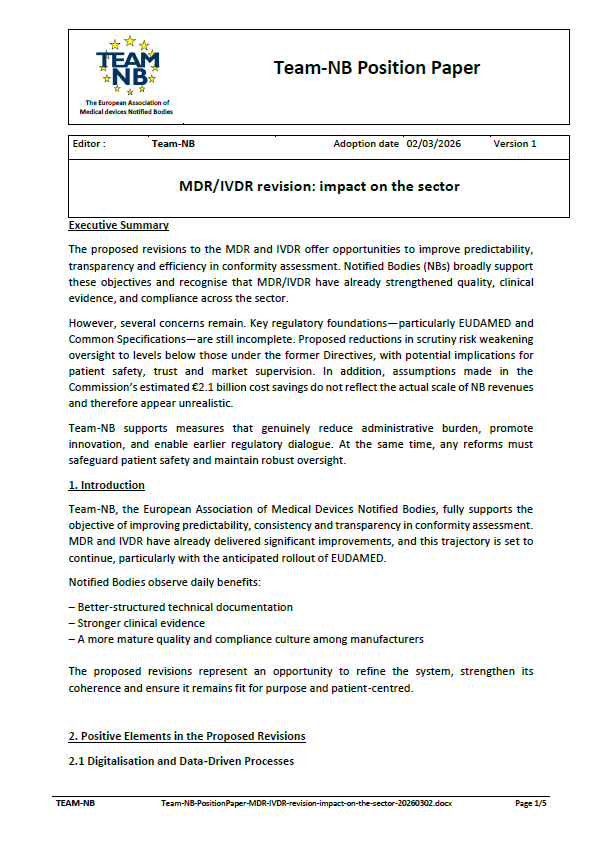
The European Association of Medical Devices Notified Bodies (Team-NB) has published a position paper analysing the European Commission’s proposed targeted revision of the Medical Devices Regulation (MDR) and In Vitro Diagnostic Regulation (IVDR). The paper identifies several positive developments aimed at improving efficiency in the regulatory system but also raises concerns regarding regulatory oversight and market impact.
Digitalisation and regulatory dialogue welcomed
Team-NB supports initiatives designed to improve predictability, transparency and efficiency in conformity assessment.
Among the positive elements highlighted are measures to advance digital and data-driven regulatory processes, including electronic technical documentation, digital certificates, electronic labelling and declarations of conformity. Combined with the progressive rollout of EUDAMED and the use of remote audit tools, these initiatives could reduce administrative burden and improve transparency.
The organisation also welcomes efforts to strengthen early regulatory dialogue between manufacturers, notified bodies, expert panels and the Medical Device Coordination Group (MDCG), which could support higher-quality assessments and facilitate earlier access to safe devices.
The proposed revision also includes measures aimed at supporting innovation, such as regulatory sandboxes, combined studies and specific pathways for orphan and breakthrough devices.
Concerns about reduced regulatory scrutiny
Despite these positive elements, Team-NB warns that some proposed changes could reduce regulatory scrutiny below levels previously applied under the Medical Devices Directives.
The organisation highlights potential reductions in areas including:
Quality management system audits
Technical documentation sampling
Unannounced audits
Review of vigilance data and post-market reports
Public information requirements such as SSCP
Recertification and certificate expiry timelines
According to the paper, these changes may offer short-term administrative relief but could also weaken regulatory oversight and increase reliance on market surveillance by competent authorities.
Key regulatory definitions require clarification
Team-NB also stresses the importance of clear regulatory definitions to ensure consistent implementation across the EU.
Several concepts are identified as requiring further clarification, including:
Well-established technologies (WET)
Basic UDI-DI
Generic device group
Article 61(10)
Equivalence criteria
Definitions such as “similar device” and “clinical outcome”
The position paper also raises concerns about the possible re-introduction of Own Brand Labelling (OBL), particularly regarding access to underlying technical documentation.
Cost-saving estimates questioned
Another key point raised by Team-NB concerns the European Commission’s estimate of €2.1 billion in savings related to conformity assessment activities.
The organisation notes that the total revenue of notified bodies was approximately €475 million in 2024, suggesting that savings of this magnitude may not be realistic.
Notified body activities represent only about 0.28% of the €170 billion EU MedTech market, meaning that large reductions in conformity assessment work would have limited impact on overall system costs but could significantly affect regulatory oversight.
Potential unintended consequences for SMEs
The proposal also introduces mandatory discounts on notified body fees for micro and small manufacturers, regardless of whether they are established inside or outside the EU.
While the intention is to support smaller companies, Team-NB notes that more than half of micro and small manufacturers placing devices on the EU market are located outside the EU, based on data from 25 notified bodies.
According to the organisation, applying the same discounts to all small manufacturers could unintentionally increase competitive pressure on EU-based SMEs while reducing notified body revenues.
Implementation challenges remain
Team-NB also highlights challenges related to the timing and implementation of further regulatory reforms, particularly while key elements of the MDR/IVDR system are still being developed.
Initiatives such as EUDAMED, Common Specifications and ongoing MDCG guidance work remain underway, and additional regulatory changes with short transition periods could create uncertainty for the sector.
The organisation concludes that while the proposed revision offers opportunities to improve efficiency and regulatory dialogue, any reforms should remain evidence-based and carefully implemented to ensure patient safety and regulatory oversight are maintained.
What manufacturers should watch
Manufacturers placing devices on the EU market may want to monitor several aspects of the proposed revision:
Possible changes in conformity assessment oversight, including audits and documentation reviews
Clarifications of key regulatory definitions that could affect classification and clinical evidence requirements
The impact of mandatory notified body fee discounts on market dynamics and access to conformity assessment
The timeline for implementing new regulatory measures, particularly while EUDAMED and other core MDR/IVDR elements are still under development
Read the full document below.