TGA Publishes Updated Guidance on the Regulation of Software-Based Medical Devices – Key Considerations for Manufacturers
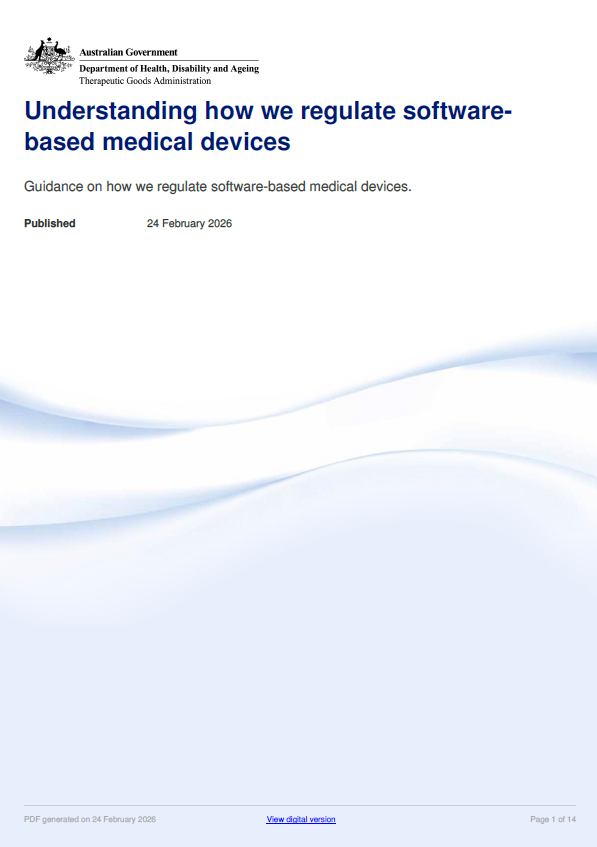
On 24 February 2026, the Australian Therapeutic Goods Administration (TGA) published updated guidance titled “Understanding how we regulate software-based medical devices.”
The guidance explains how software, including artificial intelligence (AI), is regulated under the Therapeutic Goods Act 1989 and the Therapeutic Goods (Medical Devices) Regulations 2002.
Although the document does not introduce new legislation, it provides detailed clarification on regulatory obligations that directly affect manufacturers of software-based medical devices supplied in Australia.
Manufacturers Are Responsible for Determining Device Status
The TGA clearly states that it is the manufacturer’s responsibility to determine whether their product meets the definition of a medical device.
Importantly, software developers may meet the legal definition of a manufacturer even if development activities are outsourced or based on pre-existing software platforms. Where a developer alters the intended purpose of a general platform, they may assume manufacturer responsibilities under the Act.
For manufacturers, this reinforces the need for:
Clear determination of regulatory status
Defined intended purpose
Documented regulatory assessment
Intended Purpose Determines Regulatory Classification
The guidance reiterates that regulation is based on the manufacturer’s intended purpose, as documented in:
Instructions for use
Labelling
Advertising materials
Technical documentation
Website information
Even where two software products appear technically similar, differences in intended purpose may result in different regulatory outcomes.
The intended purpose determines:
Whether the product is a medical device
Device classification
Applicable conformity assessment procedures
Requirement for ARTG inclusion
Software Updates May Trigger Regulatory Consequences
The TGA highlights that software updates can affect regulatory status.
If new functionality is introduced — such as diagnostic support, treatment recommendations, or clinical monitoring — the software may:
Newly meet the definition of a medical device; or
Change classification due to altered risk profile; or
Trigger additional regulatory obligations, including ARTG inclusion.
Manufacturers must assess the regulatory impact of updates and ensure continued compliance with the Therapeutic Goods Act 1989 and associated regulations.
Broad Definition of “Supply” in Australia
Under the Act, “supply” includes making software available in Australia via:
App stores
Cloud platforms
Websites
This applies whether software is downloaded or accessed remotely, and whether it is free or paid.
Even if hosted overseas, software that is accessible or intended for use in Australia is subject to regulation if it meets the definition of a medical device.
For manufacturers operating internationally, this is a critical consideration.
Classification of Software-Based Medical Devices
All software-based medical devices are considered active medical devices for classification purposes.
Australia applies a four-tier classification system:
Class I
Class IIa
Class IIb
Class III
Higher classification results in increased regulatory scrutiny and more rigorous conformity assessment requirements.
The classification rules for programmed, programmable and software-based medical devices are set out in Schedule 2 of the Regulations.
Conformity Assessment and Regulatory Evidence
Manufacturers must demonstrate compliance with applicable regulatory requirements through:
TGA Conformity Assessment Certification; or
Appropriate market authorisation evidence from a comparable overseas regulator.
The level of conformity assessment depends on device classification.
For Class I devices, manufacturer certification and declaration of conformity are required, but direct third-party assessment is generally not required.
Essential Principles – Specific Obligations for Software
Manufacturers must demonstrate compliance with all relevant Essential Principles (Schedule 1 of the Regulations).
The guidance highlights specific software-related requirements:
Essential Principle 12.1
Safe operation and system requirements
Cybersecurity
Data management
Design and development controls
Version control
Risk management
Verification and validation
Change and configuration management
Maintenance and problem resolution
Essential Principle 13.2(3)
Electronic provision of information where applicable
Essential Principle 13B
Identification of current software version and build number
Version information must be accessible and identifiable
Information must be in English
Manufacturers must maintain documentation demonstrating compliance throughout the device lifecycle.
Ongoing Post-Market Responsibilities
Following inclusion in the Australian Register of Therapeutic Goods (ARTG), manufacturers and sponsors must continue to meet regulatory obligations, including:
Incident reporting via IRIS
Cooperation in safety corrective actions
Maintenance of technical documentation
Compliance with advertising requirements
Ensuring ARTG information remains accurate
Regulatory compliance continues throughout the product lifecycle.
Key Takeaways for Manufacturers
The updated TGA guidance reinforces that manufacturers of software-based medical devices must:
Clearly define and document intended purpose
Assess regulatory implications of software updates
Determine classification correctly
Maintain conformity assessment evidence
Ensure compliance with software-specific Essential Principles
Implement robust lifecycle and change management processes
Manufacturers supplying software in Australia should review their regulatory strategy to ensure alignment with the clarified expectations set out by the TGA.
Read the full document below.