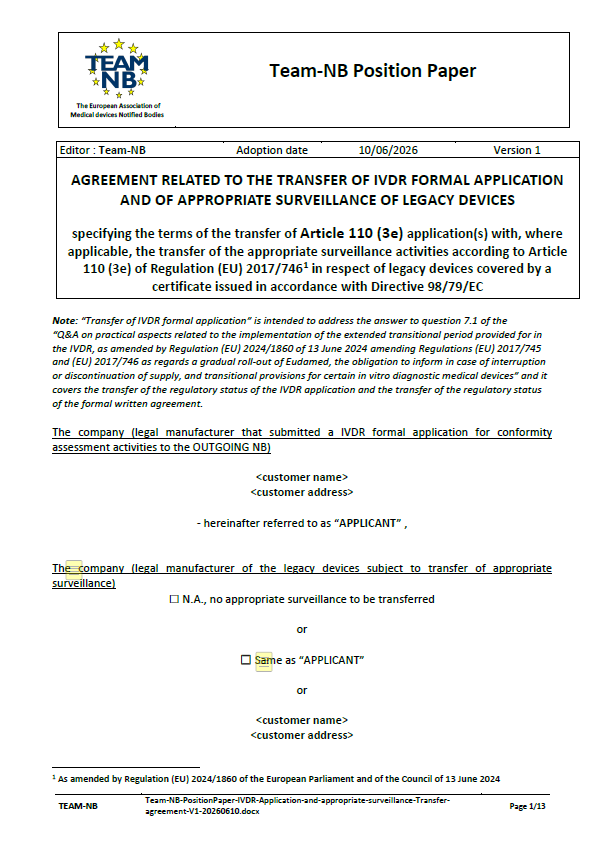
The European Association of Medical Devices Notified Bodies (Team-NB) has published a new Position Paper introducing a template agreement for the transfer of IVDR formal applications and, where applicable, the transfer of appropriate surveillance activities for legacy devices between notified bodies.
The document aims to address practical implementation aspects of the extended IVDR transitional provisions introduced by Regulation (EU) 2024/1860. In particular, it provides a framework for situations where a manufacturer wishes to transfer an IVDR application from one notified body to another after the applicable Article 110 deadlines have already passed.
According to the Position Paper, where an applicant has submitted an IVDR formal application and concluded a written agreement with a notified body within the applicable deadlines, the application may subsequently be transferred to another notified body. The agreement is intended to preserve the regulatory status of the original application, provided that all applicable IVDR requirements continue to be met.
The document explicitly states that, where an applicant or the outgoing notified body terminates the existing written agreement and the applicant simultaneously enters into a new written agreement with another notified body to which the IVDR formal application is transferred, the conditions set out in Article 110(3c)(e) IVDR are considered to remain fulfilled and the transitional period continues to apply.
Background
The Position Paper references Question 7.1 of the European Commission’s Q&A on the practical implementation of the extended transitional periods introduced by Regulation (EU) 2024/1860.
The Commission had previously clarified that manufacturers should not automatically lose the benefit of the transitional provisions if they change notified bodies, provided that the regulatory status of the application and written agreement is appropriately maintained.
The Team-NB document seeks to operationalise this principle by providing a structured transfer mechanism and a standardised agreement that can be used by manufacturers, outgoing notified bodies and incoming notified bodies.
Transfer of IVDR Formal Applications
The proposed agreement establishes the conditions under which an IVDR formal application may be transferred from an outgoing notified body to an incoming notified body.
The transfer applies to devices covered by an IVDR application that was submitted within the applicable regulatory deadlines and for which a written agreement was concluded with the original notified body.
The Position Paper clarifies that:
The original IVDR application should remain valid until the agreed transfer date.
The applicant should not withdraw the original application before the transfer takes place.
The outgoing notified body should not reject the application solely because the manufacturer intends to transfer to another notified body.
The incoming notified body must enter into a new written agreement covering the transferred application.
The transfer may cover all or only part of the original application scope.
The document also addresses situations where conformity assessment activities are already ongoing. In such cases, relevant information, including assessment reports, findings, performance verification activities and batch release activities, should be made available to the incoming notified body to support continuity of the conformity assessment process.
Transfer of Appropriate Surveillance for Legacy Devices
In addition to application transfers, the Position Paper provides a framework for transferring appropriate surveillance responsibilities for legacy devices certified under Directive 98/79/EC (IVDD).
The transfer mechanism applies to devices covered by certificates that remain valid under the transitional provisions of Article 110 IVDR.
Under the proposed approach, the incoming notified body assumes responsibility for appropriate surveillance from the agreed transfer date, while the outgoing notified body remains responsible for activities performed before that date.
The document describes a broad range of activities that may form part of the transferred surveillance responsibilities, including:
Quality management system audits;
Focused and unannounced audits;
Surveillance activities;
Vigilance assessments;
Review of non-significant changes to devices;
Assessment of quality management system changes;
Communication with competent authorities;
Complaint and appeal handling;
Certificate restrictions, suspensions and withdrawals where required.
The Position Paper also clarifies that certification which has already been withdrawn or invalidated before the transfer date cannot be transferred.
Assessment Before Transfer
A key feature of the proposed framework is the requirement for an assessment by the incoming notified body before the transfer becomes effective.
The incoming notified body remains responsible for determining the extent of its review and for deciding whether the transfer can proceed.
Before accepting responsibility, the incoming notified body is expected to obtain an overview of:
Conformity assessment activities already performed;
Open findings and nonconformities;
Surveillance observations;
Corrective actions;
Pending issues that may affect certification or future conformity assessment activities.
The document states that any unresolved concerns should be considered when planning subsequent assessment and surveillance activities.
Documentation Requirements
The Position Paper includes a detailed list of information that may need to be transferred between parties.
Depending on the circumstances, manufacturers may be requested to provide:
Copies of confirmation letters;
Audit reports and findings;
Technical documentation assessment reports;
Consultation reports issued by authorities;
Vigilance records;
Lists of open nonconformities and corrective actions;
Pending appeals;
Information related to performance verification and batch testing activities for Class D devices.
For legacy devices, additional documentation may include existing IVDD certificates, technical documentation, surveillance records and information relating to ongoing change assessments.
The document also foresees direct information exchange between outgoing and incoming notified bodies to facilitate continuity of regulatory oversight.
Traceability and Notified Body Identification Numbers
The Position Paper contains optional provisions addressing situations where the transfer of appropriate surveillance also results in a change of notified body identification number.
Where such a change occurs, manufacturers may need to document the transition on a product-by-product basis and maintain traceability records identifying the last serial numbers or lot numbers associated with the outgoing notified body and the first products falling under the incoming notified body’s surveillance activities.
What Manufacturers Should Consider
For manufacturers with IVDR applications currently under assessment, the Position Paper provides additional clarity on how transfers between notified bodies may be managed without automatically affecting eligibility for Article 110 transitional provisions.
The document highlights the importance of maintaining the validity of the original application and written agreement until the transfer is completed and ensuring that sufficient information is available to support the incoming notified body’s assessment.
Manufacturers considering a transfer should also be prepared for potentially significant documentation exchanges and should ensure that any open nonconformities, ongoing assessments and surveillance activities are clearly documented before initiating discussions with a new notified body.
While the Position Paper does not create new legal obligations, it provides a practical framework that may support consistent implementation of the European Commission’s interpretation of Article 110 transitional provisions and facilitate transfers between notified bodies during the ongoing IVDR transition.
Read the full document below.