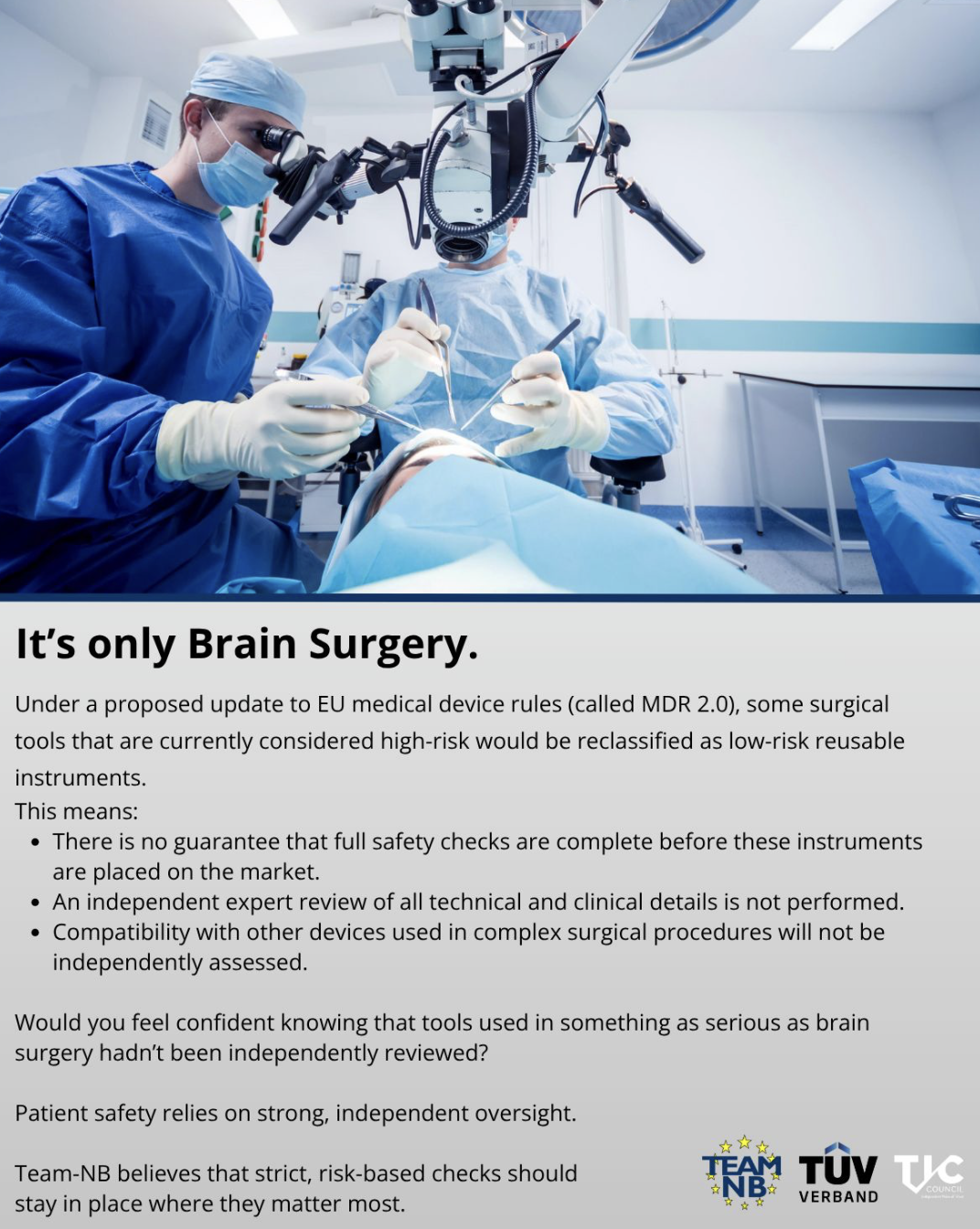
Team-NB Calls for Balanced MDR/IVDR Revision Focused on Patient Safety
Team-NB, together with TÜV Verband and TIC Council, has shared a message calling for a balanced approach to the proposed revision of the EU MDR and IVDR.
The publication highlights the importance of ensuring that efforts to improve the regulatory system continue to uphold high standards of patient safety, particularly where medical devices are used in high-risk clinical settings.
Focus on Risk-Based Oversight
The communication refers to concerns that, under a proposed update to EU medical device rules, some surgical tools currently considered high-risk could be reclassified as low-risk reusable instruments.
The message uses the example of surgical instruments used in brain surgery to question whether such devices should remain subject to strict and independent oversight.
Key Concerns Raised
The publication highlights several potential concerns linked to reduced oversight for certain reusable surgical instruments.
These include:
uncertainty around whether full safety checks would be completed before instruments are placed on the market;
the absence of independent expert review of all technical and clinical details;
lack of independent assessment of compatibility with other devices used in complex surgical procedures.
The central message is that patient safety relies on strong, independent and risk-based regulatory checks.
MDR/IVDR Revision and Patient Safety
The revision of the MDR and IVDR is intended to improve the functioning of the EU medical device regulatory system.
However, the publication stresses that any simplification or efficiency measure should remain aligned with patient safety objectives and should not weaken oversight where risks are significant.
Team-NB’s position is that strict, risk-based checks should remain in place where they matter most.
Impact on Medical Device Manufacturers
For medical device manufacturers, the message is relevant because it reflects ongoing debate around how the MDR and IVDR framework may evolve.
Manufacturers should pay particular attention to:
proposed changes to device classification;
risk-based conformity assessment;
notified body involvement;
reusable surgical instruments;
technical documentation requirements;
clinical and safety evidence;
compatibility with other devices;
independent review expectations;
patient safety considerations;
future MDR/IVDR revision outcomes.
For manufacturers of surgical instruments and devices used in complex procedures, the discussion reinforces the importance of maintaining robust technical, clinical and risk evidence, even where regulatory pathways may be reviewed or adjusted.