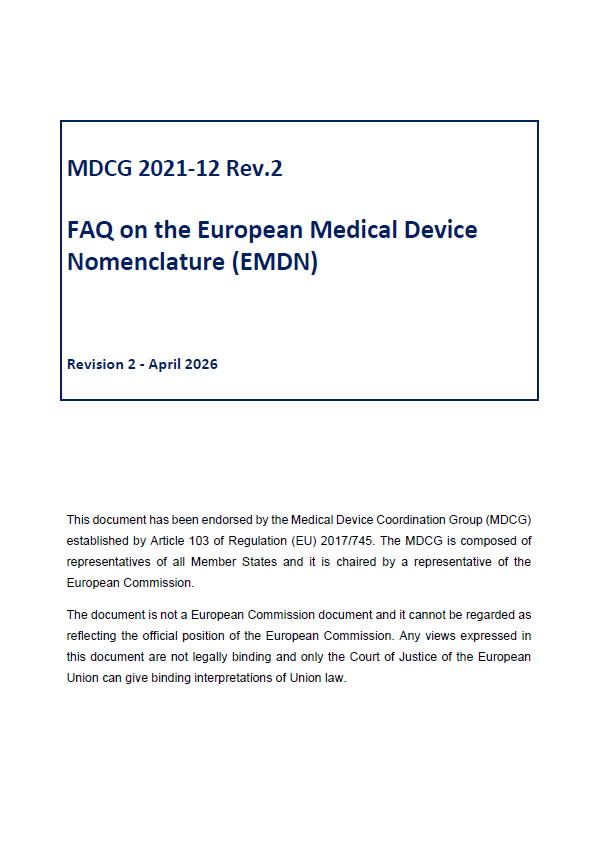
MDCG Publishes Revision 2 of EMDN Guidance (MDCG 2021-12 Rev.2)
In April 2026, the Medical Device Coordination Group (MDCG) published Revision 2 of MDCG 2021-12, providing updated FAQs on the European Medical Device Nomenclature (EMDN) .
The document clarifies the use, structure, and maintenance of EMDN under Regulation (EU) 2017/745 (MDR) and Regulation (EU) 2017/746 (IVDR).
Role of EMDN
According to the MDCG document, the EMDN:
Supports the functioning of EUDAMED
Is used by manufacturers for device registration, linked to the UDI-DI
Is used in:
Technical documentation
Notified Body sampling
Post-market surveillance
Vigilance and post-market data analysis
The nomenclature is available free of charge and accessible to all stakeholders.
Structure of the nomenclature
The EMDN is based on a seven-level hierarchical structure, including:
Categories (first level)
Groups (second level)
Types (third level and further sublevels)
Each code is alphanumeric and linked to a term describing the device.
EMDN code assignment
The document states that manufacturers:
Must assign the most granular (lowest-level) code available
Should assign one code per UDI-DI, unless multiple intended purposes apply
Where no appropriate code exists, the code extension “99 – Other” may be used.
Code extensions “90” and “99”
The MDCG clarifies that:
“99 – Other” represents a terminal level and may be used for UDI-DI assignment
“90 – Various” is not a terminal level and cannot be used for UDI-DI registration
Multiple EMDN codes
Multiple codes may be assigned in specific cases, including:
Devices with multiple intended purposes
Devices falling under Category X (Annex XVI products without an intended medical purpose)
Devices with both medical and non-medical intended purposes
No prioritisation between assigned codes is required.
Annual update procedure
The MDCG describes an annual EMDN update process, including:
Publication of updates on the European Commission website
Availability of documentation describing changes compared to previous versions
No direct notification to users on implemented changes
A 15 working day deadline is established for responding to clarification requests during the review process.
Obsolete and split codes
The document specifies that:
Obsolete codes remain visible in EUDAMED for at least 5 years, but cannot be used for new registrations or updates
Split codes remain visible but are no longer available for registration
Archives of obsolete and split codes are maintained and made publicly available
Updates to registrations and documentation
Manufacturers and notified bodies are expected to:
Reflect EMDN changes in:
EUDAMED registrations
Certificates
Declarations of Conformity
Implement updates at the latest before the next annual surveillance audit following the update cycle
Read the full document below.