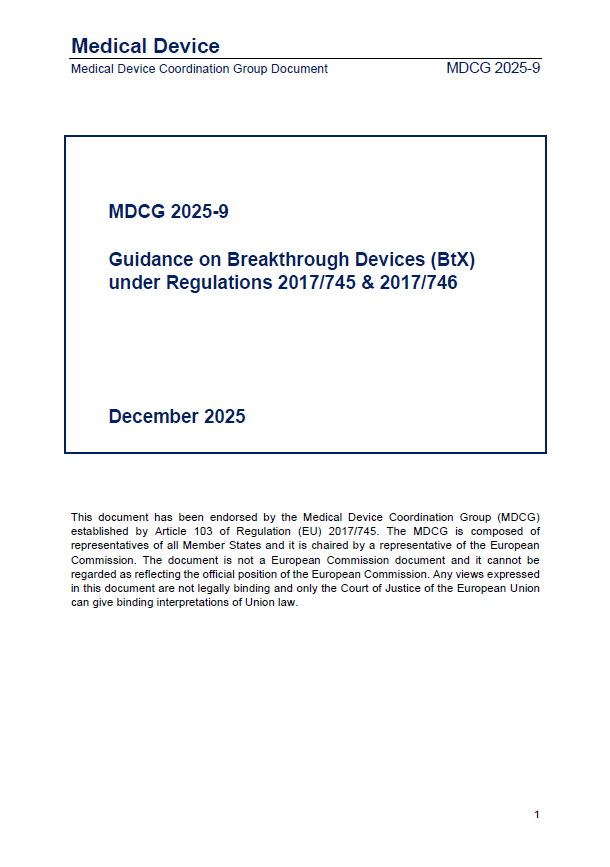
MDCG 2025-9: Breakthrough Devices Guidance Brings New Opportunities for Innovative Manufacturers
In December 2025, the Medical Device Coordination Group (MDCG) released a landmark guidance document—MDCG 2025-9: Guidance on Breakthrough Devices under the MDR and IVDR. This long-anticipated guidance introduces a dedicated regulatory framework for breakthrough devices (BtX), aiming to support earlier access to transformative technologies while maintaining the high standards of safety and clinical evidence required by the MDR and IVDR.
At Smart MDR, we believe this guidance creates real momentum for manufacturers committed to clinical innovation and addressing unmet medical needs.
What Qualifies as a Breakthrough Device (BtX)?
According to MDCG 2025-9, a device may be designated as a Breakthrough Medical Device (BtMD) or a Breakthrough In Vitro Diagnostic Device (BtIVD) only if both of the following criteria are met:
High degree of novelty — in technology, clinical procedure, or application in clinical practice.
Significant positive clinical impact — by either:
Providing a meaningful improvement over the state of the art and existing alternatives, or
Meeting an unmet medical need where adequate alternatives are absent.
Incremental improvements alone generally do not justify breakthrough designation.
Early Designation – No Exclusivity
The guidance allows manufacturers to apply for BtX designation early in the development process, potentially years before CE marking. This early pathway is designed to support proactive engagement with regulators and accelerate time-to-market.
Notably:
BtX status does not confer market exclusivity;
It can be granted to multiple devices with similar indications;
The status is not affected if another device for the same condition later reaches the market.
Clinical Evidence: Same Standards, Smarter Lifecycle Planning
MDCG 2025-9 does not lower clinical evidence requirements under the MDR or IVDR. However, it does allow a more flexible, lifecycle-based approach to evidence generation.
Where justified, manufacturers may:
Rely on limited pre-market clinical data, if:
The benefit-risk profile is acceptable;
A well-defined PMS and PMCF/PMPF plan is in place to collect confirmatory data post-market.
This flexibility is particularly valuable for technologies where delayed access could harm patients.
Post-Market Surveillance Takes Center Stage
For BtX devices, post-market activities are central to regulatory strategy. The guidance expects manufacturers to implement:
Comprehensive post-market surveillance (PMS) systems;
Structured PMCF (for medical devices) and PMPF (for IVDs) plans, which may include:
Clinical investigations or performance studies;
Patient registries for high-risk or implantable devices;
Real-world data to support safety and performance.
Notified bodies may also impose specific conditions in certificates, such as:
Milestone-based PMCF/PMPF obligations;
Enhanced post-market monitoring requirements.
Engagement with Expert Panels and Notified Bodies
To obtain BtX designation, manufacturers must request a formal opinion from the expert panels established under MDR Article 106. These panels aim to issue opinions within 60 days and prioritize BtX applications.
The guidance also provides:
Opportunities for early scientific advice on clinical development;
Prioritization of BtX files by notified bodies;
Enhanced structured dialogue to reduce regulatory uncertainty.
Why This Guidance Matters
MDCG 2025-9 offers manufacturers:
A clearer, more predictable regulatory pathway for highly innovative devices;
Early and constructive engagement with regulators;
The ability to balance pre-market and post-market evidence in a scientifically justified way;
Stronger alignment between innovation, safety, and public health priorities.
Smart MDR Perspective
At Smart MDR, we support manufacturers throughout the entire lifecycle—from determining breakthrough eligibility to preparing designation dossiers and aligning clinical, regulatory, and post-market strategies with MDCG expectations.
Read the full document below.