FDA Finalizes Guidance on Sponsor Responsibilities for Safety Reporting in IND and BA/BE Studies
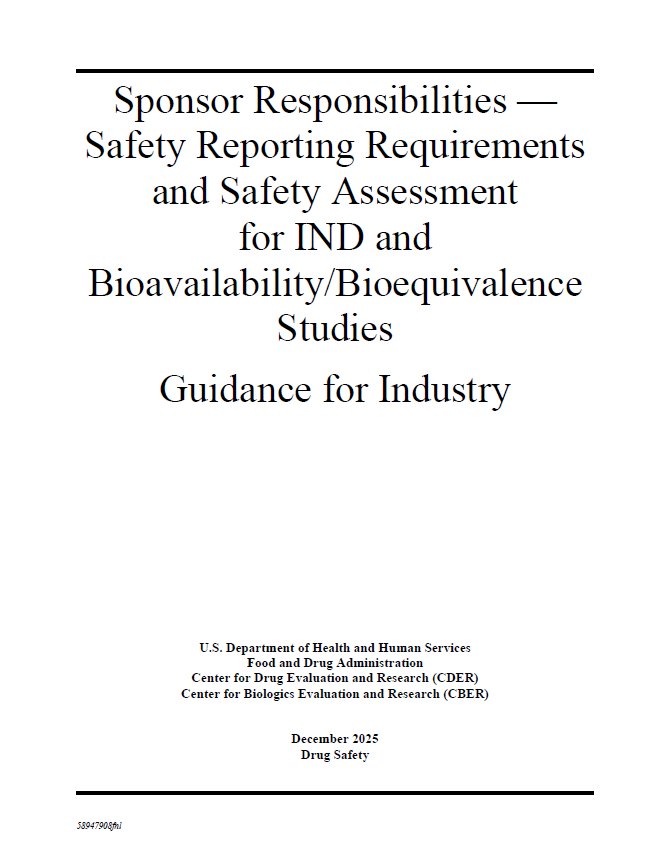
In December 2025, the U.S. FDA published the final version of its guidance titled “Sponsor Responsibilities — Safety Reporting Requirements and Safety Assessment for IND and Bioavailability/Bioequivalence Studies.” This updated document consolidates and replaces earlier guidance from 2012, 2015, and 2021, offering a comprehensive and structured approach to expedited safety reporting during clinical development.
Why does this matter for manufacturers?
The guidance outlines regulatory expectations for sponsors conducting studies under an Investigational New Drug (IND) application or BA/BE studies exempt from IND requirements. These changes are especially relevant for manufacturers involved in U.S.-based trials or working with U.S. CROs, as they clarify when and how safety data must be evaluated and reported to FDA and investigators.
Key Updates and Implications:
Refined definitions for adverse events (AEs), suspected adverse reactions (SARs), and criteria for “serious” and “unexpected” events.
Clearer expectations for aggregate data analysis, especially for anticipated serious adverse events that cannot be assessed on a case-by-case basis.
More flexibility in who reviews safety data, allowing sponsors to delegate to qualified internal or external entities.
Guidance on developing a structured safety surveillance plan, including predefined triggers for unblinding and monitoring procedures.
Detailed submission pathways, including when and how to report via FAERS and the electronic Common Technical Document (eCTD) format.
What manufacturers need to consider:
These updates mean sponsors may need to:
Revise safety reporting SOPs, especially for handling aggregate data.
Review agreements with CROs to ensure responsibilities are clear.
Update safety surveillance plans and documentation to reflect new definitions and thresholds.
The FDA is also reinforcing the need for early identification of anticipated serious adverse events and ensuring that decisions on reportability are well documented — especially when aggregate analyses are involved.
Access the full FDA guidance below.