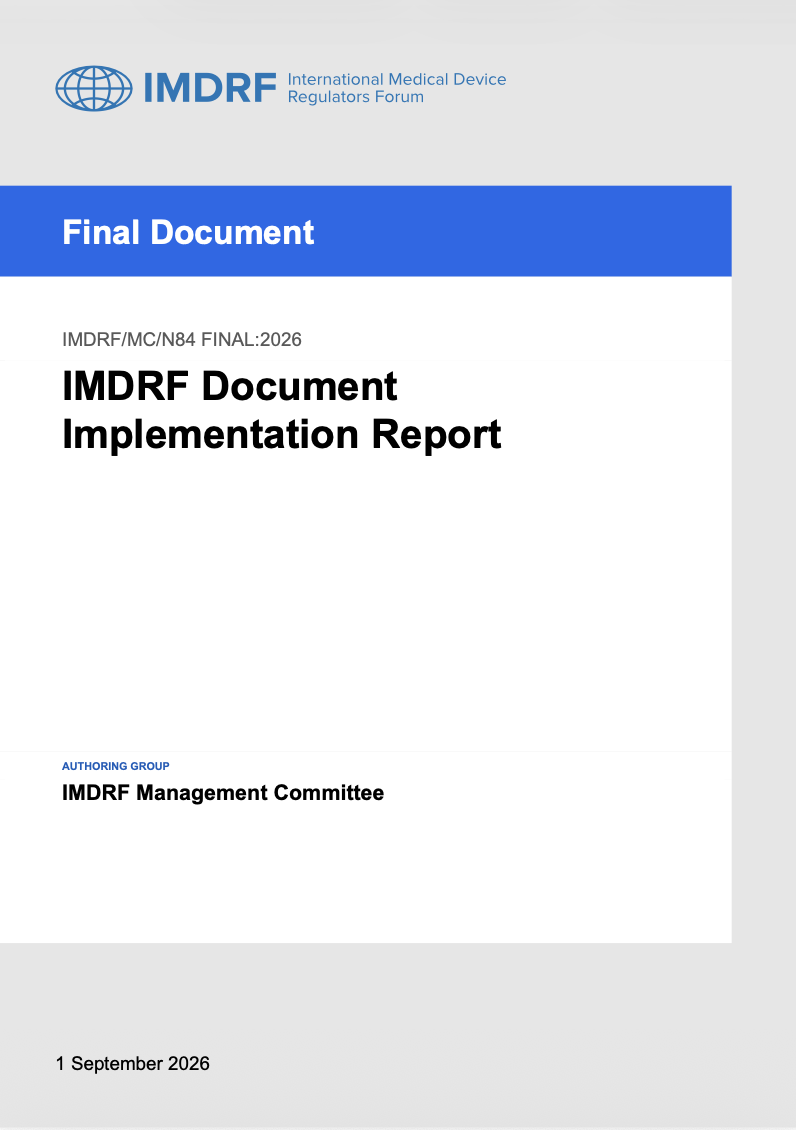
IMDRF Publishes 2026 Document Implementation Report
The International Medical Device Regulators Forum, IMDRF, has published the IMDRF Document Implementation Report, identified as IMDRF/MC/N84 FINAL:2026.
The final document was issued on 1 September 2026 and authored by the IMDRF Management Committee.
Purpose of the Report
The report provides the implementation status of IMDRF technical documents, as self-identified by IMDRF members at the time of publication.
According to the document, IMDRF is a voluntary group of medical device regulators working to accelerate international medical device regulatory convergence, building on the earlier work of the Global Harmonization Task Force on Medical Devices.
The report explains that IMDRF technical documents address technical matters relating to the regulation of medical devices and that implementation is the last stage in the IMDRF document development process.
Implementation Levels
The report uses implementation levels defined in the IMDRF Standard Operating Procedure.
These include implemented, partly implemented, not applicable and not implemented. An implemented document means that all relevant elements, concepts and principles of the IMDRF document are followed. A partly implemented document means that the document has been implemented in a modified way or for a smaller range of products than outlined in the IMDRF document.
The report also clarifies that documents relevant to the Medical Devices Single Audit Program, or MDSAP, are not included.
Areas Covered by the Report
The implementation report covers a broad range of IMDRF technical document areas, including:
Software as a Medical Device;
Unique Device Identification;
Regulated Product Submission;
standards for regulatory use;
Good Regulatory Review Practices;
personalized medical devices;
adverse event terminology;
medical device clinical evaluation;
medical device cybersecurity;
IVD medical device classification;
artificial intelligence and machine learning-enabled medical devices.
These areas are presented in tabular format, showing whether jurisdictions have implemented, partly implemented or not implemented each document.
Software as a Medical Device and UDI
The report includes implementation status for several Software as a Medical Device, or SaMD, documents, including key definitions, risk categorization, quality management system application, clinical evaluation and software-specific risk characterization.
It also covers IMDRF documents on Unique Device Identification, including UDI guidance and the UDI system application guide.
Regulatory Submissions and Review Practices
The report includes the implementation status of the IMDRF Regulated Product Submission documents, including the non-IVD and IVD regulatory submission tables of contents and common data elements for medical device identification.
It also includes multiple Good Regulatory Review Practices documents, including competence and training requirements for regulatory reviewers, essential principles of safety and performance, labelling principles and regulatory reliance programs.
Clinical Evaluation, Cybersecurity and IVD Classification
The report also covers IMDRF documents on medical device clinical evaluation, including clinical evidence, clinical evaluation, clinical investigation and post-market clinical follow-up studies.
For cybersecurity, the report includes implementation status for IMDRF documents on medical device cybersecurity, legacy medical devices and software bill of materials for medical device cybersecurity.
For IVDs, the report includes implementation status for the IMDRF document on Principles of In Vitro Diagnostic Medical Devices Classification.
Artificial Intelligence and Machine Learning
The report also includes IMDRF documents related to artificial intelligence and machine learning-enabled medical devices.
These include Machine Learning-enabled Medical Devices: Key Terms and Definitions and Good Machine Learning Practice for Medical Device Development: Guiding Principles.
This makes the report particularly relevant for stakeholders monitoring international regulatory alignment in AI-enabled medical device development.
Impact on Medical Device and IVD Manufacturers
For medical device and IVD manufacturers operating across multiple jurisdictions, the report provides a useful overview of how IMDRF technical documents are being adopted by regulators.
Manufacturers should pay particular attention to:
differences between implemented, partly implemented and not implemented documents;
jurisdiction-specific adoption of SaMD and AI-related IMDRF documents;
UDI implementation alignment;
regulatory submission structure expectations;
clinical evaluation and post-market clinical follow-up requirements;
cybersecurity and software bill of materials expectations;
IVD classification principles;
convergence trends that may influence future regulatory strategies.
For global manufacturers, the report reinforces the importance of tracking IMDRF implementation status across target markets, since regulatory convergence may reduce complexity over time, while partial or non-implementation may still create jurisdiction-specific requirements.