Health Canada Mandates the Use of REP for Medical Device Submissions
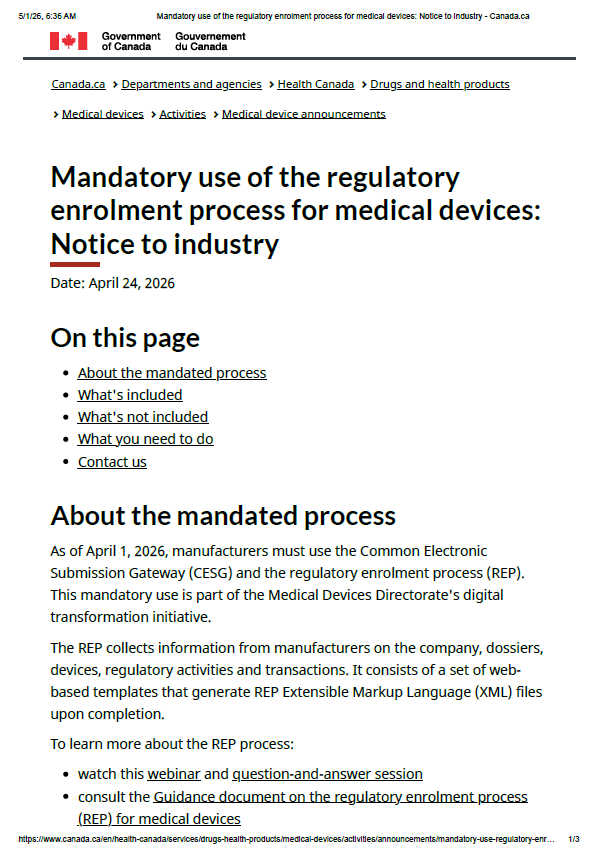
Health Canada has officially made the use of the Regulatory Enrolment Process (REP) and the Common Electronic Submission Gateway (CESG) mandatory for several medical device regulatory activities as of 1 April 2026. The change forms part of the Medical Devices Directorate’s broader digital transformation initiative and introduces a more structured electronic submission framework aligned with international standards.
What Is Changing?
Manufacturers submitting medical device applications in Canada must now use:
The Common Electronic Submission Gateway (CESG) for submission transmission
The Regulatory Enrolment Process (REP) for dossier preparation and enrolment
The IMDRF Table of Contents (ToC) format for applicable submissions
According to Health Canada, the REP consists of web-based templates that generate XML files containing structured information on:
Companies
Devices
Dossiers
Regulatory activities
Transactions
This mandatory process now applies to several licence-related activities for Class II, III and IV medical devices.
Which Submissions Are Affected?
The mandatory REP process now applies to:
Class II to IV medical device licence applications
Licence amendments
Minor change amendments (faxbacks)
Private label licence applications and amendments
Responses to terms and conditions
Responses to requests for additional information
Responses related to licence suspensions
Importantly, all these submissions must now be prepared using the IMDRF ToC structure, reinforcing global harmonisation efforts.
What Is Not Included?
Health Canada clarified that several activities are currently outside the scope of REP, including:
Investigational Testing Applications (ITAs)
Medical Device Establishment Licence (MDEL) applications
Class I device establishment activities
Special Access Program (SAP) applications
Devices regulated under Part 1.1 of the Regulations
This means many distributors and Class I manufacturers may not yet be directly impacted.
What Manufacturers Should Pay Attention To
For manufacturers already active in Canada, one key practical implication is the management of the Company (CO) Template XML.
Health Canada states that companies with previous submissions may already possess a final CO XML file based on Health Canada’s internal records. If the information remains accurate, no further action is required. However:
Any future changes to company or contact details must now be made through the CO XML
Regulatory correspondents must submit a separate CO XML before discussing another company’s regulatory activities
New applicants must complete and submit a CO XML before filing a new licence application
For manufacturers working with multiple regulatory representatives or global affiliates, maintaining accurate organisational data will become increasingly important under the REP framework.
Why This Matters
This transition signals a continued move by Health Canada toward:
Greater regulatory standardisation
Structured electronic submissions
Improved dossier traceability
Alignment with international regulatory models such as IMDRF
For manufacturers, the operational impact may include:
Updating internal regulatory workflows
Training teams on REP and CESG processes
Adapting technical documentation to IMDRF ToC formatting
Coordinating XML-based company data management
Companies planning new Canadian submissions should review their readiness early to avoid delays or validation issues.
Official Resources
Health Canada has published additional guidance and training materials, including:
REP guidance documentation
A webinar and Q&A session on the process
CO XML amendment instructions
Read the full document below.