Health Canada Updates Guidance for Private Label Medical Device Licence Applications
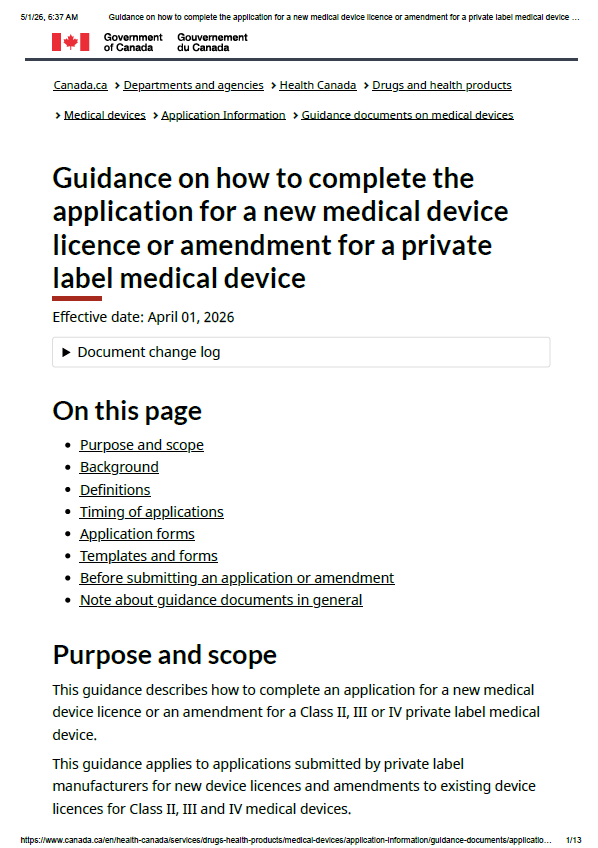
Health Canada has published an updated guidance document titled “Guidance on how to complete the application for a new medical device licence or amendment for a private label medical device”, effective from 1 April 2026. The document provides detailed instructions for private label manufacturers applying for new Class II, III, and IV medical device licences or amendments in Canada.
The updated guidance clarifies procedural and administrative expectations for manufacturers operating under private label arrangements, particularly those relying on licences and technical documentation held by an original manufacturer.
Key Clarifications Introduced
The guidance reinforces that private label manufacturers remain fully subject to the Canadian Medical Devices Regulations, even where they do not directly perform design or manufacturing activities. Health Canada reiterates that a private label device must be identical in every respect to a licensed device from the original manufacturer, except for labelling elements such as the private label manufacturer’s name, address, product name, and identifiers.
Among the main procedural points clarified:
Applications for private label devices can only be submitted after the original manufacturer’s MDL has been issued.
Amendments adding new identifiers may only proceed once the corresponding identifiers have already been licensed for the original manufacturer.
All submissions must now be completed through the Regulatory Enrolment Process (REP) using XML-based templates instead of traditional PDF forms.
The guidance provides expanded detail on dossier IDs, company templates, regulatory transaction templates, and application information templates.
Health Canada also specifies documentation expectations, including:
Declaration of Compliance
Letter of Authorization from the original manufacturer
MDSAP certificate information
Device details spreadsheets
IFUs and red-lined revisions for amendments
What This Means for Manufacturers
For manufacturers operating private label business models, the guidance places increased emphasis on administrative alignment and documentation consistency between the original manufacturer and the private label manufacturer.
Companies should pay particular attention to:
1. Coordination with Original Manufacturers
Private label manufacturers depend heavily on the cooperation of the original manufacturer, including:
authorization letters,
cross-referencing permissions,
MDSAP information,
and access to updated licensed identifiers.
Any delay or inconsistency between both parties may affect application timelines.
2. Complaint Handling and Recall Procedures
The updated Declaration of Compliance explicitly requires private label manufacturers to maintain documented procedures for:
complaint handling,
mandatory problem reporting,
recalls,
and two-way communication with the original manufacturer.
Health Canada notes that inadequate procedures or false declarations could result in licence suspension.
3. Increased Administrative Readiness
Manufacturers unfamiliar with REP submissions may need to update internal regulatory workflows. The transition to XML-based submissions through REP and CESG requires accurate company enrolment, dossier management, and template coordination.
4. Impact on Change Management
The guidance also highlights the importance of maintaining synchronization between:
licensed identifiers,
IFUs,
product naming,
and amendment documentation.
Manufacturers managing multiple private label arrangements may need tighter document control processes to avoid submission deficiencies.
Industry Perspective
While the guidance does not introduce new regulatory requirements, it significantly expands operational detail around how Health Canada expects private label applications to be prepared and maintained.
For manufacturers, the document serves as a reminder that private labelling arrangements still require robust regulatory oversight, formalized agreements with original manufacturers, and well-controlled post-market processes.
The full Health Canada guidance can be accessed below.