FDA Updates Recognized Biocompatibility Standards – Recognition List No. 065
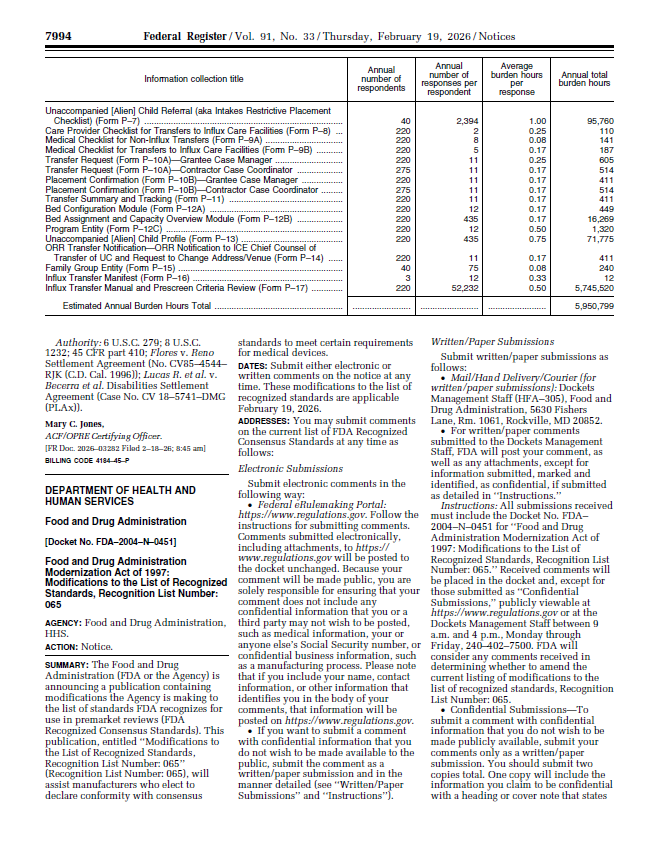
On February 19, 2026, the FDA published Recognition List Number: 065, announcing modifications to its list of FDA Recognized Consensus Standards for medical devices .
These modifications are applicable as of February 19, 2026.
For manufacturers relying on declarations of conformity in U.S. premarket submissions (510(k), De Novo, PMA), this update is particularly relevant in the biocompatibility category (Section B).
Biocompatibility Standards – Withdrawals and Replacements
Under Section B – Biocompatibility, FDA announced withdrawals and replacements of several ASTM and ISO standards .
ASTM F1984–25
Standard Practice for Testing for Whole Complement Activation in Serum by Solid Materials
Previous version withdrawn and replaced with the 2025 edition.
Regulatory relevance
Whole complement activation testing supports blood compatibility evaluations under ISO 10993-4.
Manufacturer impact
Devices with blood contact should ensure their Biological Evaluation Plan, test reports, and Declarations of Conformity reference the newly recognized edition where applicable.
ASTM F2147–01 (Reapproved 2016)
Guinea Pig: Split Adjuvant and Closed Patch Testing for Contact Allergens
Withdrawn. No replacement version listed.
Regulatory relevance
This was a historical sensitization method.
Manufacturer impact
Manufacturers can no longer newly declare conformity to this withdrawn standard in future submissions.
If this method is referenced in existing technical documentation or Declarations of Conformity, its suitability should be verified for upcoming FDA submissions.
ASTM F895–25
Agar Diffusion Cell Culture Screening for Cytotoxicity
Updated version recognized.
Regulatory relevance
Supports cytotoxicity assessment aligned with ISO 10993-5.
Manufacturer impact
Testing laboratories and Declarations of Conformity should reference the newly recognized edition for future submissions.
ASTM F748–25
Selecting Biological Test Methods for Materials and Devices
Updated version recognized.
Regulatory relevance
Supports strategic biological evaluation planning consistent with the risk-based framework of ISO 10993-1.
Manufacturer impact
Biological Evaluation Plans referencing this standard should be updated to reflect the newly recognized version when declaring conformity.
ISO 10993-4:2017 + Amendment 1 (2025)
Biological evaluation of medical devices — Part 4: Selection of tests for interactions with blood
Recognition updated to include Amendment 1 (2025).
Regulatory relevance
Core standard for devices with blood contact, addressing hemolysis, coagulation, complement activation, and thrombogenicity.
Manufacturer impact
Manufacturers of cardiovascular, extracorporeal, and implantable devices should confirm that blood compatibility testing strategies align with the amended version when submitting to FDA.
ASTM F720–24
Guinea Pig Maximization Test (GPMT)
Updated version recognized.
Regulatory relevance
Sensitization testing aligned with ISO 10993-10 principles.
Manufacturer impact
Ensure test protocols and Declarations of Conformity reference the newly recognized edition for future FDA submissions.
What Did Not Change
According to the notice :
No new biocompatibility standards were added in Table 2
No changes were made to ISO 10993-1
No new chemical characterization standards were introduced
The update primarily reflects version replacements and one withdrawal, rather than the introduction of new testing frameworks.
Why This Matters for Manufacturers
FDA recognition updates directly affect:
Declarations of Conformity
Premarket submissions
Biological Evaluation Reports
Test report referencing
Regulatory gap analyses
When a standard is withdrawn and replaced, manufacturers cannot newly declare conformity to the withdrawn version.
For devices already on the U.S. market, this does not automatically trigger re-testing. However, alignment may become relevant during:
New 510(k), De Novo, or PMA submissions
Significant design changes
FDA deficiency reviews
Strategic documentation updates
Manufacturers operating under both EU MDR and FDA frameworks should also verify alignment between the ISO editions referenced in EU technical documentation and the versions recognized by FDA for U.S. submissions.
Read the full document below.