Team-NB Publishes New Position Paper on Safety and Performance of Reagent Devices Used in Combination
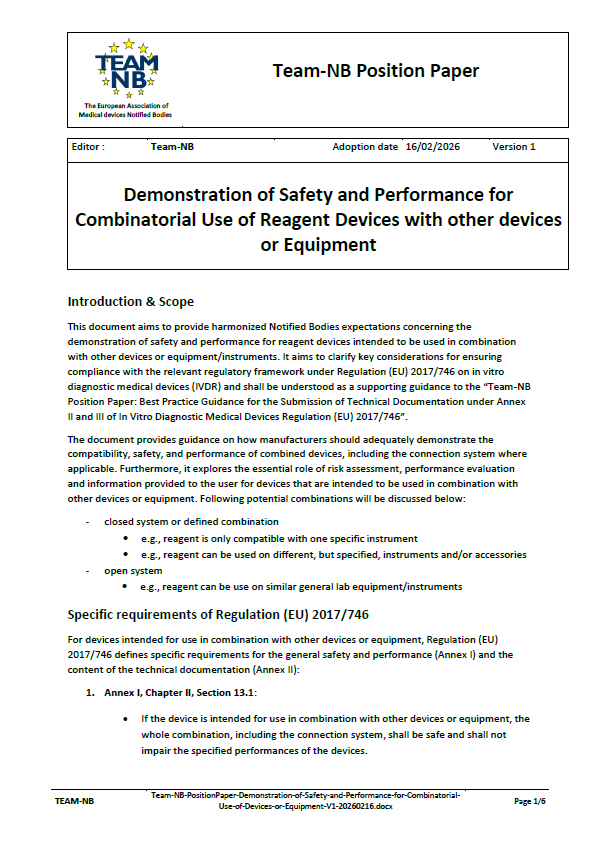
The European Association of Medical Devices Notified Bodies (Team-NB) has published a new Position Paper entitled:
“Demonstration of Safety and Performance for Combinatorial Use of Reagent Devices with Other Devices or Equipment.”
The document sets out harmonised expectations from Notified Bodies regarding how manufacturers must demonstrate safety, compatibility, and performance when reagent devices are intended to be used in combination with other devices, instruments, software, or general laboratory equipment under Regulation (EU) 2017/746 (IVDR).
The paper serves as supporting guidance to the existing Team-NB Position Paper on submission of technical documentation under Annex II and III of the IVDR, and reflects a coordinated interpretation of regulatory requirements among European Notified Bodies.
Clarification of IVDR Requirements for Combined Use
The Position Paper highlights key IVDR provisions applicable where devices are intended for combined use.
Under Annex I, Chapter II, Section 13.1, the entire combination — including the connection system — must be safe and must not impair the specified performance of the devices. Any restrictions on use must be clearly indicated in the labelling and/or Instructions for Use (IFU).
In addition, Annex I, Chapter III, Section 20.4.1(j) requires manufacturers to provide information identifying the devices or equipment necessary to achieve a validated and safe combination, including relevant performance characteristics and known restrictions.
The technical documentation must also include:
A description of accessories and other products intended to be used in combination (Annex II, Section 1.1(m)), and
Evidence that the resulting combination conforms to the General Safety and Performance Requirements when connected to specified equipment (Annex II, Section 6.5(d)).
The paper further reiterates Article 1(3a) of the IVDR, clarifying that products intended for general laboratory use or Research Use Only (RUO) fall outside the scope of the Regulation unless specifically intended by the manufacturer for in vitro diagnostic examination. Where RUO or general laboratory equipment is included in combination claims, the IVD manufacturer retains full responsibility for demonstrating safety and performance of the combined workflow.
Risk Assessment and Performance Evaluation Expectations
Team-NB emphasises that the IVDR does not define explicit validation rules for combinatorial claims. Manufacturers therefore bear full responsibility for generating robust, traceable, and reproducible evidence supporting the intended combined use.
Risk Assessment
Manufacturers must:
Identify risks associated with combined use, including operating conditions, calibration, maintenance, and disposal;
Implement appropriate risk control measures;
Demonstrate that the combination does not introduce new hazards or compromise safety.
Risk management activities must be aligned with ISO 14971.
Performance Evaluation
Manufacturers must demonstrate that the combined system performs as intended, with key performance characteristics meeting predefined acceptance criteria in accordance with Annex I, Sections 9(a) and 9(b).
The Position Paper distinguishes between:
Closed systems (defined combinations)
Where a device is intended for use in one or several specified combinations, a full performance evaluation is required for at least one claimed combination. For additional combinations, manufacturers must demonstrate equivalence across the measurement range and justify the transferability of data. If equivalence cannot be demonstrated, a full performance evaluation is expected for each combination.
Open systems
Where a device can be used with general laboratory equipment from any brand, manufacturers must define and justify the critical characteristics such equipment must possess. A full performance evaluation must be conducted using equipment that meets those defined specifications.
The paper provides practical examples where performance studies are expected, including:
PCR kits used with extraction instruments or real-time PCR cyclers
Coagulation devices used across different analysers
Clinical chemistry assays run on multiple instruments
Software interoperability with Laboratory Information Systems (LIS)
The document also refers to MDCG 2024-11, particularly Section 2.4, for guidance on qualification of in vitro diagnostic devices.
Labelling and Information to Users
In line with Annex I, Section 20.4.1(j), Team-NB outlines clear expectations regarding information provided to users.
Manufacturers must supply:
Identification of devices, accessories, equipment, or instruments intended for combined use
Relevant performance characteristics or technical specifications
Known restrictions, incompatibilities, or limitations
Functional details necessary for correct integration
Clear warnings where compatibility may affect safety or performance
The information must be presented in a way that is clear, unambiguous, and actionable for the intended user.
Post-Market Surveillance Obligations
The Position Paper confirms that manufacturers must monitor the safety and performance of all claimed combinations under their Post-Market Surveillance (PMS) system, in accordance with Article 78 and Annex III of the IVDR.
Feedback and complaints related to combined use must be evaluated to determine whether updates to risk assessments, performance documentation, or labelling are required.
Regulatory Impact
This Position Paper reinforces the expectation that combinatorial claims under the IVDR require structured validation, thorough risk management, and transparent labelling.
While the Regulation does not prescribe explicit validation pathways for combined use, Notified Bodies expect manufacturers to provide comprehensive justification and technical evidence demonstrating that safety and performance are maintained across all claimed configurations.
The document provides important clarification for manufacturers of reagent devices operating under the IVDR and contributes to greater harmonisation of Notified Body expectations across Europe.
Read the full document below.