FDA launches consultation on AI use in early-phase clinical trials
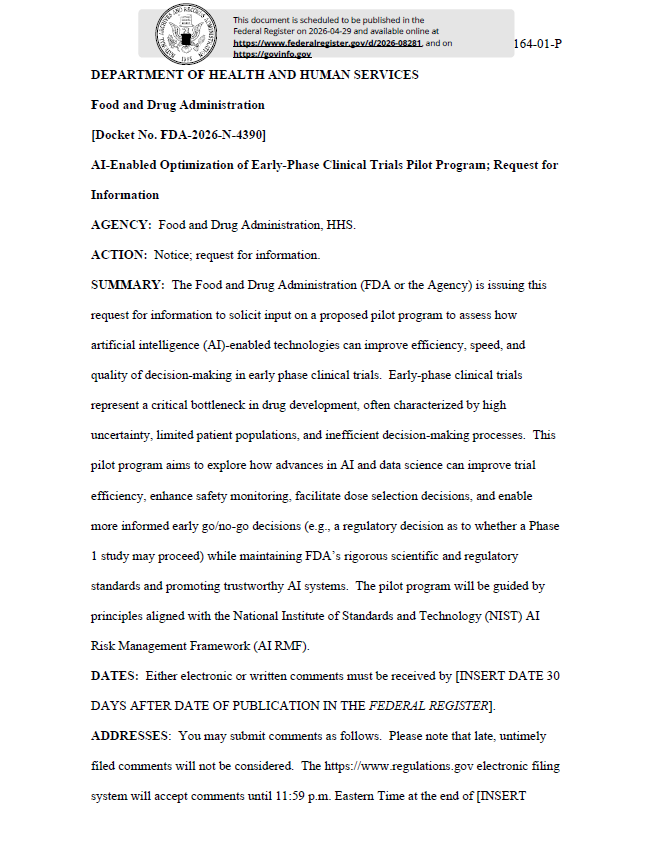
The U.S. Food and Drug Administration (FDA) has published a Request for Information (RFI) on a proposed pilot program to evaluate the use of artificial intelligence (AI) in early-phase clinical trials.
According to the notice, the initiative aims to assess how AI-enabled technologies can improve the efficiency, speed, and quality of decision-making in early clinical development.
Addressing challenges in early-phase trials
The FDA highlights that early-phase clinical trials represent a critical bottleneck in drug development, characterised by:
High uncertainty in dosing, safety, and efficacy
Limited patient populations
Inefficient progression decisions
Long timelines and high resource demands
Potential role of AI
The document outlines several areas where AI may support early-phase trials, including:
Improving patient recruitment
Optimising dose escalation
Enhancing safety monitoring
Enabling adaptive trial designs
Supporting earlier Phase 1 to Phase 2 decisions
Improving biomarker assessment and patient stratification
Supporting endpoint validation
Trustworthy AI principles
The FDA states that the pilot program will follow principles aligned with the National Institute of Standards and Technology (NIST) AI Risk Management Framework (AI RMF).
These principles include ensuring that AI systems are:
Valid and reliable
Safe and secure
Accountable and explainable
Privacy-protective and fair
The agency also refers to its existing draft guidance on the use of AI to support regulatory decision-making.
Pilot programme scope
The FDA plans to recruit sponsors conducting early-phase clinical trials through submissions to:
The Center for Drug Evaluation and Research (CDER)
The Center for Biologics Evaluation and Research (CBER)
The Oncology Center of Excellence
The pilot will be coordinated by the Deputy Chief Medical Officer within the Office of the Commissioner.
Request for stakeholder input
The FDA is seeking feedback on multiple aspects of the proposed pilot, including:
Scope and focus of the programme
Selection of participants and technologies
Collaboration models
Operational structure and infrastructure
Timeline and milestones
Knowledge sharing approaches
The agency is also requesting input on evaluation metrics, covering:
Trial efficiency and speed
Decision-making quality
Participant safety and data integrity
AI system performance
Trustworthiness aligned with NIST AI RMF
Comparative evaluation methods
Qualitative outcomes such as usability and stakeholder trust
Next steps
Stakeholders are invited to submit comments within 30 days of publication in the Federal Register.
Read the full document below.