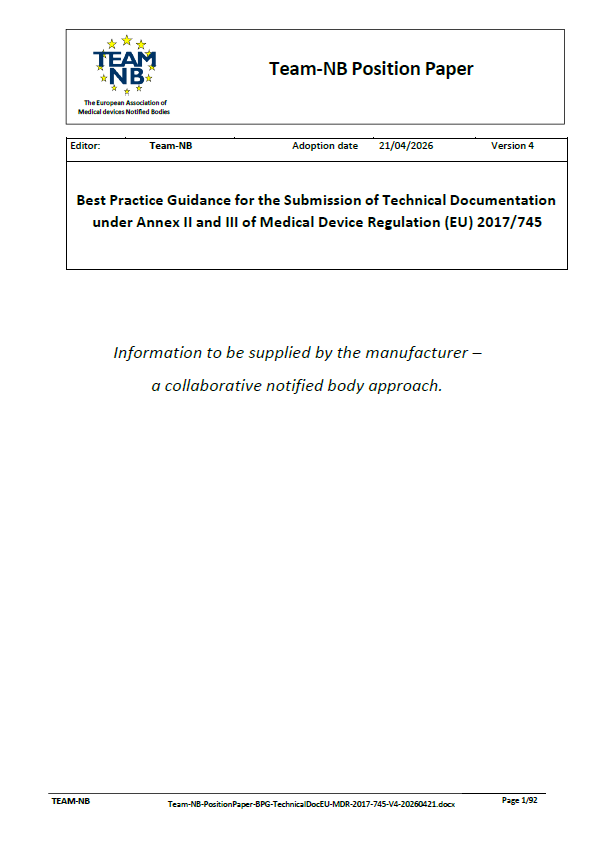
Team-NB Releases Updated Best Practice Guidance on MDR Technical Documentation (Version 4)
Team-NB has published Version 4 (April 2026) of its Best Practice Guidance for the Submission of Technical Documentation under Annex II and III of MDR (EU) 2017/745, providing a more harmonised approach to what Notified Bodies expect from manufacturers during conformity assessment.
This updated guidance reflects a collaborative alignment across Notified Bodies, aiming to reduce inconsistencies, improve submission quality, and ultimately shorten review timelines.
Why this matters for manufacturers
The document makes one point very clear:
Most delays in MDR certification are still caused by poor technical documentation—not regulatory complexity.
Key recurring issues identified include:
Incomplete submissions
Poor structure and navigation
Inconsistent information across documents
Language and translation issues
For manufacturers, this reinforces that technical documentation quality is now a critical regulatory risk area.
Stronger expectations on structure and traceability
Team-NB emphasizes that technical documentation must be:
Clear, structured, and searchable
Supported by indexing, hyperlinks, and logical folder structures
Fully aligned across all sections (e.g. intended purpose, UDI, risk, clinical data)
A notable expectation is the explicit traceability between:
GSPR compliance
Risk management
Verification & validation
Clinical evaluation
This means documentation can no longer exist in silos—cross-referencing is essential.
Increased scrutiny on consistency
The guidance repeatedly highlights consistency across documentation as a major failure point, including:
Intended use vs IFU vs CER
UDI information across all documents
Claims vs supporting evidence
For manufacturers, this implies:
Higher internal QA requirements
Greater need for document control and governance systems
Clear expectations on pre-submission interaction
Manufacturers are strongly encouraged to:
Engage early with Notified Bodies
Clarify language, format, and submission requirements
Use structured dialogue (per MDCG 2019-6)
This reflects a shift toward proactive regulatory strategy rather than reactive submission.
Leveraging legacy data—allowed, but controlled
The guidance confirms that:
Previous conformity assessment evidence (e.g. MDD) can be leveraged
However, manufacturers must:
Clearly indicate what has changed vs unchanged
Provide traceable references to prior assessments
This is particularly relevant for MDR transition strategies, where efficient reuse of data can reduce timelines.
Focus on “state of the art” and standards
While harmonised standards remain voluntary, the document stresses:
Alignment with state-of-the-art (SOTA)
Justification when using outdated or non-harmonised standards
This aligns with MDCG 2021-5 and reinforces that:
Justification is as important as compliance
Common pitfalls across key technical areas
The guidance provides detailed “pitfalls” sections across:
Device description
Risk management (ISO 14971)
Clinical evaluation (MDR Annex XIV)
PMS & PMCF (Annex III)
Across all areas, the same pattern emerges:
Lack of clarity, traceability, and justification leads to delays
Practical submission expectations (often overlooked)
Some operational details highlighted include:
PDF format preferred, avoid scanned documents
File size limits (e.g. <100 MB per file)
File naming constraints (Windows path limits)
Use of bookmarks and internal tables of contents
While simple, these can directly impact review efficiency and acceptance.
Key takeaway
This update is not introducing new regulatory requirements—but it raises the bar on how MDR requirements must be demonstrated.
For manufacturers, success under MDR increasingly depends on:
Documentation strategy
Internal consistency
Traceability across the technical file
Early engagement with Notified Bodies
Read the full document below.