FDA Issues Draft Guidance on Compliance Policy for Certain NIOSH-Approved Respirators
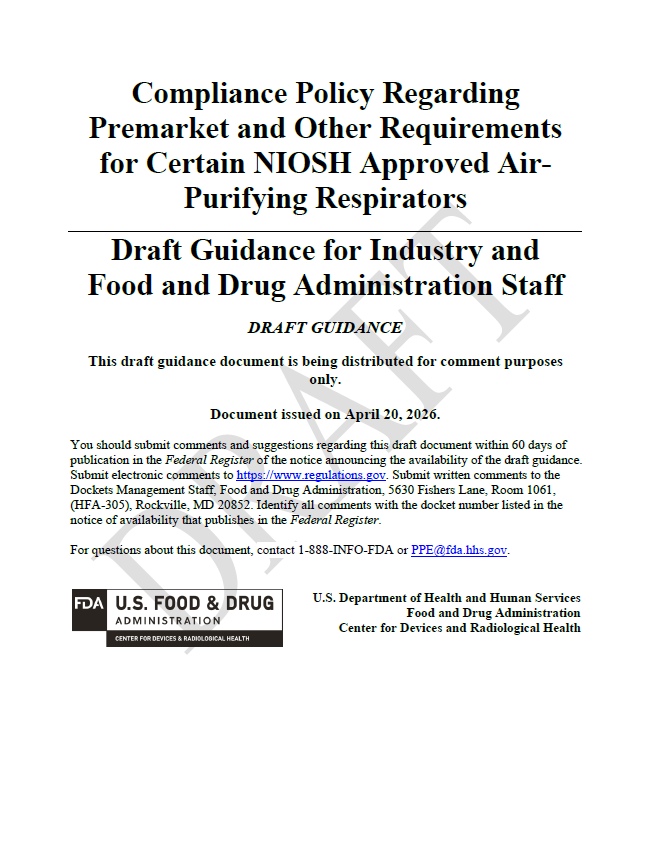
The U.S. Food and Drug Administration (FDA) has published a draft guidance outlining a proposed compliance policy for certain NIOSH-approved air-purifying respirators used for medical purposes. The document, issued on April 20, 2026, is currently open for public consultation.
Scope of the Draft Guidance
The proposed policy applies to specific categories of respirators approved by the National Institute for Occupational Safety and Health (NIOSH), including:
Surgical N95 respirators and N95 filtering facepiece respirators (FFRs) (21 CFR 878.4040)
Other NIOSH-approved non-surgical respirators, such as powered air-purifying respirators (PAPRs), non-powered particulate respirators, and reusable elastomeric respirators
FFRs intended for use by the general public during public health emergencies (21 CFR 880.6260)
These devices are considered by the FDA as medical devices when intended to prevent exposure to airborne pathogens, particularly in healthcare settings.
Key Regulatory Proposal
The central element of the draft guidance is a proposed enforcement discretion policy. Under this approach, the FDA does not intend to prioritize enforcement of several regulatory requirements for devices within scope, including:
Premarket notification (510(k))
Registration and listing
Labeling requirements
Quality Management System (QMS) requirements (except for recordkeeping and complaint handling)
Medical Device Reporting (MDR)
Unique Device Identification (UDI)
Reports of Corrections and Removals
However, manufacturers are still expected to maintain recordkeeping and complaint handling processes, enabling post-market oversight and safety monitoring.
Rationale Behind the Policy
The FDA justifies this approach based on:
The robust regulatory oversight by NIOSH, including approval processes, quality assurance, and post-market surveillance
The absence of significant safety signals identified in postmarket data between 2020 and 2024
The intention to apply a “least burdensome” regulatory approach while ensuring public health protection
NIOSH approval itself requires detailed technical documentation, product testing, and ongoing conformity assessments, including periodic audits and potential revocation of approval in case of non-compliance.
Important Limitations
The draft guidance does not apply to:
Respirators with antimicrobial or antiviral claims
Products incorporating additional technologies (e.g., drug delivery, nanotechnology, UV sterilization)
Devices making specific disease prevention or performance claims beyond respiratory protection
Such products may still require full FDA premarket submissions.
What This Means for Manufacturers
For manufacturers, this draft guidance may represent a significant regulatory shift, particularly for those placing NIOSH-approved respirators on the U.S. market for medical use.
Key implications include:
Potential reduction in FDA premarket burden for certain products
Continued reliance on NIOSH approval as a central regulatory pathway
Ongoing responsibility for post-market surveillance and complaint handling
Need to carefully assess product claims and features to determine eligibility under this policy
Manufacturers developing innovative or modified respirators should note that products outside the defined scope may still require full regulatory submissions and are encouraged to engage with the FDA through the Q-Submission Program.
Next Steps
As this is a draft guidance, stakeholders have the opportunity to submit comments within 60 days of its publication. The final version may evolve depending on industry feedback.
Read the full document draft below.