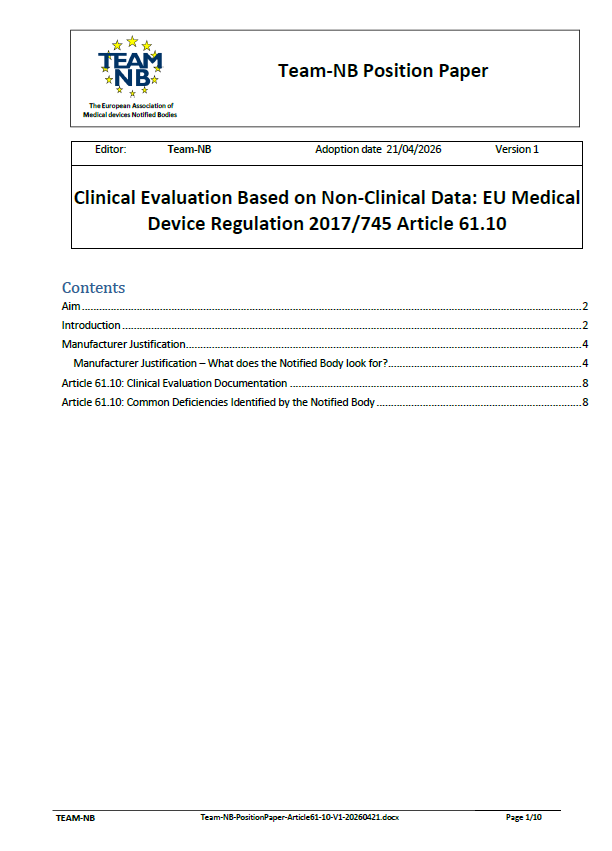
Team NB clarifies expectations for Article 61(10) MDR: When can clinical data be replaced by non-clinical evidence?
A new Team-NB Position Paper (April 2026) provides important clarification on the application of Article 61(10) of the EU MDR (2017/745)—a provision that allows manufacturers, in specific cases, to demonstrate conformity using non-clinical data instead of clinical data.
This document is particularly relevant for manufacturers of non-implantable Class I, IIa, and IIb devices, as it outlines how notified bodies assess the validity of such justifications and highlights common deficiencies observed during conformity assessments.
Article 61(10) remains an exception—not the rule
The paper reinforces a key regulatory principle:
Clinical data remains the default requirement under Article 61(1) for demonstrating safety, performance, and benefit–risk.
Article 61(10) is an exceptional pathway, applicable only when clinical data is not appropriate to verify predefined parameters.
Importantly, the objective of clinical evaluation does not change—only the type of evidence used may differ.
What determines applicability? It’s not the device type
A critical clarification for manufacturers:
There is no predefined list of devices eligible for Article 61(10).
Applicability depends on the device’s intended purpose and clinical context, assessed case by case.
This means even low-risk or “simple” devices may require clinical data depending on how they are used and what they claim.
Key expectation: A robust and evidence-based justification
To rely on Article 61(10), manufacturers must provide a detailed justification demonstrating that:
All relevant safety and performance parameters can be verified using non-clinical methods
The benefit–risk assessment does not depend on clinical data
The justification is based on state of the art, risk management, and device interaction with the human body
Notified bodies will assess this justification holistically, focusing on three pillars:
Intended clinical performance and claims
Device interaction with the human body
Risk management and residual risks
State of the art plays a decisive role
The document strongly emphasizes that state-of-the-art analysis is central to any Article 61(10) justification.
Manufacturers must demonstrate:
Which safety and performance parameters are relevant
Whether these parameters are normally assessed using clinical data
Why non-clinical methods are sufficient in this case
If clinical data exists for similar devices, justification becomes significantly more challenging.
Common pitfalls identified by notified bodies
The paper highlights recurring issues seen during assessments, including:
Generic or superficial justifications that simply repeat MDR wording
Reliance on Article 61(10) due to lack of clinical data, rather than inappropriateness
Failure to define clinical benefit, making benefit–risk assessment impossible
Ignoring implicit clinical claims
Inadequate state-of-the-art analysis
Inclusion of clinical data while claiming Article 61(10) applicability
These deficiencies often lead to rejection of the justification.
Post-market obligations still apply
Even when Article 61(10) is accepted:
Manufacturers must maintain a full clinical evaluation and PMS system
General PMCF activities (e.g. literature review, user feedback) are still expected
Specific PMCF studies are usually not required, but must be justified if omitted
Additionally, manufacturers must continuously reassess whether the justification remains valid—especially if new clinical data becomes available.
What this means for manufacturers
This position paper signals a more structured and stringent approach from notified bodies. Manufacturers should:
Treat Article 61(10) as a highly scrutinised pathway
Invest in a strong, evidence-based clinical evaluation strategy
Ensure alignment between claims, risks, and evidence type
Regularly review their justification against evolving state of the art
Final thought
The Team-NB paper does not change the regulation—but it clarifies expectations and raises the bar for justification under Article 61(10).
For manufacturers, the message is clear: non-clinical evidence can only replace clinical data when it is demonstrably sufficient—and this must be convincingly proven.
Read the full document below.