FDA CBER Updates SOPP on MDUFA User Fee Payments and Billing Activities
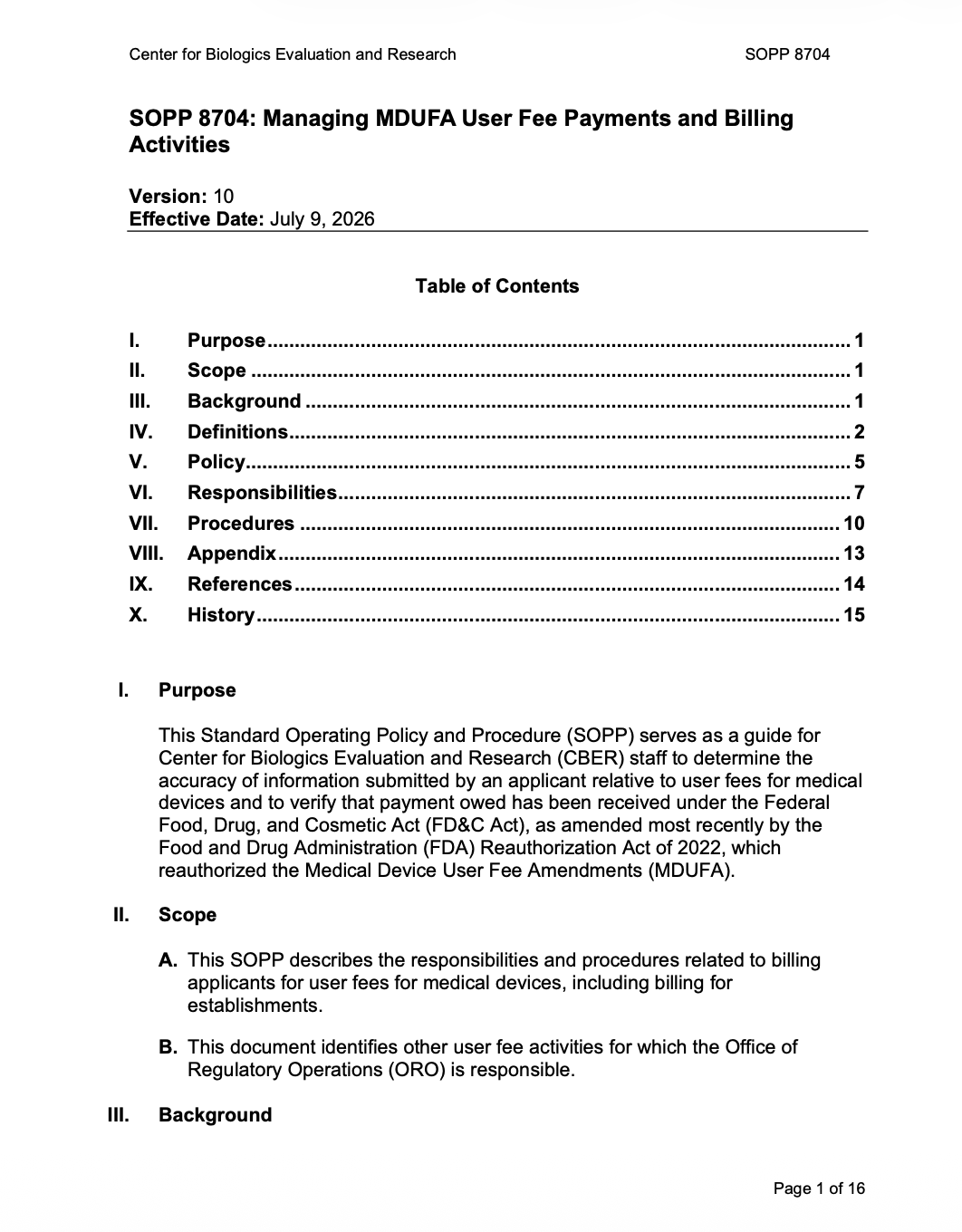
The U.S. Food and Drug Administration’s Center for Biologics Evaluation and Research (CBER) has updated SOPP 8704: Managing MDUFA User Fee Payments and Billing Activities.
The document is Version 10, effective 9 July 2026, and provides internal procedures for CBER staff to verify medical device user fee information and confirm payment under the Medical Device User Fee Amendments (MDUFA).
According to the SOPP history, Version 10 was updated to include Presidential Executive Order 14247, links to the User Fee Payment Refund Request, User Fee Payment Portal and Pay.gov, as well as language updates for clarity.
Scope of the SOPP
The SOPP describes responsibilities and procedures related to billing applicants for medical device user fees, including billing for establishments.
It applies to user fee activities for medical device submissions handled by CBER and identifies the role of the Office of Regulatory Operations (ORO) in user fee verification, billing and refund activities.
Submissions Covered by User Fees
The document states that medical device submissions covered by user fees include:
Premarket Approval Applications;
Product Development Protocols;
Premarket Reports;
PMA supplements and annual reports;
device BLAs and efficacy supplements;
De Novo requests;
510(k) submissions;
513(g) requests;
establishment registrations.
The SOPP also notes that the FD&C Act provides for certain exemptions and waivers of user fees.
Electronic Payments and User Fee Holds
A key update concerns payment methods.
The SOPP states that, effective 1 October 2025, FDA no longer accepts paper checks or money orders in accordance with Executive Order 14247. FDA has transitioned to electronic fund transfers.
Preferred payment methods include:
electronic check / ACH;
credit card;
bank wire transfer;
the FDA User Fees Payment Portal.
The document also clarifies that the user fee is not considered paid until receipt of payment has been verified by the FDA Office of Financial Management.
If a fee-liable submission is not paid, the submission is considered incomplete and not acceptable for filing or acceptance review until the fee is paid in full. The review clock does not start until payment is verified and other regulatory requirements are met.
Establishment Registration and PMA Annual Reports
The SOPP also addresses establishment registration fees.
Medical device establishments that register with FDA must pay an establishment registration fee. For CBER-licensed IVD device manufacturers, registration is handled through the Blood Establishment Registration system, and annual invoices are generated after the 31 December registration due date.
For PMA annual reports, invoices are sent at the end of the quarter in which the report is due. The SOPP notes that only Class III devices, including PMAs, PDPs and PMRs, are subject to the annual fee for periodic reporting.
Refund Requests
The SOPP includes procedures for processing MDUFA automated refund requests.
Applicants are directed to submit refund requests online through the User Fee Payment Refund Request process. CBER’s Office of Regulatory Operations reviews the request and verifies whether the submission is eligible for a refund under applicable user fee guidance.
Impact on Medical Device and IVD Manufacturers
For medical device and IVD manufacturers submitting applications to FDA, the updated SOPP reinforces the importance of accurate and timely user fee payment processes.
Manufacturers should pay particular attention to:
correct completion of the Medical Device User Fee Cover Sheet;
use of the appropriate FDA payment portals;
transition away from paper checks and money orders;
payment verification before review timelines begin;
risk of user fee hold or incomplete filing where payment is missing;
establishment registration fee requirements;
PMA annual report billing;
refund request procedures.
For manufacturers, especially those submitting 510(k), De Novo, PMA, device BLA or 513(g) requests, payment planning should be integrated into submission readiness activities to avoid delays in acceptance review, filing or regulatory review timelines.