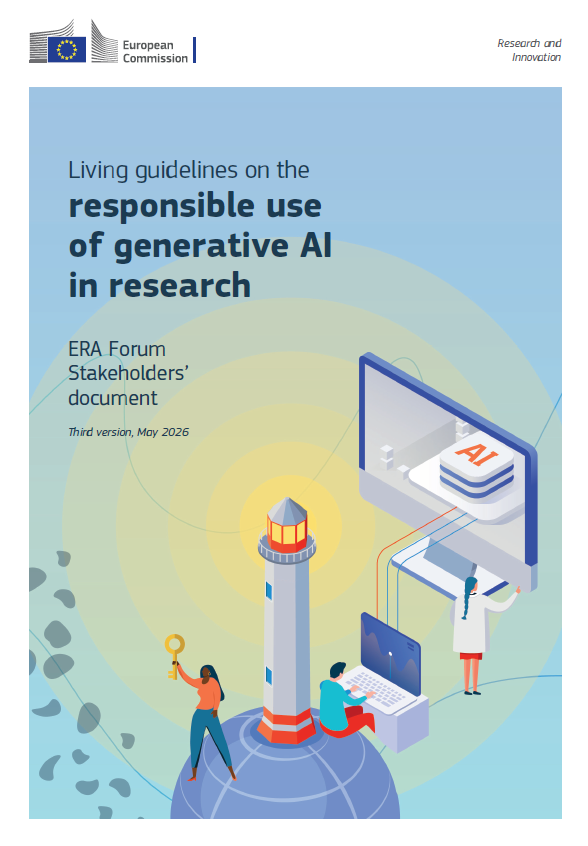
European Commission Publishes Third Version of Living Guidelines on the Responsible Use of Generative AI in Research
The European Commission has published the third version of its Living Guidelines on the Responsible Use of Generative AI in Research, developed through the European Research Area (ERA) Forum. The updated document provides practical recommendations for researchers, research organisations and research funding bodies on the responsible use of generative artificial intelligence throughout the research process.
The guidelines acknowledge the rapid adoption of generative AI technologies across research environments and their growing influence on scientific activities. According to the Commission, these tools have the potential to accelerate scientific discovery, improve productivity and support a wide range of tasks, including literature reviews, knowledge retrieval, coding, translation, summarisation and drafting activities.
At the same time, the document highlights several challenges associated with the use of generative AI, including risks related to research integrity, misinformation, intellectual property, confidentiality, data protection, bias and inaccuracies in AI-generated outputs. The guidance aims to promote a common European approach that enables the responsible use of these technologies while preserving trust in research processes and outcomes.
Key Principles for the Use of Generative AI
The guidelines build upon established European frameworks, including the European Code of Conduct for Research Integrity and the EU's work on Trustworthy AI.
Four overarching principles form the foundation of the recommendations:
Reliability, ensuring the quality and robustness of research methods and outputs;
Honesty, including transparency regarding the use of generative AI;
Respect, covering privacy, confidentiality, intellectual property rights and broader societal impacts;
Accountability, ensuring that humans remain responsible for research activities and outcomes.
The Commission emphasises that researchers remain fully responsible for any content produced with the assistance of generative AI systems. AI tools cannot be considered authors or co-authors, as accountability and scientific responsibility remain exclusively human responsibilities.
Transparency and Human Oversight
A central theme of the updated guidance is transparency.
Researchers are encouraged to disclose the substantial use of generative AI when it meaningfully contributes to research activities, such as data interpretation, literature reviews, identification of research gaps, hypothesis development or other activities that may influence research outcomes.
The document also highlights the importance of maintaining human oversight throughout the research process. Users should critically assess AI-generated outputs and remain aware of limitations such as hallucinations, inaccuracies, fabricated references, biased outputs and the limited interpretability of some AI models.
The guidelines note that AI-generated citations and summaries should always be independently verified before being relied upon in scientific work.
Privacy, Confidentiality and Intellectual Property Considerations
The Commission dedicates significant attention to privacy and information governance.
Researchers are advised to carefully consider the implications of uploading unpublished work, confidential information, personal data or other sensitive content into external AI systems. The document warns that uploaded content may potentially be reused for model training or other purposes, depending on the provider and system architecture.
The guidance also reminds users to comply with applicable data protection and intellectual property requirements and to understand how AI systems manage, store and process information.
In addition, researchers are encouraged to remain vigilant regarding the potential for plagiarism and to ensure appropriate attribution and citation practices when AI-generated content is used.
Recommendations for Research Organisations
Beyond individual researchers, the guidelines include recommendations for universities, research institutions and other organisations involved in scientific research.
The Commission encourages organisations to:
Develop internal policies governing the use of generative AI;
Provide training on responsible AI use;
Support researchers in understanding legal and ethical requirements;
Monitor how AI tools are being used within their organisations;
Assess potential environmental impacts associated with AI use;
Consider implementing locally hosted or controlled AI solutions where confidentiality and data protection requirements are particularly important.
The guidance also encourages organisations to foster a culture in which the use of AI can be disclosed openly and transparently.
Implications for Medical Device Manufacturers
Although the document is not specifically targeted at the medical device sector, many of its principles are directly relevant to manufacturers involved in research, innovation and scientific activities.
Generative AI tools are increasingly being explored to support activities such as:
Literature reviews;
State-of-the-art assessments;
Clinical research support;
Scientific writing;
Data analysis;
Post-market surveillance trend evaluation;
Knowledge management and internal research projects.
The Commission's recommendations reinforce the importance of maintaining appropriate human oversight whenever AI-generated outputs contribute to decision-making, scientific conclusions or documentation.
Manufacturers using generative AI in research-related activities may also wish to evaluate how confidential information, unpublished data, intellectual property and personal data are handled when interacting with external AI platforms.
While the guidelines do not introduce new regulatory obligations, they provide insight into emerging European expectations regarding the responsible use of generative AI within the research ecosystem. These expectations may become increasingly relevant as AI adoption continues to expand across healthcare, life sciences and medical technology sectors.
A Living Document
The Commission describes the guidance as a "living" document that will continue to evolve alongside technological developments, policy initiatives and practical experience. Stakeholders are encouraged to provide feedback, and future versions are expected as the generative AI landscape continues to mature.
As the use of AI becomes increasingly embedded within research and innovation activities, the guidelines provide a useful reference point for organisations seeking to balance innovation opportunities with transparency, accountability and research integrity.
Read the full document below.