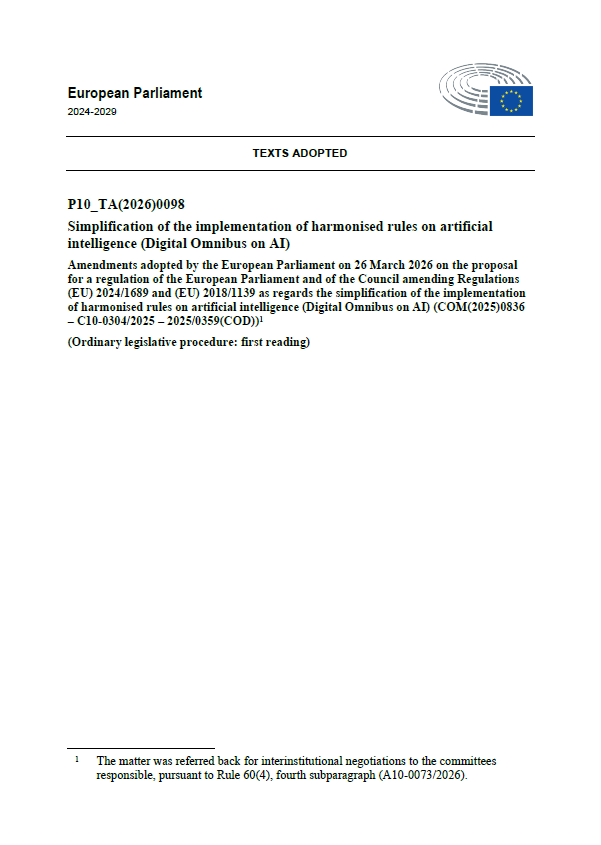
European Parliament Adopts Amendments to Simplify AI Act Implementation (“Digital Omnibus on AI”)
On 26 March 2026, the European Parliament adopted amendments to a proposed regulation aimed at simplifying the implementation of Regulation (EU) 2024/1689 (AI Act).
The proposal, referred to as the “Digital Omnibus on AI,” introduces targeted changes intended to reduce implementation challenges, improve consistency, and minimise administrative burden for stakeholders, including manufacturers.
Key Changes Introduced
Alignment with Union Harmonisation Legislation
The amendments address the interaction between the AI Act and existing Union harmonisation legislation, including frameworks such as Regulation (EU) 2017/745 (MDR) and 2017/746 (IVDR).
References to sectoral legislation are repositioned within Annex I
The amendments aim to avoid overlaps, inconsistencies, and unnecessary administrative burden
The text clarifies that AI systems integrated into products regulated under sectoral legislation remain subject to the AI Act where relevant, while conformity assessment procedures and product safety requirements under sectoral legislation continue to apply.
AI Requirements within Sectoral Frameworks
The amendments state that requirements for high-risk AI systems under Chapter III, Section 2 of the AI Act are to be considered essential health and safety requirements within relevant Union harmonisation legislation.
The Commission is empowered to adopt delegated acts to reflect these requirements in sectoral frameworks, while not exceeding the requirements set out in the AI Act.
Clarification of “Safety Function”
The definition of when an AI system performs a safety function is clarified:
AI is considered a safety function only where it is necessary to ensure compliance with applicable safety requirements
Functionalities related to performance optimisation, automation, or convenience are not considered safety functions where failure does not create safety risks
AI Literacy Obligations Adjusted
The obligation on providers and deployers is revised:
They must support the improvement of AI literacy, rather than ensure a specific level
The Commission will issue guidance on practical implementation
Bias Detection and Use of Sensitive Data
The legal basis for processing special categories of personal data is extended:
Applies not only to high-risk AI systems but also to other AI systems and models, where strictly necessary
Subject to safeguards aligned with GDPR and related legislation
Simplification of Registration Requirements
The amendments maintain the requirement to register certain AI systems in the EU database but:
Simplify the required information
Retain the obligation for providers to document classification assessments
Post-Market Monitoring
The Commission will provide:
Guidance and a template for post-market monitoring plans
Deadline set for 2 February 2027
Extended Timelines for High-Risk AI Systems
The application of obligations for high-risk AI systems is postponed:
Annex III systems: application delayed until 2 December 2027
Annex I systems (including those linked to product legislation): until 2 August 2028
Support for SMEs and Small Mid-Caps (SMCs)
The amendments reinforce proportionality by:
Introducing and clarifying SMC (small mid-cap) definition
Supporting simplified compliance approaches and access to AI regulatory sandboxes
Considerations for Manufacturers
For manufacturers, including those developing AI-enabled products:
The amendments aim to reduce duplication between the AI Act and sectoral legislation
Classification of AI systems, particularly regarding safety functions, remains relevant
Additional time is provided to prepare for high-risk AI obligations
Documentation and compliance processes remain required, including:
Assessment of AI system classification
Post-market monitoring planning
Data governance for bias detection (where applicable)
Conclusion
The Digital Omnibus on AI introduces targeted amendments focused on simplification, proportionality, and coherence in the implementation of the AI Act.
While the core obligations of Regulation (EU) 2024/1689 remain unchanged, the proposal seeks to facilitate implementation and reduce administrative complexity, particularly in relation to existing Union harmonisation legislation.
Read the full document below.