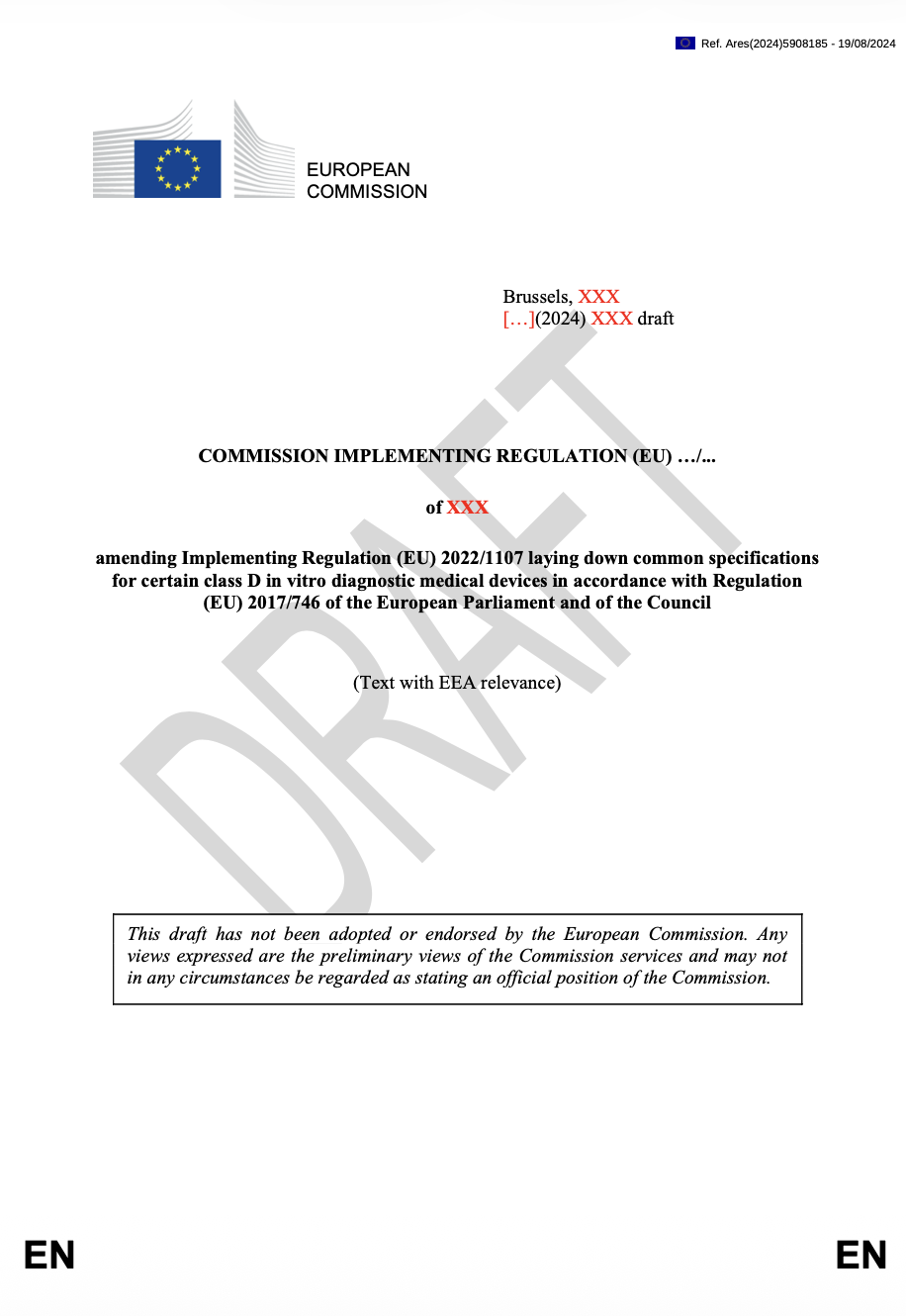
European Commission Drafts Updated Common Specifications for Certain Class D IVDs
The European Commission has published a draft Commission Implementing Regulation amending Implementing Regulation (EU) 2022/1107, which lays down common specifications for certain Class D in vitro diagnostic medical devices under Regulation (EU) 2017/746.
The draft, referenced as Ares(2024)5908185 and dated 19 August 2024, has not yet been adopted or endorsed by the European Commission. The document states that the views expressed are preliminary and should not be regarded as the official position of the Commission.
Purpose of the Draft Regulation
Implementing Regulation (EU) 2022/1107 already establishes common specifications for certain Class D IVDs.
The draft regulation proposes to amend that framework by adding common specifications for additional Class D devices where harmonised standards do not exist for certain requirements of Annex I to the IVDR and where public health concerns need to be addressed.
The draft also states that experience with the existing common specifications has shown a need to clarify or update some specifications to reflect the state of the art.
New Device Groups Covered
The draft proposes to add common specifications for Class D devices intended for the detection or quantification of markers of:
hepatitis E virus (HEV) infection;
Toxoplasma gondii infection;
Plasmodium infection;
Chikungunya virus infection;
dengue virus infection;
West Nile virus infection;
Zika virus infection.
These would be added as new Annexes XIV to XX to Implementing Regulation (EU) 2022/1107.
Presumption of Conformity and Transition
The draft regulation states that devices conforming with the updated common specifications would be presumed to conform with the relevant performance characteristics requirements set out in Annex I of the IVDR.
The draft also provides for transitional provisions. From the date of entry into force until the date of application, manufacturers would be allowed to comply with the updated common specifications on a voluntary basis.
The regulation would apply two years after its entry into force, according to the draft text.
Impact on IVD Manufacturers
For IVD manufacturers, particularly those developing or placing Class D devices on the EU market, the draft regulation may have important implications for performance evaluation, technical documentation and conformity assessment planning.
Manufacturers should pay particular attention to:
whether their Class D IVDs fall within the newly listed device groups;
performance characteristics requirements under Annex I of the IVDR;
updates to common specifications already established under Implementing Regulation (EU) 2022/1107;
potential impact on technical documentation and performance evaluation reports;
conformity assessment expectations from notified bodies;
transition planning before the date of application;
voluntary early compliance during the transition period.
For manufacturers of high-risk infectious disease IVDs, the draft highlights the importance of monitoring updates to common specifications and preparing regulatory strategies that reflect evolving IVDR requirements and the state of the art.