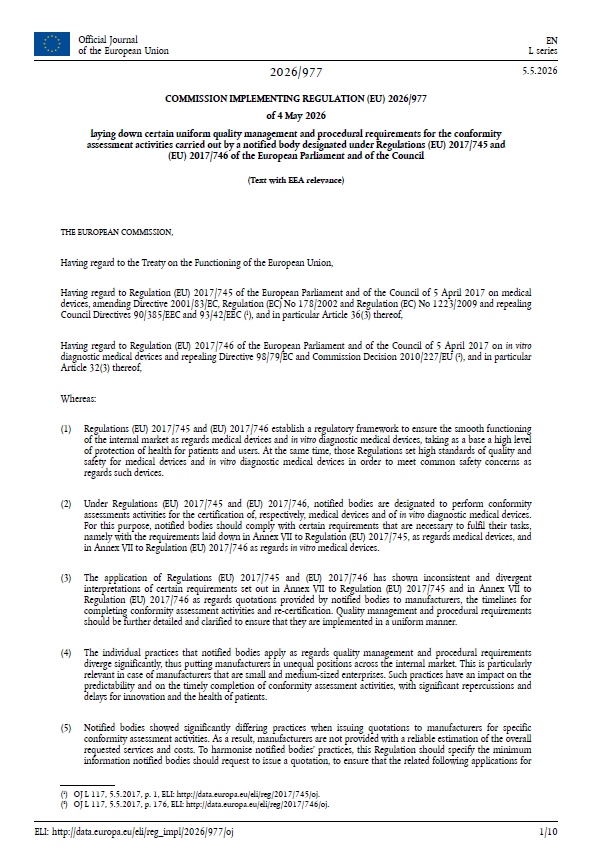
European Commission Adopts New Rules for Notified Body Timelines, Quotations and Re-Certification Under MDR and IVDR
The European Commission has adopted Commission Implementing Regulation (EU) 2026/977, introducing new uniform requirements for how notified bodies conduct conformity assessment activities under the MDR and IVDR. The Regulation was published on 5 May 2026 and will apply from 25 February 2027.
The new rules aim to address long-standing concerns around inconsistent notified body practices, unpredictable timelines, varying quotation methodologies, and divergent approaches to re-certification.
For manufacturers, the Regulation is expected to improve transparency and predictability across conformity assessment activities. However, it will also increase expectations regarding application completeness, technical documentation readiness, and change management processes.
Why the Regulation Was Introduced
According to the Commission, notified bodies have developed “inconsistent and divergent interpretations” of MDR and IVDR requirements, particularly regarding:
Quotations and cost estimation
Certification timelines
Re-certification activities
Handling of substantial changes
The Commission also acknowledged that these inconsistencies have had a disproportionate impact on SMEs, creating delays and uncertainty for market access and innovation.
New Mandatory Timelines for Notified Bodies
One of the most significant changes is the introduction of maximum timelines for conformity assessment activities carried out by notified bodies.
The Regulation establishes the following timelines:
30 days for application review and contract signature
120 days for quality management system auditing
90 days for product verification and technical documentation assessment
20 days for certification decisions and certificate issuance
The Regulation also requires notified bodies to continue conformity assessment activities until a certification decision is made. Exceeding a timeline alone cannot be used as justification to refuse certification.
However, manufacturers should note that the Regulation also permits timeline interruptions in several situations, including:
requests for additional information,
non-conformity resolution,
rolling reviews,
or where input from EMA, expert panels or EU reference laboratories is required.
As a result, the new framework may improve predictability, but it does not guarantee faster overall certification timelines in every case.
More Structured Quotations
The Regulation introduces detailed requirements for quotations issued by notified bodies.
Manufacturers seeking quotations will need to provide structured information during the pre-application phase, including:
Device description and intended purpose
Risk classification
Technologies used
Manufacturing sites and supplier information
Organisational data
SME status information
The Regulation also encourages structured dialogue between manufacturers and notified bodies before formal application activities begin.
In return, notified bodies must provide quotations that include:
Estimated overall costs
Breakdown of quality management system and technical documentation activities
Estimated surveillance and unannounced audit costs
Estimated timelines
Potential additional costs
Importantly, notified bodies must also inform manufacturers in advance if costs increase by more than 10%, including the justification for that increase.
These changes may help manufacturers compare notified body services more effectively and reduce unexpected certification costs.
Re-Certification Requirements Become More Defined
The Regulation also standardises re-certification activities, an area where practices have varied considerably across notified bodies.
For re-certification, manufacturers will need to provide structured information on:
Device changes
PMS outcomes
PSURs
Field safety corrective actions
Risk-benefit updates
State-of-the-art changes
Updated clinical or performance evaluation reports
The Commission states that re-certification activities should focus on changes, surveillance outcomes, updated risk information and continued compliance, rather than unnecessarily repeating assessments already performed during initial certification.
This may reduce duplication during renewal activities, particularly for manufacturers with mature PMS and change management systems.
New Transparency Obligations for Notified Bodies
Another notable change is the requirement for notified bodies to monitor and publish data on:
Certification timelines
Median duration of conformity assessments
Percentage of activities completed within the defined timelines
Median conformity assessment costs
Annual reports must be published on notified body websites beginning in 2028.
This could increase transparency across the European notified body landscape and help manufacturers benchmark performance when selecting or maintaining notified body partnerships.
Transitional Provisions
The Regulation includes several transitional provisions:
The new quotation and timeline rules will not apply to conformity assessment agreements signed before 25 February 2027
Monitoring and reporting obligations apply to agreements signed after 25 May 2027
Re-certification requirements will not apply to certificates expiring before 25 November 2027
Manufacturers currently negotiating MDR or IVDR certification agreements may therefore wish to assess how these transitional provisions could affect future certification planning and notified body engagement strategies.
What Manufacturers Should Consider Now
Although the Regulation primarily targets notified bodies, manufacturers are likely to feel its operational impact quickly.
Key considerations include:
Preparing more complete pre-application packages
Improving change management documentation
Ensuring PMS and clinical evaluation systems are audit-ready
Planning re-certification activities earlier
Reviewing notified body contractual arrangements before February 2027
The new framework is intended to improve consistency and predictability across the European conformity assessment system, but manufacturers will still need robust regulatory and quality processes to benefit from the intended efficiencies.
Read the full document below.