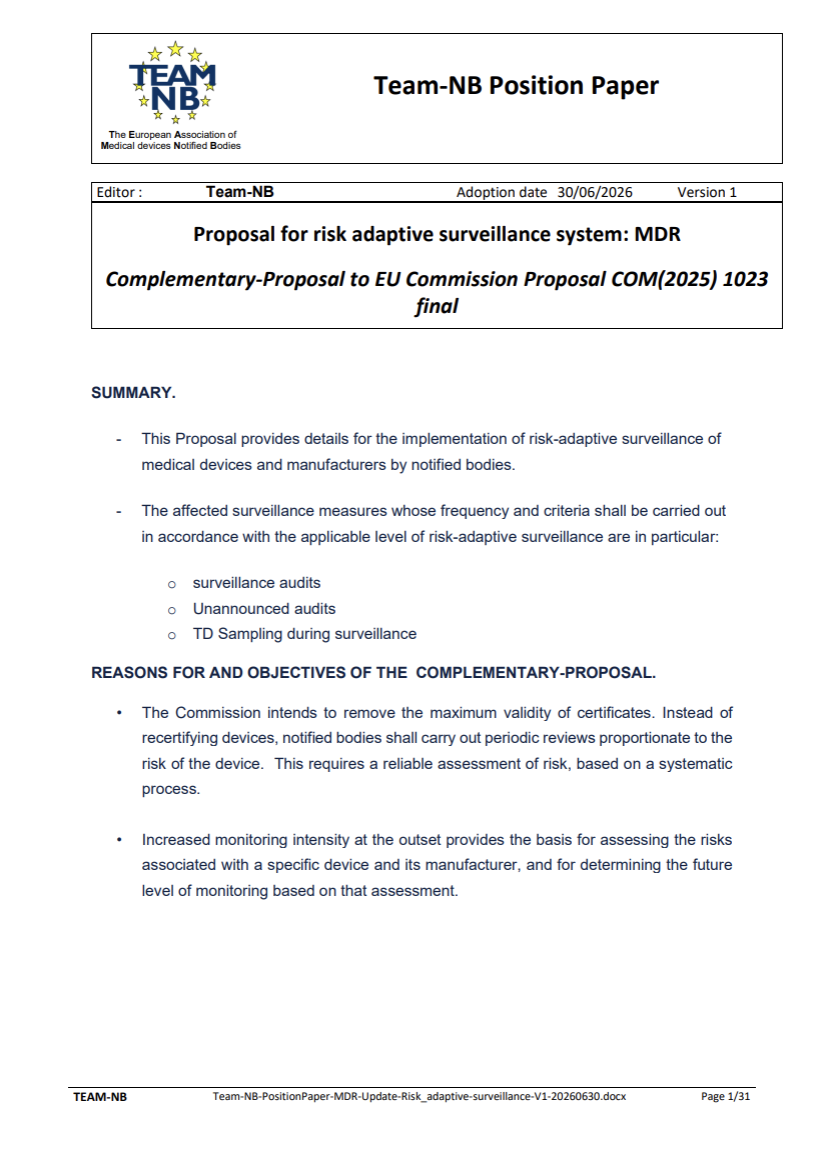
Team-NB Proposes Risk-Adaptive Surveillance System under the MDR
Team-NB, the European Association of Medical Devices Notified Bodies, has published a position paper titled “Proposal for risk adaptive surveillance system: MDR”, adopted on 30 June 2026.
The document is presented as a complementary proposal to the European Commission Proposal COM(2025) 1023 finaland provides details for the implementation of risk-adaptive surveillance of medical devices and manufacturers by notified bodies under the Medical Device Regulation (EU) 2017/745.
According to Team-NB, the European Commission intends to remove the maximum validity of certificates. Instead of recertifying devices, notified bodies would carry out periodic reviews proportionate to the risk of the device. Team-NB states that this requires a reliable risk assessment based on a systematic process.
Key Elements of the Proposal
The proposed risk-adaptive surveillance system would affect, in particular:
surveillance audits;
unannounced audits;
technical documentation sampling during surveillance.
Team-NB proposes the introduction of a new Article 52c, establishing the core legal framework and principles for risk-adaptive surveillance during the life cycle of a device.
Under the proposal, the level of surveillance would determine the intensity, frequency and modalities of surveillance activities, including surveillance audits, unannounced audits, technical documentation sampling, product sampling, review of post-market surveillance data and for-cause surveillance measures.
Surveillance Levels and Re-Escalation
The proposal sets out three levels of risk-adaptive surveillance:
initial/enhanced surveillance level;
medium surveillance level;
reduced surveillance level.
Following completion of the initial conformity assessment, the manufacturer, or where appropriate the relevant device group, would be assigned to the initial/enhanced surveillance level.
A reduction in surveillance level would be stepwise and time-based, while re-escalation could occur immediately where a triggering event occurs. The proposal indicates that the surveillance level could be lowered at the earliest three years after initial completion of the conformity assessment procedure.
Re-escalation triggers may include serious incidents, field safety corrective actions, major or recurrent non-conformities, ineffective CAPA implementation, quality management system deficiencies, post-market surveillance indicators, delayed responses to notified body requests and credible third-party information.
Other Proposed Changes
The position paper also includes proposals related to:
the definition of well-established technology device;
the definition of for-cause surveillance;
periodic reviews replacing re-certification logic where certificate validity changes;
use of technology in auditing processes;
technical documentation sampling for Class IIa and Class IIb devices;
PSUR update requirements;
clinical evidence and equivalence claims.
For PSURs, Team-NB proposes that Class III manufacturers update the PSUR at least annually and whenever there is a significant change in the benefit-risk determination. Manufacturers of Class IIa and Class IIb devices would update the PSUR in the first year after certificate issuance and every two years thereafter, or when there is a significant change in the benefit-risk determination.
Impact on Medical Device Manufacturers
For medical device manufacturers, the proposal could have important implications for post-certification oversight and interactions with notified bodies.
Manufacturers may need to pay particular attention to:
post-market surveillance data quality;
vigilance data and trend reporting;
CAPA effectiveness and timelines;
QMS maturity and process control;
technical documentation readiness;
PSUR and PMCF outputs;
supplier and subcontractor controls;
responsiveness to notified body requests;
clinical evidence and equivalence justification.
The proposal highlights the importance of maintaining consistent compliance throughout the device life cycle. A strong compliance and post-market performance history may support a lower surveillance level, while unresolved issues, poor documentation quality or safety signals may lead to increased notified body scrutiny.