FDA Updates SOPP 8212 on Breakthrough Therapy Designation for Biologics
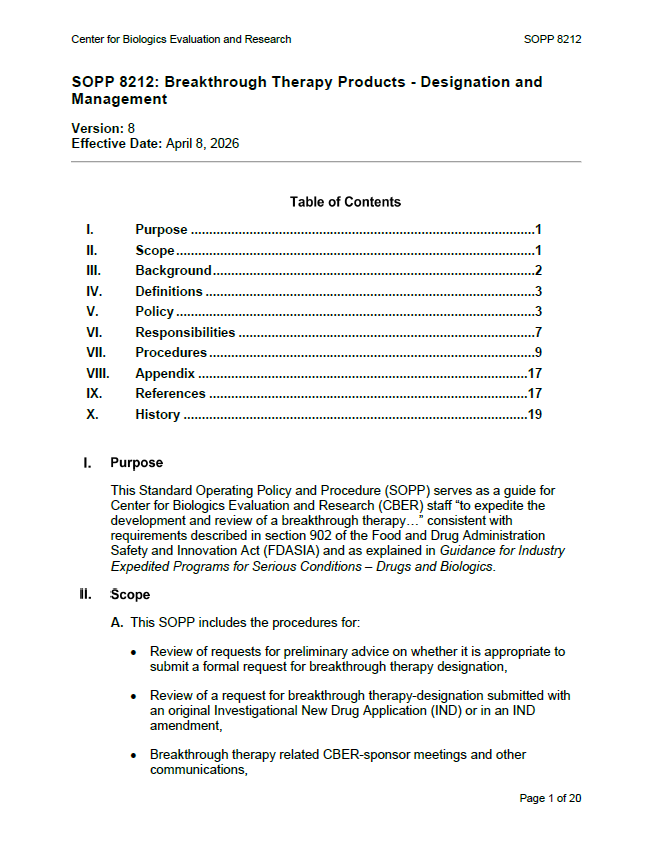
The U.S. Food and Drug Administration (FDA), through its Center for Biologics Evaluation and Research (CBER), has released Version 8 of SOPP 8212, effective April 8, 2026, outlining updated procedures for the designation and management of breakthrough therapy products.
This update provides further clarity on how CBER manages breakthrough therapy designation requests, sponsor interactions, and lifecycle oversight of designated products.
What is Covered in the Updated SOPP?
The SOPP defines internal FDA procedures related to:
Preliminary advice on whether a breakthrough designation request is appropriate
Submission and review of designation requests within an IND
Sponsor–FDA interactions, including meetings and communications
Periodic review of designated development programs
Withdrawal or rescinding of designation
It is important to note that this SOPP does not apply to medical devices or combination products led by devices, which are covered under a separate FDA framework.
Key Regulatory Principles
To qualify for breakthrough therapy designation:
The product must target a serious or life-threatening condition
There must be preliminary clinical evidence indicating substantial improvement over existing therapies
The FDA reiterates that:
Designation is not approval
Standard requirements for safety and effectiveness remain unchanged
What Changes in Practice?
1. Greater Emphasis on Early Interaction
Sponsors can request non-binding preliminary advice before submitting a formal designation request. This aims to:
Avoid premature or insufficient applications
Streamline FDA review workload
However, these interactions are informal and do not result in official meeting minutes.
2. Structured and Accelerated Communication
Once designation is granted, the FDA commits to:
Frequent and more interactive communication
Early multidisciplinary engagement, including senior reviewers
A formal communication plan agreed with the sponsor
This includes discussions on:
Clinical development strategy
Manufacturing considerations
Post-marketing requirements
3. Defined Timelines and Review Expectations
FDA will respond to designation requests within 60 calendar days
IND amendments related to breakthrough products are typically reviewed within 60 days
Annual periodic reviews assess whether the program remains eligible
4. Possibility of Rescinding Designation
A key operational element is the formal process to rescind breakthrough designation if criteria are no longer met.
FDA must notify the sponsor and provide justification
Sponsors have 60 days to respond with additional data or request a meeting
Rescinding does not imply lack of product potential, only that criteria are no longer fulfilled
5. Flexibility Around Clinical Hold Situations
An important policy clarification:
Being under clinical hold or partial hold does not automatically prevent designation
FDA will assess whether the hold impacts the ability to demonstrate clinical improvement
This reflects a more nuanced, case-by-case approach.
What This Means for Manufacturers
Although this SOPP is specific to biologics and drugs, it offers relevant insights for manufacturers, particularly those working on:
Combination products
Innovative or high-impact therapies
Parallel EU–US development strategies
Key takeaways:
Early engagement with regulators is increasingly critical
Robust clinical evidence at early stages is essential for accelerated pathways
Manufacturers should be prepared for intensive regulatory interaction once designation is granted
Development programs must remain continuously justified to retain designation
For device manufacturers, it is also important to recognize that:
The Breakthrough Devices Program follows a different regulatory pathway, even though some principles (e.g., early interaction, prioritised review) are conceptually aligned
Read the full document below.