IMDRF Publishes 2026 Playbook for Medical Device Regulatory Reliance Programs
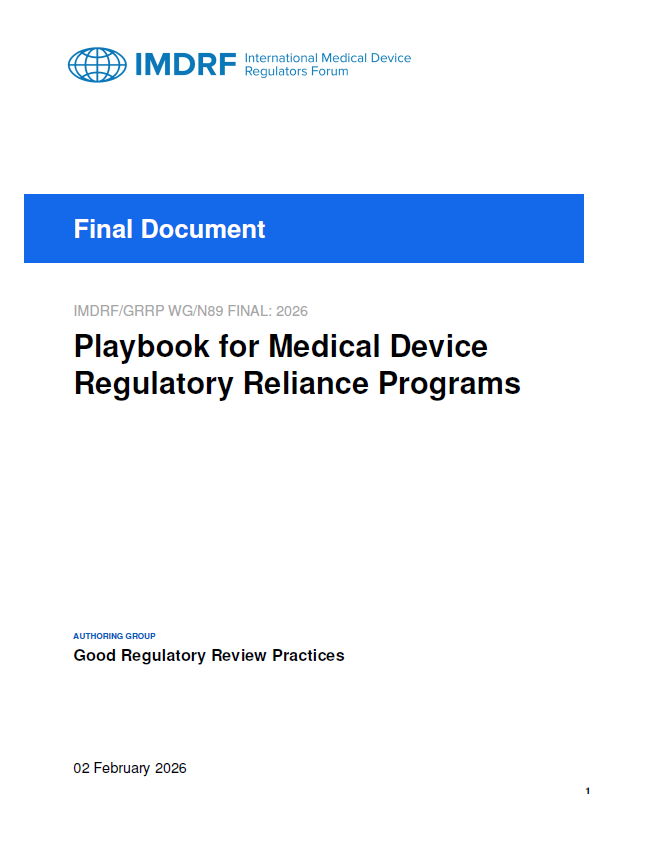
The International Medical Device Regulators Forum (IMDRF) published the final document IMDRF/GRRP WG/N89 FINAL: 2026 – Playbook for Medical Device Regulatory Reliance Programs .
Developed by the IMDRF Good Regulatory Review Practices (GRRP) Working Group, the Playbook provides structured guidance for regulatory authorities (RAs) on the development and implementation of medical device regulatory reliance programs. The document applies to all medical devices, including in vitro diagnostic (IVD) medical devices.
Although addressed to regulators, the publication is relevant to manufacturers operating across multiple jurisdictions where reliance-based pathways may be implemented.
What the Playbook Covers
The document provides:
Definitions of reliance-related concepts
A comparison between reliance, convergence and harmonization
Examples of existing reliance models
Considerations before establishing a reliance program
Practical steps for implementation and management
The Playbook clarifies that it does not establish a single IMDRF-endorsed reliance framework, nor does it mandate a specific approach. Regulatory authorities retain independence and flexibility in determining the extent and type of reliance used.
Definition of Regulatory Reliance
The Playbook adopts the WHO definition of reliance:
The act whereby a regulatory authority takes into account and gives significant weight to assessments performed by another regulatory authority or trusted institution, while remaining responsible and accountable for its own decision.
The relying authority remains independent and retains final decision-making responsibility.
Types of Reliance Described
The document outlines three main reliance approaches:
Work-Sharing
Regulatory authorities collaborate to perform regulatory tasks jointly.
Example provided:
Medical Device Single Audit Program (MDSAP)
Abridged Regulatory Pathway
A regulatory authority conducts a partial review that takes into account prior assessments from a trusted reference authority.
Examples provided:
Singapore Health Sciences Authority (HSA)
Brazil ANVISA optimized review pathway
Recognition
A regulatory authority accepts another authority’s regulatory decision with minimal or no additional review.
Examples provided:
Australian TGA recognition frameworks
Mutual recognition arrangements
The EU single market system based on CE marking
Elements Relevant to Manufacturers
While the Playbook is directed to regulators, several aspects are relevant for manufacturers where reliance mechanisms are adopted.
1. Eligibility Criteria
The document states that regulators should clearly define eligibility for reliance programs, including:
Device type and risk classification
Regulatory activity covered (e.g., pre-market, post-market, inspections)
Marketing status in the reference jurisdiction
Whether the original decision was based on a full review
The Playbook also emphasizes the importance of confirming that the device under review is “essentially identical” to the version assessed by the reference regulatory authority. This includes alignment in:
Intended use
Manufacturer
Technical specifications
Safety and performance evidence
2. Documentation Requirements
The document indicates that regulators should determine:
What documentation is required to support reliance
Whether information will be obtained from public sources, the manufacturer, or via agreements with the reference authority
It also recommends avoiding documentation requirements that go beyond what is necessary for decision-making.
Supporting documentation may include:
Proof of approval or authorization by the reference authority
Regulatory submission documentation
Evidence aligned with IMDRF Essential Principles
3. Lifecycle Considerations
The Playbook states that reliance may apply to multiple regulatory activities across the product lifecycle, including:
Technical documentation review
Quality management system assessments
Inspections and audits
Post-market surveillance
Market withdrawals
Emergency contexts
Regulators are encouraged to define how lifecycle changes and post-market actions in the reference jurisdiction affect eligibility within reliance programs.
4. Use of International Standards and IMDRF Guidance
The document references several internationally recognized frameworks and standards, including:
IMDRF Essential Principles (WG/N47)
IMDRF Labeling Principles (WG/N52)
IMDRF Regulatory Submission Table of Contents (RPS WG/N9 and N13)
ISO 13485
WHO Good Reliance Practices
The Playbook notes that alignment with internationally recognized guidance can facilitate reliance implementation.
Management and Oversight of Reliance Programs
The document emphasizes that regulatory authorities should establish management systems for reliance programs, including:
Process monitoring
Performance measurement
Stakeholder feedback
Change management
Ongoing assessment of reference regulatory authorities
Reliance programs are described as structured and subject to ongoing evaluation.
Strategic Context
The Playbook supports the broader objectives of regulatory efficiency, cooperation, and improved patient access to safe and effective medical devices. It encourages regulators to explore reliance mechanisms suited to their legal frameworks and operational capacities.
The document does not impose obligations on manufacturers. However, where reliance pathways are implemented by regulators, manufacturers may encounter reliance-based regulatory processes aligned with the principles and considerations described in this Playbook.
Read the full document below.