TGA Updates PRAC Guidance: What Sponsors and Manufacturers Need to Know in 2026
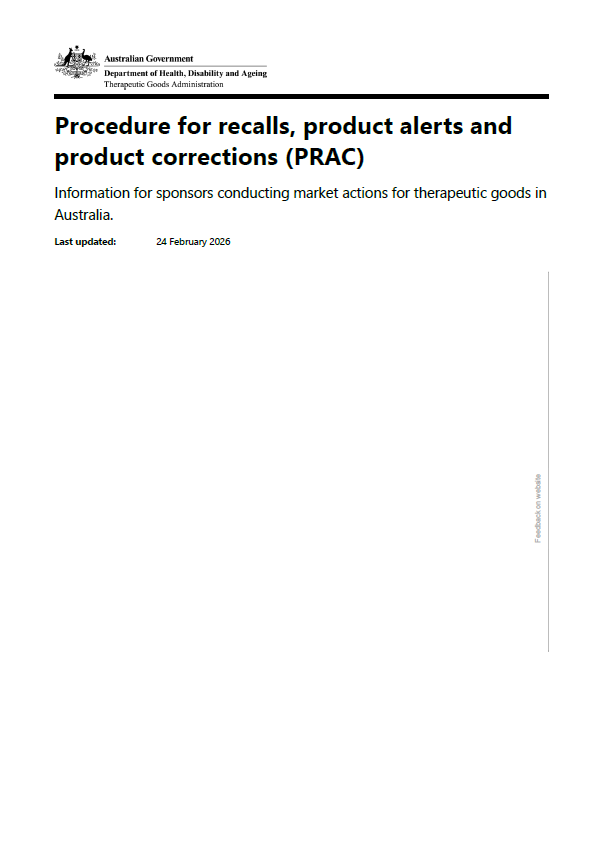
On 24 February 2026, the Australian Therapeutic Goods Administration (TGA) published minor updates and clarifications to its Procedure for Recalls, Product Alerts and Product Corrections (PRAC) .
The PRAC, which replaced the former Uniform Recall Procedure for Therapeutic Goods (URPTG) in March 2025, continues to define how sponsors must conduct market actions in Australia.
While the latest changes are described as minor, they introduce important clarifications that manufacturers and sponsors should carefully review — particularly those supplying medical devices, medicines, biologicals, or consumer-facing therapeutic goods in Australia.
Background: PRAC Replaced URPTG
The PRAC came into effect on 5 March 2025, replacing the URPTG .
Although largely a structural rewrite, the PRAC introduced several key procedural refinements:
Replacement of the “recall” vs “non-recall” distinction with the broader term “market actions”
Reduction of the recall process from 10 steps to 5
Simplified classification system (Class I, II, III)
Greater transparency around the Early Advice process
Flexible reporting requirements
Introduction of updated TGA templates
Removal of TGA verification of sponsor customer lists
The February 2026 update introduces additional clarifications and structural improvements.
What Was Updated in February 2026?
According to the TGA page history, updates include :
Clarification of the timeframe for notification under Immediate Actions
Amendment of the “Purpose” section
Addition of a new graphic clarifying what constitutes a “problem”
Renaming and minor revision of the section addressing:
High-profile actions
Actions involving untraceable products
Minor wording updates to definitions of:
Recall
Product Correction
Clarification regarding who may perform a product correction/repair
Additional requirements concerning exported goods
Amendments to the section on wholesalers and distributors
Addition of new sections:
TGA legislative powers relating to market actions
Frequently Asked Questions (FAQs)
Minor editorial changes across the document
These adjustments do not change the fundamental process, but they do refine expectations and compliance responsibilities.
Immediate Actions: Clarified Expectations
The TGA clarified the notification timeframe for Immediate Actions, which apply to situations involving:
Imminent or significant risks to patient lives or public health
Suspected tampering
Radiopharmaceuticals
Blood or biological products
Clinical trials
Sponsors must notify customers immediately (before TGA review) in urgent cases and contact the TGA within 48 hours .
Impact for manufacturers:
Companies must ensure their internal escalation procedures allow for rapid quarantine, communication, and regulatory notification within tight timeframes.
No More TGA Verification of Customer Lists
One of the most operationally significant changes retained under PRAC is that the TGA:
No longer verifies the accuracy of sponsor customer lists
Sponsors are now fully responsible for:
Submitting accurate customer lists
Using correct TGA templates
Avoiding delays due to incomplete information
Impact:
Manufacturers must ensure distribution traceability systems are robust. Poor record-keeping may delay recall approval or lead to regulatory scrutiny.
This aligns closely with ISO 13485 traceability expectations for medical devices.
Increased Transparency: Early Advice & Public Communications
The PRAC formalizes the Early Advice Notice process, allowing TGA to alert state and territory recall coordinators or professional bodies before formal agreement .
Additionally, high-profile or untraceable consumer-level actions may require:
Public notices
Website announcements
Retail notices
Social media communications
Impact:
Manufacturers should prepare crisis communication strategies in advance. Public visibility of recalls is increasing through:
DRAC (Database of Recalls, Product Alerts and Corrections)
TGA web statements
Stakeholder notifications
Reputational risk management must now be considered part of recall preparedness.
Reporting and Closeout: Stricter Follow-Up Expectations
Sponsors must submit:
An interim report at 6 weeks
A closeout report at 12 weeks
If reports are incomplete or repeatedly inadequate, the TGA may use its legislative powers to compel submission of information .
The February 2026 update also introduced a dedicated section on legislative powers relating to market actions .
Impact:
Manufacturers should ensure:
Root cause investigations are documented
CAPA timelines are realistic
Non-responder follow-up attempts are recorded (minimum three attempts required)
Overseas supply notifications are managed within statutory timeframes
Interaction with ACCC – Lead Regulator Clarified
The PRAC reiterates that when a therapeutic good is also a consumer good, the Australian Competition and Consumer Commission (ACCC) may be the lead regulator in cases involving:
Non-compliance with product bans
Non-compliance with mandatory safety standards
Sponsors must notify the ACCC within 2 days of initiating a market action when applicable .
Impact:
Manufacturers of consumer-facing devices (e.g., diagnostic kits, home-use devices, PPE) must assess whether dual regulatory notification applies.
Strategic Considerations for Manufacturers
Although described as minor, the 2026 updates reinforce key regulatory expectations:
Speed of response
Traceability accuracy
Clear risk classification
Structured reporting
Public transparency
Alignment between sponsor and manufacturer responsibilities
Manufacturers supplying Australia should verify that their QMS:
Clearly defines recall responsibilities
Aligns with ISO 13485 (medical devices) and ISO 14971 risk management
Includes mock recall testing
Covers export and consumer-law obligations
Integrates ACCC notification triggers where applicable
Final Takeaway
The PRAC remains structurally stable, but the February 2026 refinements confirm that the TGA expects:
Greater sponsor accountability
Higher documentation quality
Faster escalation
More transparent public communication
For manufacturers operating globally, alignment between EU MDR, UK MHRA recall requirements, and Australian PRAC procedures should be part of regulatory strategy planning.
Read the full document below.