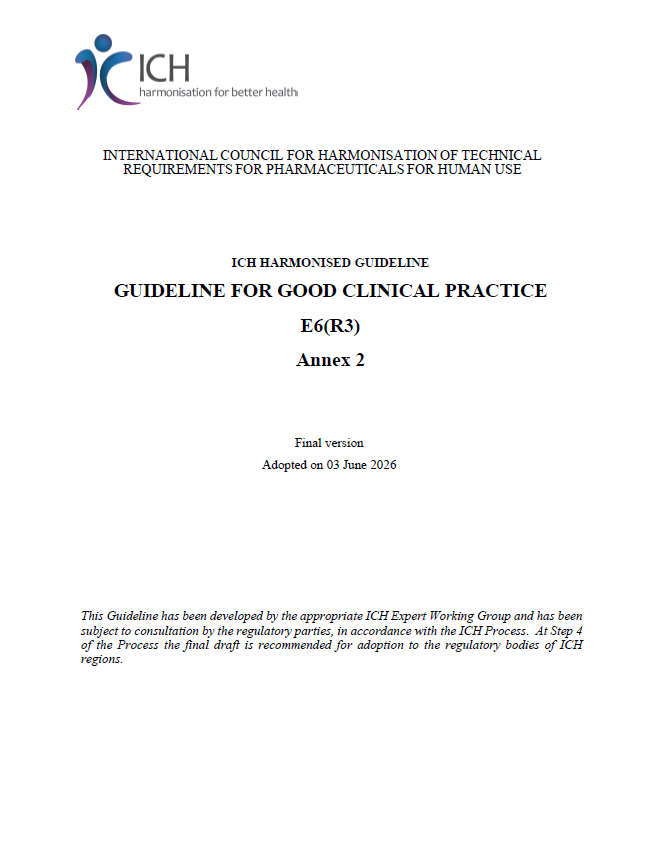
The International Council for Harmonisation (ICH) has formally adopted Annex 2 of the ICH E6(R3) Good Clinical Practice (GCP) Guideline, marking an important milestone in the evolution of modern clinical research. The document was endorsed under Step 4 of the ICH process on 3 June 2026 and complements the core E6(R3) guideline that entered into force earlier this year.
Annex 2 provides additional Good Clinical Practice considerations for clinical trials incorporating decentralised elements, pragmatic trial approaches and Real-World Data (RWD). While the core E6(R3) guideline establishes principles applicable across all clinical trials, the new annex addresses the growing use of digital technologies, remote interactions and healthcare data generated outside traditional research environments.
The publication reflects a broader transformation across the life sciences sector, where sponsors increasingly seek to improve patient access, reduce participation burden and generate evidence using technologies and data sources that extend beyond conventional site-based clinical studies.
Why Was Annex 2 Needed?
Clinical research has changed significantly since the publication of the original ICH E6 guideline nearly three decades ago.
Remote patient monitoring, wearable devices, mobile applications, electronic health records and registry-based studies have become increasingly common. At the same time, regulators worldwide have shown growing interest in the use of Real-World Evidence (RWE) to support regulatory decision-making.
While many of these approaches were already being used in practice, stakeholders often relied on fragmented regional guidance. Annex 2 seeks to provide a harmonised international framework describing how GCP principles should be applied when these methodologies are incorporated into clinical trials.
Importantly, ICH emphasises that the annex should not be interpreted as an endorsement of any specific methodology. Instead, it provides a risk-based framework to ensure participant protection and data reliability regardless of the technologies or operational models adopted.
Key Areas Covered by the New Guidance
Decentralised Clinical Trial Elements
Annex 2 formally recognises that trial-related activities may occur outside the investigator's site.
Examples include:
Home healthcare visits;
Local healthcare centres;
Mobile medical units;
Remote consultations via video calls;
Collection of data through Digital Health Technologies (DHTs).
The guidance stresses that decentralised approaches should be implemented using a proportionate risk-based approach while maintaining appropriate investigator oversight and participant protection.
The document also addresses operational considerations such as remote informed consent, shipment of investigational products directly to participants and the use of home nursing services.
Greater Focus on Digital Health Technologies
One of the most significant developments is the extensive recognition of Digital Health Technologies.
ICH defines DHTs broadly to include technologies used to collect, measure or monitor health-related data, such as:
Mobile applications;
Wearables;
Sensors;
Remote monitoring platforms.
Where DHTs are used to acquire participant data, they are treated as data acquisition tools and must support reliable and meaningful clinical data collection.
The guidance repeatedly highlights the need to consider data integrity, cybersecurity, participant privacy and operational suitability when deploying these technologies in clinical research.
Real-World Data Receives Detailed Regulatory Attention
A major portion of Annex 2 focuses on the use of Real-World Data.
The guidance recognises that data originating from electronic health records, patient registries, claims databases and other healthcare systems may play an increasingly important role in clinical development programmes.
However, ICH also introduces detailed expectations regarding data quality and governance.
Sponsors are expected to demonstrate that RWD is fit for purpose by evaluating:
Relevance;
Reliability;
Accuracy;
Completeness;
Provenance;
Traceability.
The document further highlights challenges such as missing data, differences in data collection practices, variability between healthcare systems and the risk of bias when external datasets are incorporated into clinical studies.
For studies using RWD to support critical efficacy or safety endpoints, Annex 2 indicates that sponsors may need direct access to source records to adequately verify data quality and support regulatory inspections.
Enhanced Expectations for Data Governance
Data governance emerges as one of the central themes throughout Annex 2.
The guideline emphasises that sponsors remain ultimately responsible for ensuring that data generated from multiple sources remain reliable, traceable and suitable for regulatory decision-making.
Where data are obtained from third-party organisations, including hospitals, registries or service providers, formal agreements should define:
Data access arrangements;
Data protection measures;
Responsibilities for data management;
Access for regulatory inspections.
Particular attention is given to situations involving data linkage between multiple sources, where sponsors must ensure both accurate patient matching and protection of personal information.
Increased Oversight of Service Providers
As decentralised models often depend on external organisations, Annex 2 places strong emphasis on sponsor oversight.
The guidance recognises that home nursing services, logistics providers, digital platform operators and other third parties may perform activities that directly affect participant safety or data quality.
Sponsors are therefore expected to establish clear responsibilities, communication pathways and quality oversight mechanisms to ensure that outsourced activities remain compliant with GCP requirements.
What Does This Mean for Medical Device Manufacturers?
Although ICH E6(R3) Annex 2 was developed primarily for medicinal product trials, several elements are highly relevant for medical device manufacturers.
Manufacturers conducting clinical investigations, PMCF studies or other evidence-generation activities can expect regulators and notified bodies to increasingly scrutinise:
Use of Digital Health Technologies for endpoint collection;
Remote patient monitoring methodologies;
Real-world evidence strategies;
Data integrity controls;
Cybersecurity and privacy safeguards;
Oversight of outsourced clinical activities.
The guidance is particularly relevant for manufacturers developing software medical devices, connected devices and digital health solutions that may be used to generate clinical evidence.
In addition, organisations planning to leverage registry data, electronic health records or remote monitoring technologies as part of their clinical evaluation strategy should review whether their existing data governance frameworks align with the expectations described in Annex 2.
Looking Ahead
The adoption of Annex 2 represents one of the most significant updates to international Good Clinical Practice expectations since the introduction of risk-based quality management under E6(R2).
Rather than introducing entirely new regulatory concepts, the document provides greater clarity on how established GCP principles should be applied in an increasingly digital and data-driven clinical research environment.
As decentralised trial models continue to expand and Real-World Evidence becomes more prominent in regulatory decision-making, Annex 2 is expected to serve as an important global reference for sponsors, technology developers and manufacturers seeking to generate robust clinical evidence using innovative methodologies.