FDA Updates SOPP 8001.4 on Proprietary Name Review for Biologics
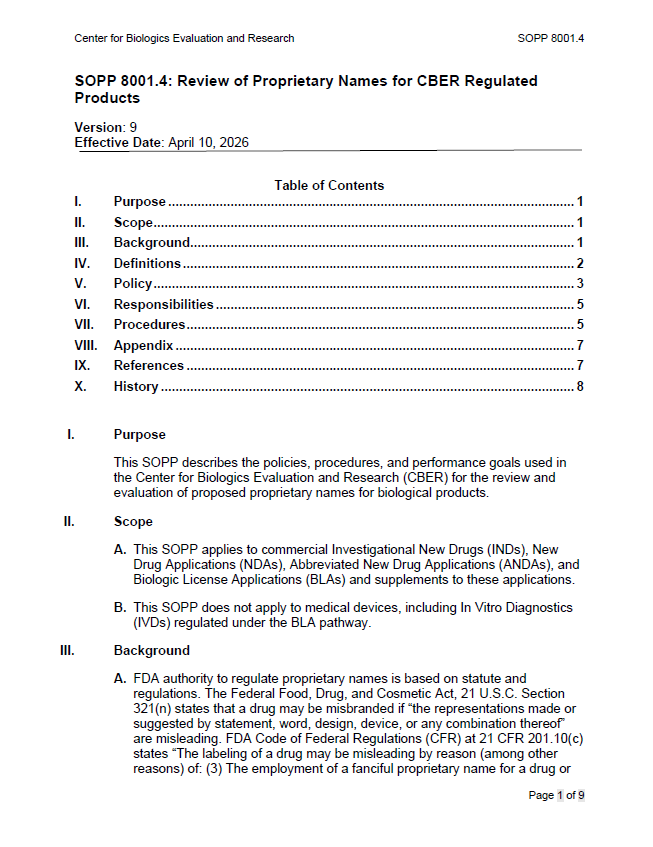
The U.S. Food and Drug Administration (FDA), through its Center for Biologics Evaluation and Research (CBER), has released Version 9 of SOPP 8001.4, effective April 10, 2026, outlining the review process for proprietary (brand) names of biologic products.
What’s new?
The latest revision introduces minor editorial updates and corrections, with no substantive policy changes compared to Version 8.
Key regulatory principles (unchanged but reinforced)
1. Focus on patient safety and medication error prevention
FDA continues to emphasize that name similarity (look-alike/sound-alike) is a major contributor to medication errors—accounting for up to 25% of cases.
Evaluation includes:
Phonetic and orthographic analysis (via POCA system)
Screening for misleading or promotional claims
Risks from naming conventions (e.g., umbrella branding, modifiers, reuse of names)
2. Clear acceptability categories
Proprietary names are classified as:
Acceptable
Acceptable at this time (early-stage/IND)
Unacceptable (requires resubmission)
3. Strict submission and review timelines
IND stage: 180 days
BLA/NDA/ANDA stage: 90 days
For rolling submissions, review starts only after the final module is received
4. Limited flexibility for applicants
Maximum of two proposed names per submission
No reservation of names
Names cannot be reused or transferred across products
Acceptance is product-specific (no cross-product applicability)
5. Formal challenge pathway
If a name is rejected:
Sponsors may submit a rebuttal or
Request a Type C meeting within 60 days
Why this matters for manufacturers
Although this SOPP does not apply to medical devices or IVDs under MDR/IVDR, it highlights regulatory expectations that are increasingly relevant across sectors:
Branding strategy must be risk-based
Even outside FDA biologics, regulators globally (including EU MDR) are increasingly sensitive to:
Misleading product claims
Confusion risks in labeling and IFU
Consistency across product families
Early planning is critical
The structured timelines and limited resubmission flexibility reinforce the need to:
Validate naming early in development
Align branding with regulatory and clinical positioning
Cross-functional alignment is essential
Naming is not just marketing:
It intersects with risk management (ISO 14971)
Labeling and usability (e.g., IEC 62366-1)
Post-market surveillance (error trends)
Read the full document below.